Councilman Predicts No Racial Backlash From Mobile’s 2005 Mayoral Race
With Mayor Mike Dow expected to step aside, Councilman Fred Richardson said Mobile's history suggests voters will accept the outcome of the August mayoral election without racial discord, whoever wins.
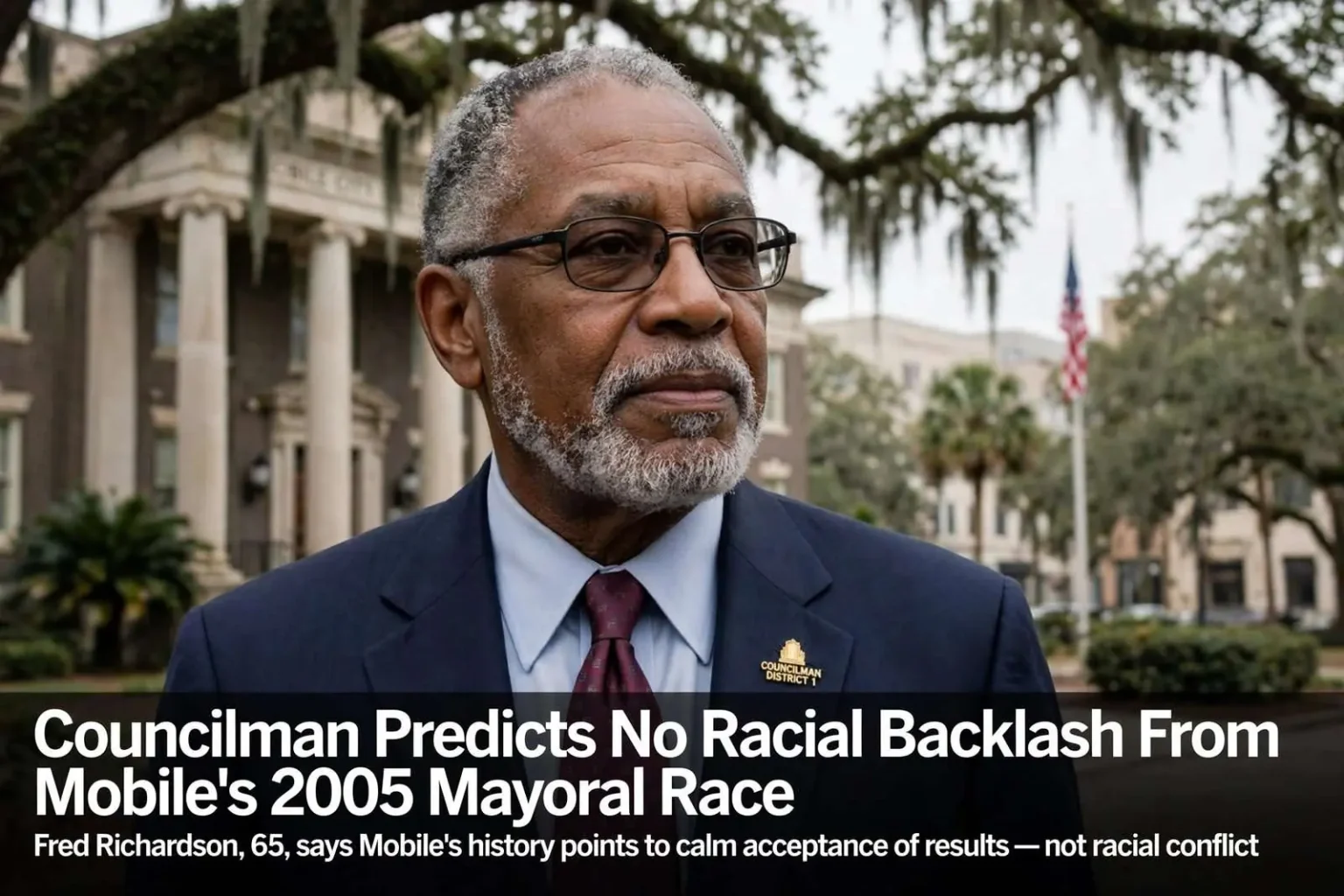
MOBILE — As the city moved toward what promised to be its most consequential municipal election in two decades, one of its longest-serving black officials offered a prediction that ran directly against the storyline forming in some quarters: whatever happens in the August mayoral election, there will be no racial backlash.
City Councilman Fred Richardson, 65, who represents District 1, said Mobile’s political record points not to discord but to a matter-of-fact acceptance of results — and he cited history to make the case.
The Record He Cites
Richardson pointed to the 1989 election in which Mike Dow unseated then-Mayor Arthur Outlaw. Outlaw, he noted, had significant black support at the time; all three of the black council members then serving backed him. Dow won anyway, and the city absorbed the result without incident.
Dow went on to win three re-elections while steadily building support among black voters, and he made allies of the men who had opposed him. The arc of that administration, in Richardson’s telling, demonstrated something about Mobile’s political temperament: an upset at City Hall did not harden into grievance, and the losers of one cycle frequently became the governing coalition of the next.
He also recalled the 1985 mayoral bid of Dr. Herbert Stone, a black physician whose campaign drew solid backing in black precincts but fell well short of City Hall. “When he lost, there was no fallout,” Richardson said. “There was no media down here that the South had done something ill to minority members.”
Mobile’s political history, in this telling, is marked more by fish fries than fire bombs. Federal lawsuits have reshaped the city’s official structure — the mayor-council system itself dates to a court-driven overhaul two decades ago — but insurrection has not been part of the pattern.
That structural overhaul matters to the argument. When Mobile’s form of government was redrawn under federal court order, replacing a three-member commission era with a mayor and a district-based council, the city learned to absorb fundamental political change through ballots and litigation rather than unrest. Every election since has tested that machinery, and every transfer of power has gone through it.
District 1, which Richardson represents, takes in much of downtown and the city’s historically black neighborhoods north of Government Street, giving him a constituency with a long institutional memory of both the movement era and the decades of political consolidation that followed. His read on the city’s temperament carries the weight of someone who has watched Mobile’s cycles up close, first as an activist and organizer and then from a council seat.
The Race Taking Shape
The concern arises from the field. With Dow’s departure looking increasingly certain even to his staunchest supporters, two well-known figures have moved to fill the vacuum: Mobile County Commissioner Sam Jones, who is black, and City Councilman John Peavy, who is white. Both have begun mobilizing. Local political veterans assume one or two additional white candidates will enter.
The arithmetic that follows is straightforward, and it is the reason some reporters have reached for a racial frame. Projections call for Jones to lead the first round without reaching the 50-percent-plus-one threshold required for outright victory. That would force a runoff between Jones and whichever white candidate finishes highest. Jones would then need to pull enough support from the eliminated white contenders to cross the majority line — or watch the “in play” vote consolidate behind the surviving white candidate.
Evenly matched black and white candidates, a runoff, a city with Mobile’s history: the ingredients of a familiar national narrative are all present.
“The Best Person Will Win”
Richardson does not buy it. He expects supporters of the losing candidates to be disappointed — briefly — and then to accept the result and get on with the business of the city.
“Let’s just say that Commissioner Sam Jones runs,” Richardson said. “That would not be the first time” a person of color sought the office. He pointed again to Stone.
“I think the best person will win,” he said. “People will make a decision and, whoever wins, that person will have little notoriety. Michael C. Dow displaced one of the most powerful members of this community. The earth didn’t shake. There was no major fallout. We just picked up and went on.”
There is, he said, no “historical rationale” for fearing racial unrest arising from a Mobile election. The city’s experience, from the court-ordered restructuring to the peaceful transitions that followed, offers nothing for the fear to attach to, in his view. Elections in Mobile have been contested fiercely and sometimes bitterly, but the outcomes have been accepted, and the losing coalitions have regrouped for the next cycle rather than against the system.
Richardson’s confidence also rests on the composition of the electorate itself. A city that has elected and re-elected a mayor who displaced an entrenched incumbent, and that has repeatedly seated council members of both races across its districts, has demonstrated a pattern of judging candidates rather than categories. The 2005 field, whatever its final shape, will campaign before voters who have seen this dynamic before.
A Warning About Coverage
Richardson did attach one caution, and it was aimed squarely at the press. A steady stream of reporting focused on racial implications rather than on issues and candidate qualifications, he warned, could become a self-fulfilling prophecy.
“They could turn around and put in place” the ingredients that make the prediction come true, he said. “To predict that something is going to happen, some people may come to feel that it will.”
The warning reflects a debate that outlasted the 2005 cycle. Political reporters in Southern cities have long wrestled with how prominently race belongs in coverage of biracial campaigns — whether the honest answer is to name the demographic arithmetic or to treat it as background noise. Richardson’s position was unambiguous: the frame itself, repeated often enough, does more to shape events than to describe them.
His own forecast was deliberately unremarkable: “I expect to see that the losing candidate will lose and the winning candidate will win and we will continue to move forward, march forward, and we’ll not be marching backward.”
The posture was characteristic. Richardson had built a reputation as one of the council’s most quotable members, and his political instincts had been formed in the era when Mobile’s black political leadership was being built from the ground up — through registration drives, district battles and the long work of converting protest-era energy into governing representation. Predicting calm was, for him, an argument from experience rather than optimism.
About the Councilman
Richardson took the District 1 seat in 1997, when then-Councilwoman Vivian Figures left the council to succeed her late husband, Michael Figures, in the Alabama Senate. The special transition placed Richardson, already a familiar figure in the district’s civic life, into one of the most closely watched seats on the council, representing neighborhoods whose fortunes rose and fell with the economic cycles of downtown Mobile and the port.
He has been among the most visible and quotable members of the body ever since, willing to break with consensus, challenge the administration in office, and speak plainly about the city’s racial and economic fault lines. That history gives his 2005 prediction its particular weight: a councilman who has rarely minimized the city’s racial divisions chose, in the face of a potentially explosive election, to forecast composure instead.
The August election would go on to write its own verdict on that forecast. Whatever narrative the coverage chose in January, Mobile’s voters would spend the summer deciding the race on their own terms — in living rooms, at fish fries and church halls, and finally at the polls, where the city’s long record suggested the result would be absorbed the way Mobile has absorbed every result before it: with disappointment, then acceptance, and then the next campaign.
Editor’s note: This account was reported in January 2005, ahead of Mobile’s August 2005 municipal elections. Sam Jones went on to win that race and became the first African-American mayor of Mobile, serving two terms.
The mayor-council structure under which the 2005 race would be decided took effect in 1985, replacing Mobile’s old city commission with a mayor elected citywide and a council elected by district. The change came after federal litigation over representation, and it deliberately concentrated minority voting strength in certain districts while preserving citywide elections for the mayor’s office — the very tension now on display as a strong black candidate from a commission-era power base prepared to run citywide.
Under that system, the road to City Hall runs through both kinds of politics: the district-level races that build a base, and the citywide coalitions that decide the mayor’s office. Richardson’s own career illustrated the first path, while the elections of Dow demonstrated how the second could reward a candidate who expanded beyond his original coalition. The 2005 field would test whether the city’s black political leadership — by then two decades into the council era — could complete the second path.
Jones, as a county commissioner, brought an executive resume and a constituency that extended beyond the city limits, while Peavy’s council seat placed him inside the city government he sought to lead. Both entered with name recognition that most would-be candidates cannot buy, and both had spent careers accumulating the kind of relationships — church networks, business ties, neighborhood associations — that a Mobile mayoral race is ultimately fought through.