Foley Man Wanted in Gulf Shores Marriott Robbery Turns Himself In
Days after police named him as the main suspect in an armed robbery at the Courtyard Marriott on Ala. 59, a 20-year-old Foley man surrendered to Gulf Shores police.
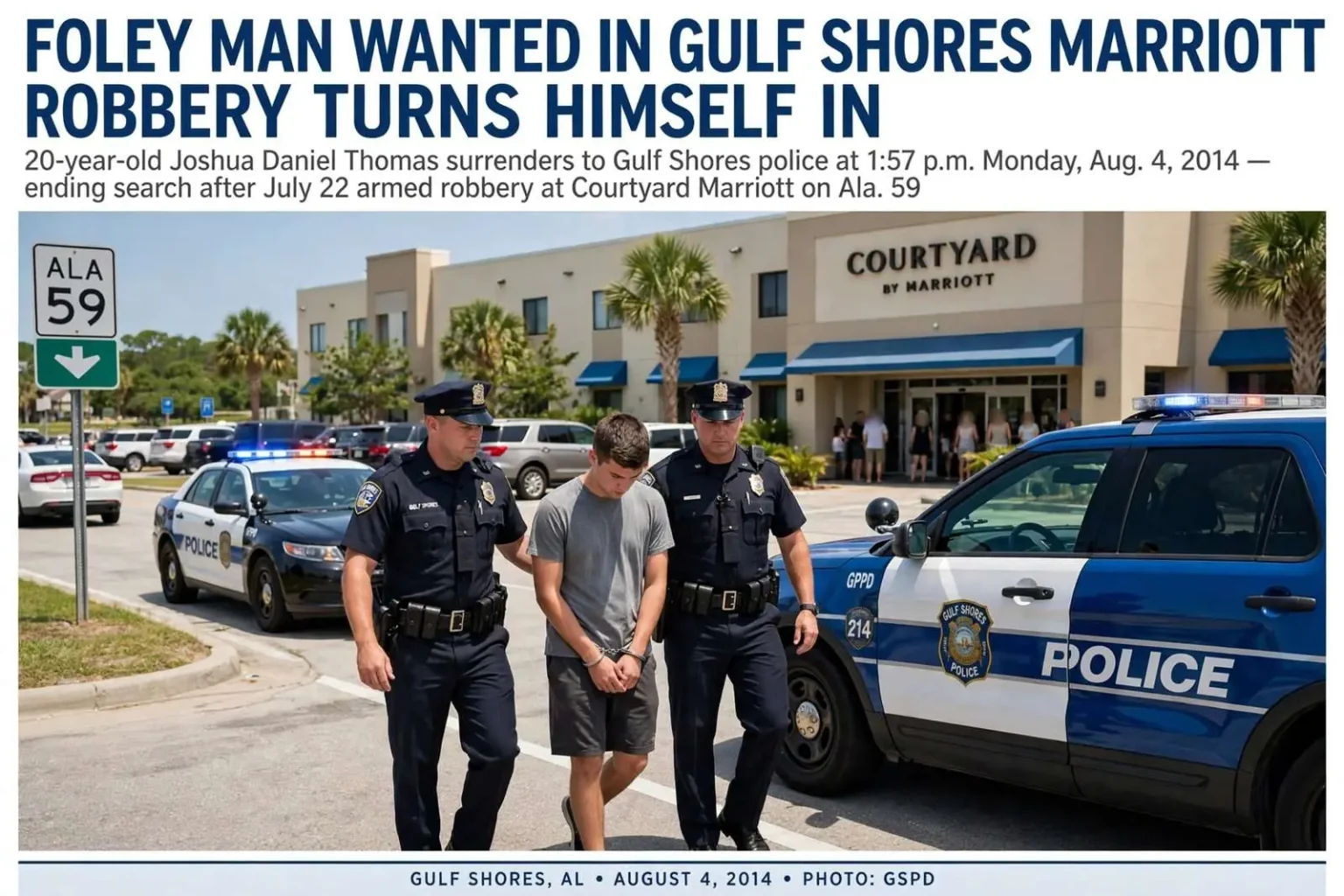
A young man sought in connection with an armed robbery at a Gulf Shores hotel surrendered to police, bringing a swift conclusion to a search that had unfolded partly in public view.
Joshua Daniel Thomas, 20, of Foley, turned himself in to Gulf Shores police at 1:57 p.m. on Monday, Aug. 4, 2014, according to department spokesman Cpl. Josh Coleman.
Thomas had been wanted in connection with the robbery of the Courtyard Marriott on Ala. 59, which police said was carried out at gunpoint during the early morning hours of July 22. The hotel sits along one of the busiest corridors in the resort city, a route that carries a steady stream of vacationers to and from the beach throughout the summer season.
Ala. 59 is the artery that nearly every visitor to Gulf Shores uses at some point during a stay. The highway runs from the interstate down through Foley and directly into the heart of the beach town, lined with the hotels, restaurants and shops that serve the summer crowd. A crime at a well-known hotel on that route, in the middle of peak season, put the case squarely in front of the public from the start — both because of where it happened and because of how many people were in town to notice.
Investigators had a significant advantage as they worked the case. The incident was captured on surveillance video, footage that was later shared with the public in an effort to identify the person responsible. That release of images preceded the announcement naming Thomas as the main suspect, and within days of being publicly identified, he presented himself to police.
The charges he faced
Gulf Shores police had obtained warrants for Thomas’ arrest on two counts. The charges, and the potential penalties under Alabama law, were substantial:
First-degree robbery, a Class A felony carrying a sentencing range of 10 to 99 years in prison upon conviction. Second-degree theft of property, a Class C felony punishable by one to 10 years in prison upon conviction.
The gravity of a first-degree robbery charge reflects the presence of a weapon during the crime. Under Alabama’s classification system, Class A felonies sit at the most serious end of the scale short of capital offenses, which is why the possible term stretches so far into a defendant’s future.
The pairing of the two charges is typical in armed robberies. The robbery count addresses the confrontation itself — the use or threat of a weapon against a person — while the theft count addresses the taking of property that motivated it. Prosecutors pursue the combination so that the case does not turn on a single theory of the crime, and the two charges together cover the full span of what police said happened in the hotel lobby that morning.
For a 20-year-old defendant, the exposure was enormous. A conviction on the first-degree robbery count alone could mean decades in prison, a sentence that would extend far past middle age. That reality shapes every stage of such a case, from the initial decision about surrender to the choices defense counsel makes about trial, plea negotiations and sentencing. As with any criminal charge, the accusations would be tested through the judicial process, where the felony counts would ultimately be weighed.
A case resolved by surrender
The decision to turn himself in spared the community and law enforcement the uncertainty that often accompanies an active search for an armed robbery suspect. Coleman confirmed the time of the surrender to the minute, an indication of how closely the department had been tracking the case since the July incident.
Surrender, when it happens, changes the shape of a case in practical ways. A defendant who walks into the police station voluntarily is not adding flight or resistance charges to the ledger, and the booking proceeds without the risk — to officers, to bystanders and to the suspect himself — of an arrest in a public place. In a resort town where a manhunt could have involved patrol activity along packed summer streets, the voluntary appearance closed out the search quietly.
The surrender also spoke to the weight of the surveillance evidence. Once images from the hotel had circulated publicly and the suspect had been named, the practical options narrowed: the footage existed, it had been seen, and the department had identified the person it believed appeared in it. Presenting himself to police was, under those circumstances, the step that resolved the situation on terms that were at least partly his own.
Thomas, a resident of nearby Foley, was booked in connection with the warrants. The short distance between the two Baldwin County cities is a familiar pattern in coastal crime reporting — the beach communities draw workers, visitors and, occasionally, suspects from the inland towns that ring them, and cases in Gulf Shores routinely touch the communities up the highway in Foley, Robertsdale and beyond.
The booking process itself moved the case into a new phase. At the jail, the warrants were served, the defendant was processed and the paperwork that would follow him through the court system began. From there the matter belonged to the district attorney’s office and the Baldwin County courts, which handle the felony cases arising from the beach cities along with the rest of the county’s docket. Preliminary proceedings would determine whether the case moved forward as charged, was presented to a grand jury or became the subject of negotiation — the standard crossroads that every felony case reaches after the arrest that starts it.
The wider pattern
The case fit a broader reality of policing a resort corridor. Violent crime in the beach cities is rare relative to the volume of visitors, but the properties that operate around the clock — hotels, convenience stores, late-night restaurants — present the recurring opportunities that armed robbery thrives on, and when such a crime occurs it lands on a department that must solve it in public view. The Courtyard Marriott case tested that capacity in midseason, and the department’s handling of it became part of the local record: video secured, images released, suspect named, and a surrender on a Monday afternoon recorded to the minute.
What the case said about policing on the coast
For a city whose economy and daily rhythm revolve around visitors, an armed robbery at a well-known hotel on its main thoroughfare was the kind of event that drew immediate public attention. The rapid identification of a suspect through surveillance footage, followed by his voluntary surrender, allowed police to move the matter into the court system without further incident.
Gulf Shores police operate in an environment unlike most departments their size. The city’s population swells dramatically each summer as tourists arrive, and the seasonal surge brings with it a corresponding rise in the volume — and variety — of calls for service. Hotels along the highway corridor are among the most demanding assignments, operating around the clock with rotating guests, staff members handling cash and valuables, and lobbies that anyone can walk into at any hour. The department’s familiarity with that landscape shapes how it investigates the rare violent crime that occurs within it.
Surveillance video has transformed that work. By 2014, cameras had become fixtures at hotels, retail centers and intersections along the coast, and departments had learned to move quickly when footage captured a serious crime: secure the recording, extract usable images, and put them before the public while memories were fresh and tips were still likely. The Gulf Shores case followed that playbook, and the interval between the release of the video and the naming of a suspect showed the method working as intended.
The timing also mattered for the city’s image. August is the height of the season, when hotel occupancy peaks and the visitor economy is at its most valuable, and word of an armed robbery in a familiar hotel can travel fast through the same social channels that carry vacation plans. A resolution measured in days, rather than a lingering open case, gave the department a clean narrative: crime occurred, footage identified the suspect, and the suspect is in custody. That sequence is what a tourism city wants its public safety story to look like.
At the time of his surrender, the case stood as a reminder that even in a community defined by leisure and tourism, serious crime occasionally intrudes, and that modern surveillance tools had given local police a powerful means of responding when it did. The next steps belonged to the courts, where the Class A felony count would carry the weight of Alabama’s harshest sentencing range and where the outcome for the 20-year-old from Foley would be decided on the evidence — including the video that had started it all.