Gulf Shores Police Chief’s Open Letter Goes Viral Nationwide
An open letter from Gulf Shores Police Chief Ed Delmore criticizing a Missouri commander's handling of civil unrest has spread nationally online.
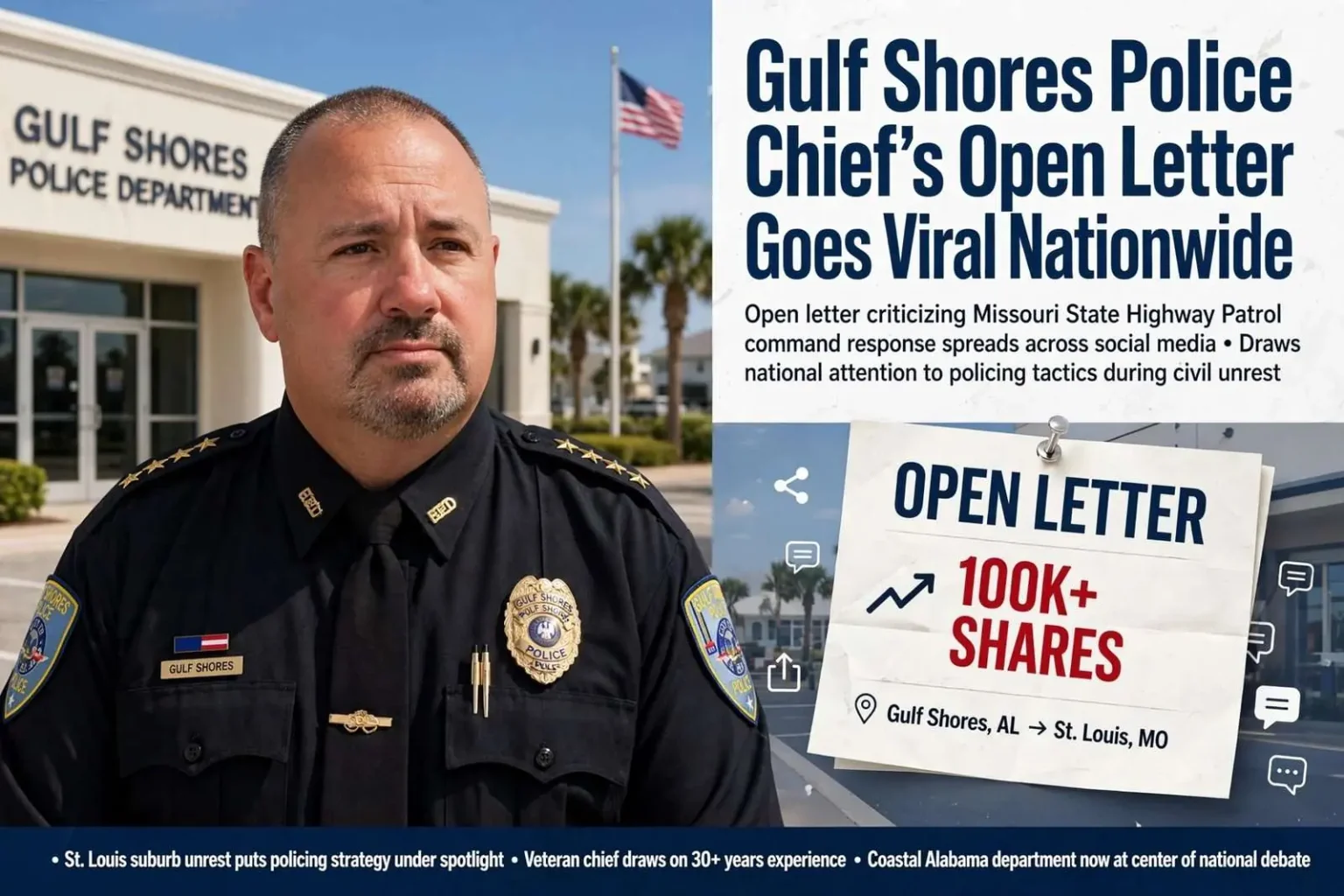
Gulf Shores Police Chief Ed Delmore is drawing national attention this week after an open letter he wrote sharply criticizing the leadership of a Missouri State Highway Patrol commander spread rapidly across social media, racking up tens of thousands of shares within a single day.
Delmore, who has led the Gulf Shores Police Department since 2010 after a long law enforcement career based in the St. Louis area, published the letter through a law enforcement trade publication. In it, he took aim at the commander who had been placed in charge of security operations following days of civil unrest in a St. Louis suburb tied to a police shooting earlier in the month.
The unrest had put the St. Louis region under international scrutiny, with nightly confrontations between demonstrators and police forcing Missouri’s governor to shift control of security operations to the state highway patrol in an attempt to reset the tone. The commander selected to lead that effort became the public face of the new approach, and his decisions were dissected nightly on national television — which is precisely the stage onto which a police chief from coastal Alabama now inserted himself.
The Baldwin County chief did not mince words, arguing that the commander’s approach, which included walking alongside protesters and promising a softer response, ultimately backfired once emotionally charged decisions about releasing information to the public were made under pressure.
Delmore argued that decisions made for public relations purposes, rather than sound law enforcement strategy, put both officers and the community at greater risk. His letter joined a running national argument about how police should handle mass demonstrations — a debate that split sharply between those who saw the conciliatory approach as a model for rebuilding trust and those, like Delmore, who viewed it as a tactical failure dressed up as outreach.
Why this letter carried weight
What has made the letter resonate so widely, according to law enforcement observers, is Delmore’s background. Having spent more than three decades in policing, much of it in the same metropolitan region where the unrest was unfolding, he offered a rare insider’s critique from someone who understands both big-city crowd control challenges and the pressures of leading a department during a high-profile crisis.
Officers reading the letter recognized the credentials behind it. A chief commenting on events in a city he never worked in would be dismissed as a talking head; a veteran of the St. Louis area’s law enforcement community, writing about command decisions in that same region, speaks with knowledge of the streets, the agencies and the politics involved.
Colleagues in Alabama describe Delmore as a typically low-key, measured leader, which only added to the surprise when his blunt assessment began circulating widely among police officers, forum communities and news outlets across the country. The contrast between his usual public demeanor and the letter’s forceful tone is part of what propelled the sharing: readers sensed a professional stepping out of character to say something he considered urgent.
The letter also arrived at a moment when rank-and-file officers nationwide were looking for voices to articulate frustrations they felt but rarely voiced publicly. Trade publications and officer-focused social media communities became pressure valves during the unrest, and letters like Delmore’s traveled through those channels at a speed that traditional police-association statements never approached.
The view from a beach city
Local officials in Gulf Shores say the attention has put an unusual spotlight on the small beach city’s police department, which normally focuses on tourism-season enforcement and coastal public safety rather than national controversies.
Gulf Shores policing looks little like the crowd-control scenes playing out in Missouri. The department’s daily workload is shaped by the coast: traffic on Highway 182 and the beach boulevards, alcohol and ordinance enforcement among a transient summer population, water-related emergencies, and the logistics of policing a city whose population swells each season to many times its year-round size. Spring break, Shrimp Festival weekends and holiday beach crowds define the department’s operational rhythm, not protest lines.
That difference is part of what made Delmore’s commentary notable rather than routine. A chief whose officers manage festival crowds and beach traffic weighed in on paramilitary-style civil unrest command, and his argument — that PR considerations had overtaken strategy — drew on command principles that apply in both settings: information discipline, unified messaging, and the risks of making public promises about tactics before conditions on the ground are known.
The episode also illustrated how the profession’s internal conversation now flows. Twenty years ago, a chief’s critique of another agency’s command decisions would have circulated in professional journals or conference hallways. Social media collapsed that distance, and within a day the Gulf Shores chief’s analysis was being read in precincts, headquarters and academies across the country — along with the inevitable replies, rebuttals and commentary.
National attention of this kind cuts both ways for a small department. Residents who encountered the story gained a glimpse of their chief’s professional standing and the respect he commands among peers nationwide. At the same time, the letter placed Gulf Shores into a polarizing national debate, and officials in the city were left managing a story that had nothing to do with local operations but everything to do with their police department’s name.
The debate behind the letter
The underlying dispute — how police command should handle mass unrest — has no settled answer in American policing. Advocates of the conciliatory model argue that militarized responses inflame crowds, that officers who face protesters as citizens rather than combatants defuse tension, and that the walk-along approach marked a needed turn after days of escalating confrontation.
Critics like Delmore counter that symbolism is not strategy, and that commanders who promise restraint in advance constrain their own options. In his view, the decisive failures came in communication — releasing information under emotional pressure rather than according to investigative and legal discipline — and those failures eroded the very trust the softer approach was meant to build. Officers on the line, he argued, paid the price for decisions made for the cameras.
The argument taps into a broader tension in modern policing between transparency and operational discipline. Departments under crisis face enormous pressure to speak quickly, and commanders must balance the public’s right to information against the integrity of investigations and the safety of personnel. Chiefs across the country have watched high-profile cases turn on what was said, when it was said, and what had to be walked back — which is why the question resonated so far beyond Missouri.
For Alabama law enforcement, the episode was a reminder that the state’s police leaders participate in national professional debates, and that a department of two dozen officers in a beach town can contribute to the profession’s conversation as credibly as agencies many times its size. Alabama municipal police chiefs lead departments that range from a handful of officers to hundreds, and the profession’s networks — training associations, command colleges and trade press — put them in continuous contact with peers nationwide.
What comes next for the department
The immediate practical effect in Gulf Shores was attention rather than change. The department’s operations, budget and local priorities were untouched by the controversy, and the city’s officials found themselves fielding media questions about a letter rather than any local incident. Chiefs who step into national debates generally weather the cycle by letting it pass, and Delmore’s standing in the region — built over years of local service — provides a buffer against any political fallout.
The letter’s longer significance may be professional. Open letters from sitting chiefs are rare, and one that draws tens of thousands of shares becomes a reference point in the profession’s ongoing argument about crowd response and crisis communication. Police command training programs routinely use real cases like the Missouri unrest as teaching material, and Delmore’s critique — from a commander with St. Louis roots and a sitting chief’s perspective — is likely to appear in those discussions for years.
For Gulf Shores residents, the episode offered a view into their police department beyond the summer enforcement headlines. Their chief, described by colleagues as measured and low-key, demonstrated both the professional network behind a small-city department and the willingness to take an unpopular public position when he judged the profession’s direction was wrong.
The national cycle will move on, as such cycles do, and Gulf Shores police will return to the work that actually defines them: summer beaches, festival crowds, hurricane preparedness and the daily calls of a growing coastal city. But for one week, a Baldwin County beach department stood at the center of the country’s most closely watched law enforcement debate — because its chief decided the profession needed to hear it.