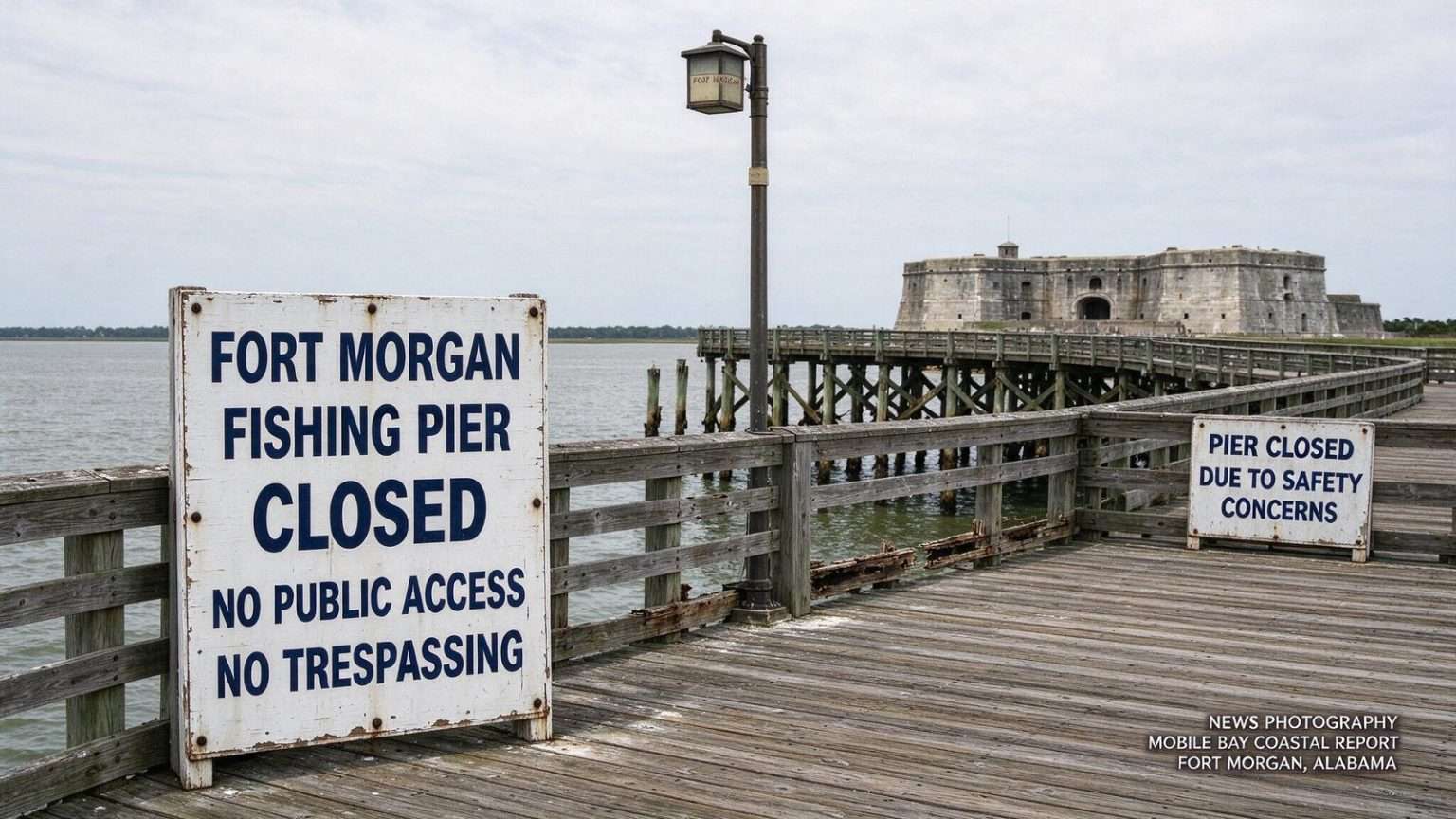
A wooden fishing pier extending into a coastal bayThe historic fishing pier at Fort Morgan has been closed since September due to structural decay.

The popular fishing pier at Fort Morgan State Historic Park remains closed indefinitely, and no agency has stepped forward with a plan to pay for the repairs needed to reopen it.

The pier along Mobile Bay has been shut down since early September after a diver confirmed what officials had suspected for months: the wooden pilings supporting the structure have deteriorated to the point where they can no longer be trusted to hold weight. Stephen McNair, historic sites director for the Alabama Historical Commission, said the decay is especially severe near the waterline, where sections of wood have eroded away entirely.

Commission staff estimate repairs will cost around $250,000, money the agency does not have in its current budget. McNair said reopening the pier will likely require finding an outside partner willing to fund the repairs and take on long-term maintenance responsibilities.

Fort Morgan receives roughly $300,000 annually in lease tax revenue from Baldwin County, but McNair said he doesn’t believe that funding can legally be redirected toward pier repairs, since it is intended specifically for preserving historic elements of the site. A separate legislative effort to redirect related funding was vetoed by the governor earlier this year.

The Alabama Department of Conservation, which maintains the boat launch adjacent to the pier, told the Historical Commission it could not afford to take on the repair costs either. That has left the question of funding largely unresolved, even as several Baldwin County officials have expressed a willingness to get involved.

Baldwin County Commission Chairman Skip Gruber said he personally supports the county taking financial responsibility for repairing and maintaining the pier going forward, since no other agency appears positioned to do so. Commissioner Tucker Dorsey voiced similar frustration, noting that the county already contributes heavily to state coffers and now faces an additional financial ask on top of existing road and infrastructure needs.

County staff have visited the site and found the pier in worse shape than initially expected, with repair costs potentially exceeding the $250,000 estimate. County Engineer Cal Markert said the next step involves sending a diver underneath the structure to inspect each piling individually for rot.

The pier’s troubles didn’t start with September’s closure. It was shut briefly over the summer for partial decking repairs, then closed again during the event marking the 150th anniversary of the Battle of Mobile, held in early August, out of concern that it could not safely support large crowds.

See also  Baldwin County Commission District 3 Candidates Report Little Fundraising Ahead of November

The closure has struck an emotional chord with longtime visitors. Janet Kynard, founder of a local event website, started a Facebook page and a GoFundMe campaign called the Save the Fort Morgan Pier Project after learning of the closure. As of this week, the campaign had raised less than $800, a total Kynard called disappointing given how many people say the pier holds sentimental value tied to memories with family. She said she is weighing whether to refund donors if broader public interest in funding repairs doesn’t materialize.

For now, the pier remains off-limits to the anglers and visitors who have long made it a fixture of trips to south Baldwin County, with its future resting on whether a funding partner emerges in the months ahead.

Baldwin County sits directly east of Mobile County across Mobile Bay and is the largest county in Alabama by land area. It encompasses the Eastern Shore communities of Daphne, Fairhope, Spanish Fort, and Foley and stretches south to the beaches of Gulf Shores and Orange Beach along the Gulf of Mexico.

Long among the fastest-growing counties in the state, Baldwin blends suburban development near the bay with tourism-driven coastal economies. Its proximity to Mobile and its position on the Eastern Shore make it a recurring subject of regional news covering growth, infrastructure, schools, and the balance between development and coastal preservation.

Mobile is the county seat of Mobile County in southwest Alabama and the state’s only saltwater port. Situated where the Mobile River meets Mobile Bay near the northern Gulf of Mexico, the city has long served as a commercial and cultural gateway between Alabama and the wider Gulf Coast. Founded in 1702 as Fort Louis de la Louisiane and ruled in turn by France, Britain, and Spain before joining the United States in 1813, Mobile carries a layered heritage distinct from the rest of the state.

Today Mobile anchors a metropolitan area spanning Mobile County and neighboring Baldwin County, and it remains a center for shipping, aerospace, healthcare, and higher education in the region. Its downtown and waterfront have seen sustained revitalization, while historic neighborhoods preserve architecture from its colonial and antebellum past. The city’s identity is shaped as much by its working port and industrial base as by its festivals and food culture, making it a frequent focal point for news about growth and change in southern Alabama.

See also  A GOP Loyalty Fight Fizzled in the Race for Baldwin County's Open Senate Seat

Alabama is a state in the southeastern United States bordered by Tennessee, Georgia, Florida, the Gulf of Mexico, and Mississippi. Often called the Heart of Dixie, it spans Appalachian foothills in the north and flat coastal plains in the south. Its largest cities include Birmingham, Montgomery, Huntsville, and Mobile.

Alabama’s history encompasses Indigenous roots, Spanish and French colonial settlement, a cotton-plantation economy, the Civil War and Reconstruction, and the Civil Rights Movement of the 1950s and 1960s, followed by a shift toward manufacturing, aerospace, and technology. Local news across the state frequently reflects this mix of tradition and change.

Local government in the Mobile area operates through a combination of mayor-council or commission structures at the municipal level and a county commission in Mobile County, with elected officials handling budgets, public safety, infrastructure, and zoning. Baldwin County has its own commission and a collection of incorporated municipalities.

Decisions made in council chambers and commission meetings affect roads, school funding, economic development, and quality of life, which is why coverage of local government is a staple of regional journalism. The interplay between city, county, and state authorities often determines how effectively the area can address shared challenges.

Because many services residents rely on are delivered at the local level, the choices of elected officials have direct, everyday consequences. Budget priorities, in particular, reveal a community’s values and shape the trajectory of growth and public welfare for years to come.

The history of South Alabama is shaped by its position at the crossroads of cultures and waters. Indigenous peoples, including the Muscogee (Creek) and Choctaw, lived in the region for centuries before European colonization by French, British, and Spanish powers.

The cotton economy and the Civil War left deep imprints, as did the Civil Rights Movement, in which Alabama played a defining role. Understanding present-day debates in the region often requires appreciating this layered past, in which port commerce, racial history, and coastal geography have long intertwined.

That inheritance is visible in the architecture, street names, and institutions of the area. Public memory of the past informs contemporary conversations about growth, equity, and identity, and it frequently surfaces in coverage of local events and policy.

The economy of the Mobile region is diversified across shipping and logistics, aerospace and shipbuilding, healthcare, tourism, and manufacturing. The Port of Mobile is one of the nation’s busiest seaports and a cornerstone of the local and state economy.

See also  TV Schedule for Mobile-Baldwin Prep Football Now Set After Saraland Broadcast Cut

Major employers in aviation and defense contribute to a skilled workforce, while economic-development organizations aim to attract investment and jobs through incentives and infrastructure improvements. Small businesses, from restaurants to professional services, form the backbone of neighborhood commerce.

The health of the regional economy is a frequent subject of public discussion and reporting. Workforce development, recruitment of industry, and the fortunes of local retailers all feed into a broader picture of how the Gulf Coast competes and adapts in a changing national economy.

The natural environment is central to life on the Gulf Coast, where barrier islands, bays, rivers, and wetlands support fisheries, recreation, and storm protection. Coastal Alabama faces challenges common to low-lying regions, including hurricane exposure, erosion, and the management of fragile ecosystems.

The Mobile-Tensaw Delta, one of the largest river deltas in the country, is a particularly significant natural asset. Conservation efforts, fisheries regulation, and shoreline restoration are frequent points of collaboration among state agencies, federal bodies like the Army Corps of Engineers, and environmental groups.

How the region plans for growth while protecting its natural assets is a recurring theme in local reporting. The tension between development pressure and ecological stewardship plays out in zoning fights, infrastructure projects, and disaster-recovery decisions that shape the coast for generations.

Behavioral-health care on the Gulf Coast is provided by a mix of community mental-health organizations, hospital systems, and private practitioners. Community centers play an especially important role in serving patients who might otherwise lack access to care, often coordinating with courts, jails, and social services.

Demand for these services has grown alongside heightened public awareness of mental illness and the lasting effects of disasters such as hurricanes. Workforce shortages of psychiatrists and other clinicians are a persistent challenge nationwide, and they shape how providers allocate limited staff time between direct patient care and the administrative and legal obligations that accompany treatment.