Body of Louisiana Teen Recovered on Gulf Shores Beach After Drowning
The body of a 17-year-old Louisiana visitor was recovered off a Gulf Shores public beach two days after he went under in rough surf.
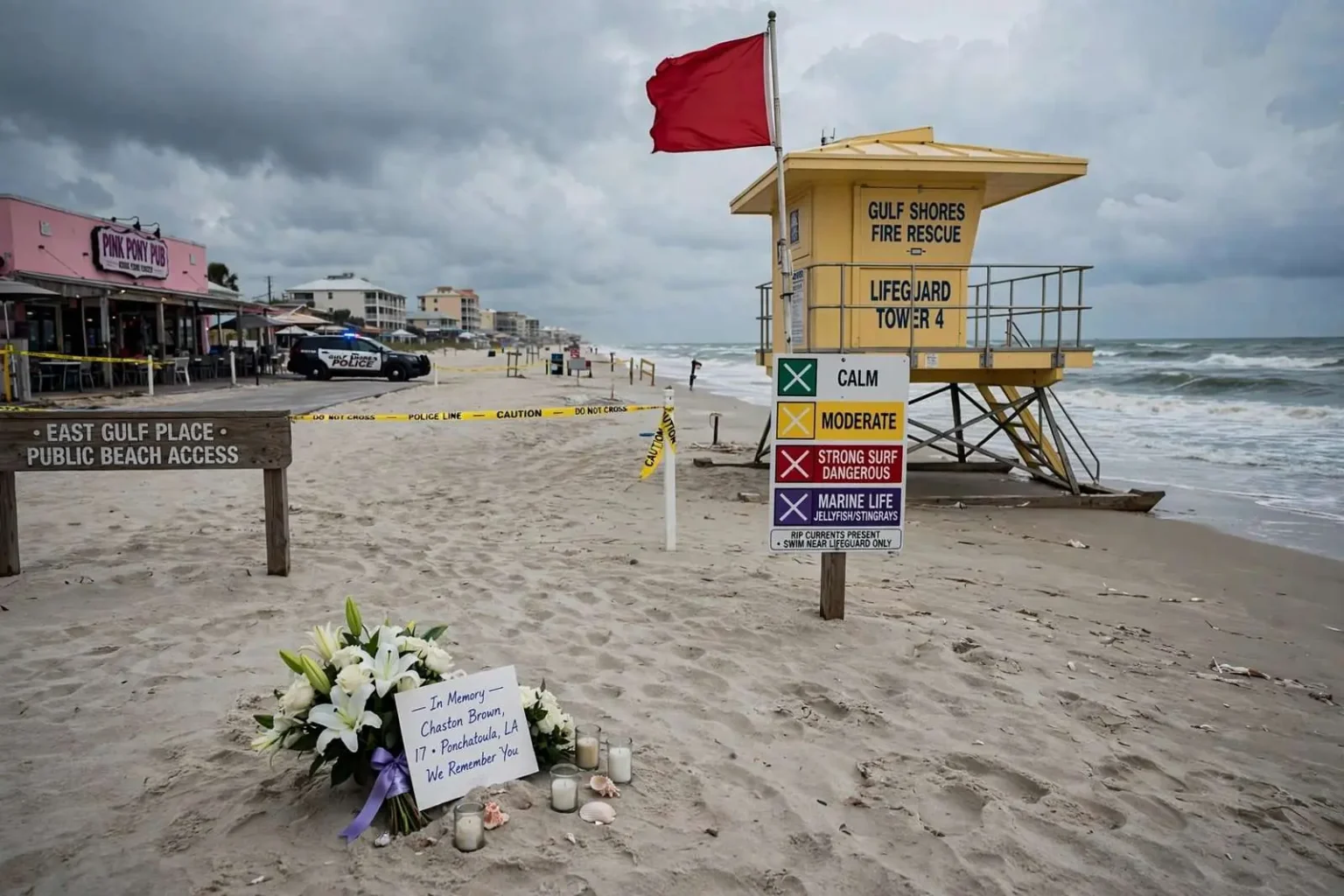
The body of a teenage visitor from Louisiana was pulled from the water off a Gulf Shores public beach Tuesday afternoon, two days after he disappeared beneath rough surf while vacationing with family and friends.
Gulf Shores police said a swimmer first spotted something floating in the water around 1:33 p.m. directly in front of East Gulf Place, an area near the Pink Pony Pub on the city’s main public beach. A nearby jet skier confirmed it was a body, and the original swimmer then helped bring it to shore, according to a police spokesman.
The 17-year-old was found only a few blocks east of where he had last been seen entering the water two days earlier. Police had not officially released his identity, but friends and family began identifying him on social media as Chaston Brown, a teenager from Ponchatoula, Louisiana. Tributes and messages remembering him quickly spread across platforms including Twitter in the days following his death.
Caught in Rough Surf
According to police, Brown was vacationing in the Gulf Shores area with friends and family when he got caught in dangerous surf conditions around 4 p.m. that Sunday and went under. Search and recovery efforts launched immediately by Gulf Shores police and other local law enforcement agencies continued through the following two days but did not locate him until the discovery Tuesday afternoon.
Officials later clarified and corrected an earlier account of exactly how the body was found, updating the public record several hours after the initial recovery to make clear it was a beachgoer, rather than a member of law enforcement, who first spotted the body in the surf.
A Recurring Danger on the Northern Gulf
The drowning is a stark reminder of how quickly conditions can turn dangerous along the Gulf Coast, where rip currents and rough surf can develop rapidly, particularly during the peak of summer tourist season when beaches like those in Gulf Shores draw large crowds of visitors from across the region. Local officials routinely urge swimmers to pay close attention to the flag system used at public beaches along the Alabama coast, which signals water conditions each day with a color-coded display at lifeguard stations and beach access points.
Under the flag system, a green flag means calmer conditions, yellow signals moderate surf and cautions swimmers to remain alert, red indicates strong surf and recommends that only strong swimmers enter the water, a double red flag closes the water entirely, and purple warns of dangerous marine life such as jellyfish or stingrays. Rip currents — narrow channels of fast-moving water that pull swimmers away from shore — are the leading hazard, and safety officials emphasize that a person caught in one should not fight it directly. The guidance taught across Gulf Coast beach communities is to stay calm, signal for help, and swim parallel to the beach until free of the current’s grip, then angle back toward shore.
The Search Along the Beach
The recovery effort that followed Brown’s disappearance brought together multiple agencies along the coast. Gulf Shores police were joined in the search by other local law enforcement, and searchers concentrated on the stretch of public beach around East Gulf Place, where the teenager was last seen. The two-day search reflected the difficulty of locating a person in active Gulf surf, where currents can move a body substantial distances in a matter of hours and where visibility below the surface is often limited by churned sand.
The area where Brown went missing is among the busiest on the Alabama coast. Gulf Shores’ main public beach sits at the heart of the city’s tourist district, within walking distance of the shops, restaurants and attractions that line Gulf Place and Highway 59, which runs south from Interstate 10 through the middle of town and ends at the beach. On summer afternoons, thousands of visitors spread across the sand there, and the Pink Pony Pub and neighboring businesses overlook the water directly.
Gulf Shores, a city of roughly 10,000 year-round residents at the southern tip of Baldwin County, swells to many times that population during summer months as tourists arrive from across Alabama, Louisiana, Mississippi, Tennessee and beyond. The city’s economy is built almost entirely on beach tourism, and its fire department provides lifeguard coverage at the public beach during peak season, with rescue patrols running daily through the summer.
Ponchatoula Mourns
Brown’s death reached beyond the Alabama coast to his hometown. Ponchatoula, the Tangipahoa Parish community about 45 minutes northwest of New Orleans where he lived, is a small city known for its strawberry farms and its antique district along the railroad tracks. News of the drowning spread quickly through the community, where friends and family posted tributes on social media while officials had still not released the teen’s name publicly.
The loss underscores a pattern that coastal officials have repeated for years: most drowning victims at Gulf Shores and neighboring Orange Beach are visitors rather than residents, tourists unfamiliar with Gulf conditions who encounter rip currents or rough surf that locals know to avoid. Visitors from inland communities frequently have little experience with the Gulf’s sudden weather shifts, afternoon thunderstorms that kick up steep waves, and the subtle channels of seaward-flowing water that give little warning until a swimmer is being carried away from the beach.
What Officials Urge Swimmers to Know
Gulf Shores authorities use the recovery to renew their standard advice for beach visitors. Swimmers should check the day’s flag before entering the water, remain within sight of a lifeguard whenever possible, avoid swimming alone, and keep a close watch on children and teenagers even in waist-deep water. Rip currents often appear calm from the beach, forming in gaps between sandbars where water drains back toward the Gulf, and even strong adult swimmers can be overmatched.
Anyone who sees a swimmer in trouble is urged to call 911 immediately and, if possible, throw the person something that floats rather than entering the water themselves, a rescue approach that prevents would-be rescuers from becoming victims. Along the Alabama coast, beach warning flags and condition updates are posted at major public access points, and hotels and rental offices along the beachfront pass along daily conditions to their guests.
Summer Season Safety Push
Drownings and water rescues along Alabama’s beaches tend to cluster in the heart of the summer season, when east winds and afternoon storms combine with crowded beaches to create hazardous conditions. Baldwin County’s coastal communities — Gulf Shores, Orange Beach and the Fort Morgan peninsula — share the same stretch of shoreline and the same vulnerability to rip currents, and their public safety agencies coordinate on beach safety messaging throughout the season.
The two days between Brown’s disappearance and the recovery of his body were marked by continued rough conditions along the coast, the kind of prolonged surf that complicates both search operations and everyday swimming. Search teams working in such conditions face repeated risks themselves, and officials often have to balance the urgency of recovering a missing person against the safety of the crews in the water.
For the family and friends who had gathered in Gulf Shores for what was meant to be a vacation, the days between the disappearance and the recovery were spent waiting along the same public beach where the teenager had last been seen, as word of the search spread through the community of beachgoers around East Gulf Place.
A Community’s Response
The response to Brown’s death followed a pattern familiar to coastal communities: an outpouring of grief on social media, tributes from classmates and friends in his Louisiana hometown, and renewed calls from beach safety advocates for visitors to take the Gulf seriously. While the teenager’s identity remained officially unconfirmed by police, the tributes posted online painted a picture of a young man remembered by dozens of people across two states.
Public safety officials in Gulf Shores have long emphasized that the single most effective step visitors can take is to swim near a lifeguard. The city’s lifeguarded beach areas are marked with flags and signage, and lifeguards perform preventive actions — moving swimmers away from rip currents, warning people entering the water under red-flag conditions — far more often than they perform rescues. Visitors who bypass those guarded zones take on the Gulf without any of that protection.
As the summer tourist season continues, Gulf Shores officials will keep delivering the same message they deliver after every drowning: the Gulf is beautiful and unforgiving in equal measure, conditions change faster than the weather forecast suggests, and the flags flying at the beach each morning are the best available guide to whether the water is safe. For one Louisiana family, that lesson has already come at the cost of a 17-year-old son, remembered now in Ponchatoula and on the beaches where he spent his final days.