Downtown Mobile Mural Takes Shape With Help From Neighborhood Kids
A colorful new mural is spreading across a Warren Street building in downtown Mobile, with local kids pitching in ahead of ArtRide.
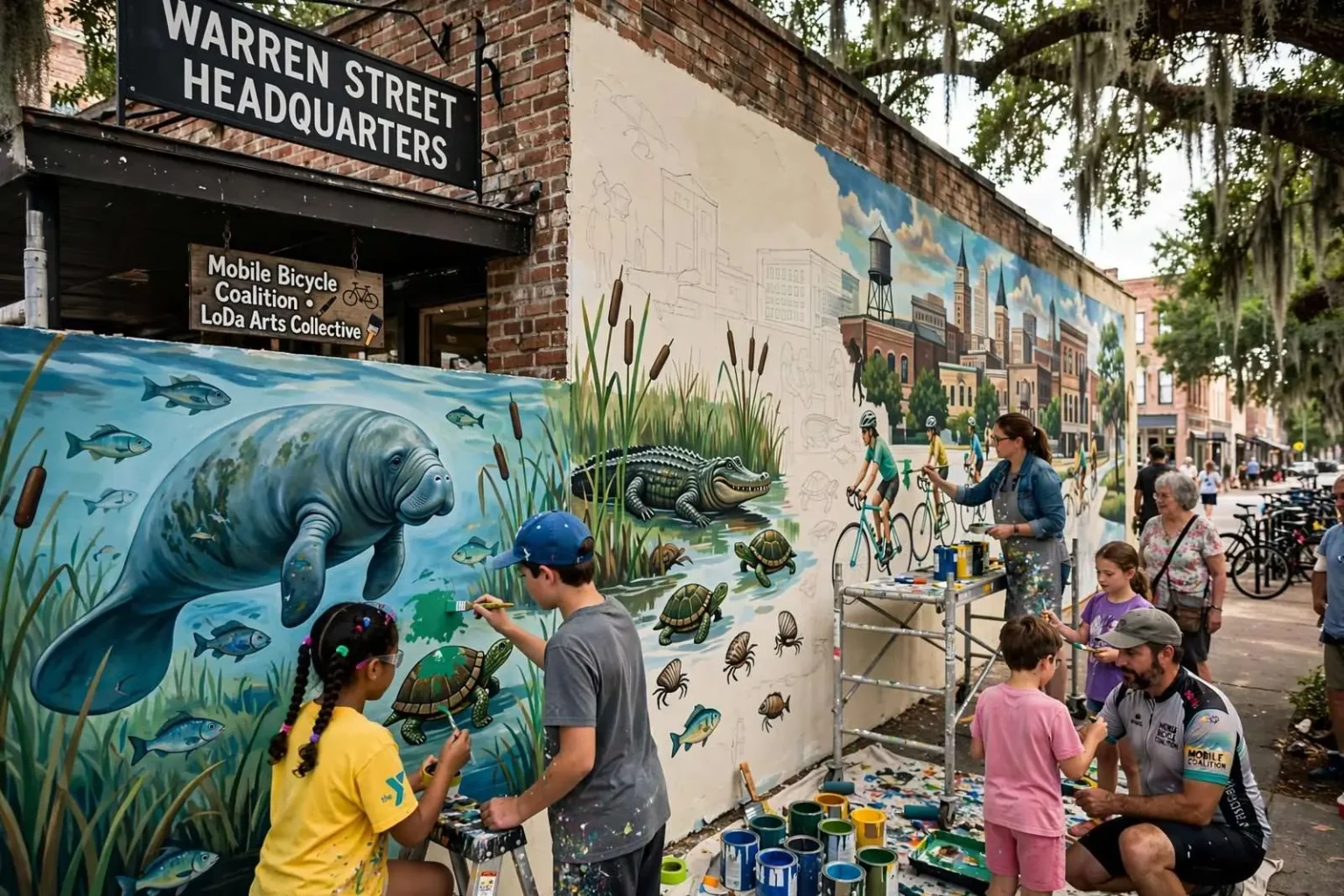
A sprawling new mural is taking over the side of a busy community building on Warren Street in downtown Mobile, and the artists behind it have made sure the whole neighborhood gets a hand in painting it. What began in mid-July as a handful of professionals sketching outlines has grown into a rolling community project, with volunteers of all ages picking up brushes to fill in fish, bicycles and city rooftops on a wall that most passersby had never given a second look.
The mural covers the headquarters shared by a bicycle advocacy nonprofit and a local artistic collective, and it is packed with images of manatees, bicyclists, city rooftops and marine life meant to capture the character of the Mobile-Tensaw Delta and the people who call the area home. The pairing is fitting: the two organizations sharing the building represent two of the forces shaping downtown Mobile’s recent revival — a growing cycling culture that has pushed for better bike lanes and friendlier streets, and an arts community that has turned vacant walls and empty storefronts into canvases across the historic core.
One of the bike group’s founders said the piece is meant to reflect everything happening inside the building, from art-making to cycling, while also nodding to the biodiversity of the delta itself. The Mobile-Tensaw Delta, the vast wetland system that feeds Mobile Bay from the north, is one of the most biologically rich regions in North America, home to black bears, alligators, hundreds of bird species and, famously, manatees that drift in from the Gulf during warm months. Working those creatures into a downtown wall is a way of reminding residents that the wild delta begins not far from the city’s office towers and row houses.
Volunteers keep the wall growing
Work on the mural began in mid-July, when a core group of artists gathered to rough out the design. Since then, volunteers have shown up nearly every day to keep the project moving, with scaffolding, paint cans and brushes scattered along the wall as the piece has grown. The daily rhythm of drop-in volunteers has turned the site into something of a neighborhood gathering spot, where people passing on foot stop to watch, and those who stop long enough are often handed a brush and pointed toward an unpainted section.
That open-door approach is deliberate. Public art projects in downtown Mobile have increasingly leaned on community participation, both to stretch limited budgets and to give residents a stake in the finished work. A mural painted entirely by visiting professionals can impress a neighborhood; one painted in part by the neighborhood itself tends to be defended and maintained by it, and organizers here have made that argument in practice rather than in print.
Kids put their mark on the design
Some of the most enthusiastic helpers have been children. A summer camp group from a nearby YMCA branch has stopped by repeatedly to add finishing touches to fish, turtles, clams and alligators worked into the design. The animals give young painters an accessible entry point — forgiving shapes that welcome wobbly lines — while still tying the finished wall to the delta ecosystem the artists set out to celebrate.
A camp counselor said many of the kids, who range from 8 to 14 years old, had never painted before and were being introduced to a different, more creative side of their own neighborhood while also learning about giving back to the community. For children growing up within sight of downtown but often on its margins, the project doubles as a hands-on civics lesson: the wall they helped paint will still be there when camp ends, and every time they pass it they can point to the exact fish or turtle they brought to life.
Guest artists who live and work nearby say that community involvement has been central to the project from the start. Volunteers helping supervise the younger painters described the effort as a way of replacing blighted, overlooked spaces with something the neighborhood can be proud of. One counselor noted that after seeing so many run-down buildings around the city, it was refreshing to help create something that stands out for the right reasons.
An unveiling timed to LoDa ArtWalk
Organizers say the finished mural will be unveiled at a public ceremony around midday on Aug. 8, timed to coincide with that evening’s LoDa ArtWalk festivities. LoDa — short for Lower Dauphin — is the heart of Mobile’s downtown entertainment and gallery district, and its monthly ArtWalk draws hundreds of residents and visitors through the streets to browse galleries, studios and street performances. Anchoring the unveiling to the ArtWalk calendar ensures the finished wall gets an audience far beyond Warren Street on its first night.
City leaders and community groups are expected to attend the unveiling, which will cap weeks of volunteer labor under the oak trees lining Warren Street. The shade of the old oaks has made the work site bearable through the height of an Alabama summer, though volunteers have still had to race afternoon thunderstorms and work around the building’s regular traffic to keep the project on schedule.
The project reflects a broader push by downtown Mobile arts and cycling groups to use public art as a tool for neighborhood revitalization, turning an ordinary building wall into a shared canvas for residents of all ages. Across the country, cities have found that murals can slow graffiti, draw foot traffic to forgotten blocks and give a district a recognizable identity, and Mobile’s downtown advocates have taken that lesson to heart. For the organizations sharing the building, the finished mural will do more than brighten their headquarters — it will announce to everyone who passes that the building, and the block, belong to the neighborhood.
From outline to finished wall
Murals of this scale unfold in stages. The core artists first transferred their design onto the wall as a loose grid of outlines, blocking in the largest shapes — the sweep of water, the curve of a manatee’s back, the skyline of rooftops — before any color went up. Only after the composition was anchored did the volunteer work begin in earnest, with painters filling broad fields of color while the lead artists moved along the wall refining edges, adding shading and pulling the individual scenes together into a single image.
Paint choices matter as much as design. Exterior murals on the Gulf Coast face brutal conditions: driving rain, summer sun that bleaches pigment, and humidity that swells and shrinks the underlying brick and stucco. The project’s organizers selected exterior-grade paints and primers designed to hold color for years, an investment that separates a lasting neighborhood landmark from a wall that fades within a season. Protective clear coats applied at the end will add further resistance to weather and to the grime that accumulates along busy streets.
The location itself amplifies the impact. Warren Street sits within walking distance of Bienville Square and the main downtown commercial corridors, in a block where pedestrians and cyclists pass regularly. A wall that faces steady foot traffic works harder than one tucked into a parking lot; it becomes part of the daily routine of hundreds of people, and its imagery — delta wildlife riding alongside bicycles — turns a routine walk into a small encounter with the city’s identity.
Arts and cycling groups as revitalization partners
The partnership on the wall mirrors partnerships happening across downtown. Mobile’s cycling advocates have spent years pushing the city to treat bicycles as transportation rather than recreation, arguing for connected lanes, better signage and education campaigns, while the arts community has built a national reputation through the city’s public art programming. When the two share a building, their projects naturally braid together: a mural about the delta painted by a community, on a wall owned by groups devoted to healthier streets and a creative economy.
Nationally, studies of public art consistently find that murals and similar installations deliver benefits beyond aesthetics — they can deter vandalism on targeted buildings, increase pedestrian activity, and serve as anchors for tours, festivals and social media visibility that reach potential visitors far beyond the neighborhood. Downtown Mobile has seen this dynamic firsthand, as photographed walls across the district now appear in visitors’ itineraries alongside the city’s historic attractions.
For the children from the YMCA camp, the most lasting benefit may be intangible: the realization that art is something made by people like them, in places like theirs, rather than something that only happens behind gallery doors. Organizers hope that some of the young painters will return to Warren Street on their own, bringing family members to see the turtles and alligators they helped finish, and perhaps coming back as volunteers for the next wall.
Until the Aug. 8 unveiling, the wall remains a work in progress visible from the street — scaffolding by day, painted marine life emerging one section at a time. Neighbors say they already treat it as finished in spirit, pointing visitors toward it and checking on its progress. The formal ceremony will simply make official what the summer’s volunteers have built: a block of downtown Mobile that now looks like the community that painted it.