Bayside Academy Seniors Reflect on Final First Day in Daphne
Bayside Academy's Class of 2015 kicked off senior year in Daphne, sharing what they'll cherish most and advice for incoming freshmen.
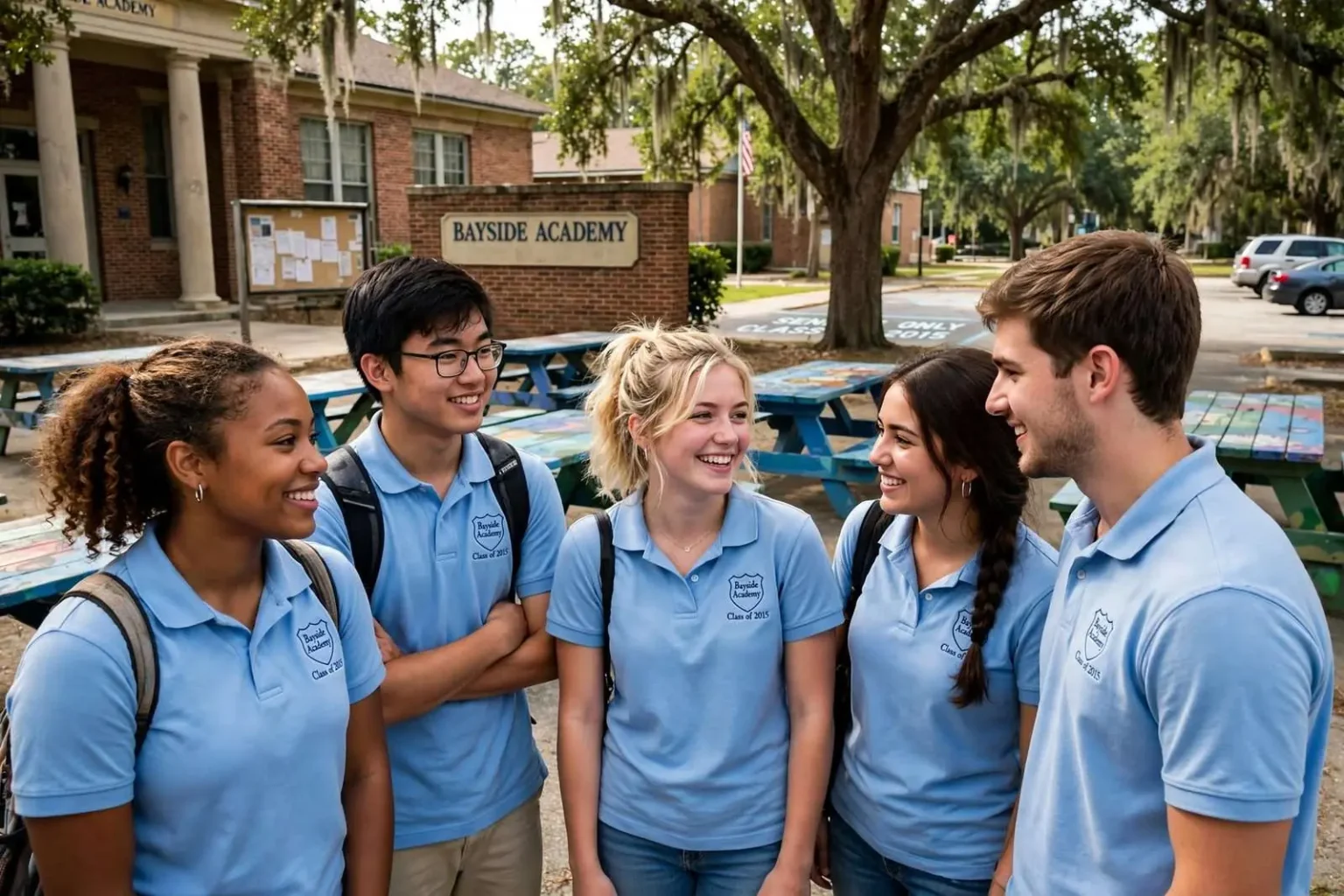
DAPHNE, Ala. — The hallways at Bayside Academy filled again in mid-August as roughly 720 students in pre-kindergarten through twelfth grade returned for the new school year, but for one group the first bell carried extra weight. About 58 seniors traded in their old uniforms for the light blue shirts that mark the top class on the small private campus, a tradition students say signals both privilege and pressure as their final year begins.
For the Class of 2015, the light blue shirt is more than a color change. Longtime students describe it as an unofficial badge that comes with perks — claiming the senior section of the parking lot, gathering at reserved picnic tables painted with class colors, and taking on leadership roles in the Student Government Association.
The tradition reflects the character of a campus where students often spend more than a decade together. On a school that spans pre-kindergarten through twelfth grade, the senior class functions less like a cohort and more like a family unit, and the visible markers of seniority — the shirts, the parking spaces, the tables — are the school’s shorthand for a hierarchy students absorb from their first years on campus.
Leadership and last chances
Several seniors said they were most looking forward to guiding underclassmen through school traditions, from spirit weeks to homecoming preparations that keep the campus buzzing every fall. The year’s calendar — pep rallies, theme days, class competitions — is largely built by the senior class, which means the students planning their own final events are also staging the memories the younger grades will inherit.
That mentoring role carries real weight at Bayside, where older students organize the rituals that define the school calendar. For many of them, running the traditions they once watched from the sidelines is the part of senior year they have anticipated longest — the moment when the class takes full ownership of campus life before handing it off to the class behind them.
Not every part of the year is celebrated, though. More than one student named the college application process as the most stressful part of the coming months, while others admitted that saying goodbye to long-running rituals — their last homecoming, their last prom — will be an emotional adjustment after growing up together in a tight-knit senior class.
A handful of students pointed to advanced coursework, including calculus, as the academic hurdle they expect to face head-on. Balancing a senior-year course load with application deadlines and the pull of final-year events is the season’s defining juggling act, and students say the campus culture pushes them to keep academic performance from slipping in the stretch after college acceptances arrive.
Favorite subjects and favorite teachers
History emerged as a favorite subject among several seniors, who credited the school’s history department with making the material engaging well beyond what was required. In a small-school setting, a department’s teaching style can define a subject for an entire class, and Bayside’s seniors describe history courses as discussion-driven and demanding in ways that stuck with them.
Other students highlighted strong relationships with teachers in math and foreign language courses as reasons they stayed motivated throughout high school. Those relationships are among the most-cited advantages of a small private school — class sizes small enough that teachers know each student’s work and habits, and continuity across years that lets instruction build rather than restart. For students applying to selective colleges, the letters those teachers write carry the weight of years of firsthand knowledge.
College plans take shape
Several seniors are weighing in-state options such as Auburn University and the University of Alabama, while others are looking further afield to schools including the University of Virginia, the University of North Carolina, Vanderbilt University and The Citadel, with interests ranging from the humanities to a future military career.
The spread of the list says something about the class itself. In-state flagships like Auburn and Alabama remain the gravitational center for Baldwin County graduates — close enough for family weekends, with alumni networks that dominate the state’s professional life. But the seniors also named public universities in Virginia and North Carolina and private institutions like Vanderbilt, a range that reflects both the academic ambitions of the class and the recruiting reach that Gulf Coast private schools now attract.
The mention of The Citadel — South Carolina’s military college — points to a student pursuing service, a path families on the Eastern Shore have long followed through the nation’s service academies and senior military colleges. Whether the class scatters across the Southeast or concentrates at the state’s two big universities, the decisions made in the coming months will define where the school’s network of alumni takes root next.
Advice for the classes behind them
Asked what advice they would offer incoming freshmen, the seniors were consistent: take the first year seriously, get involved in clubs and activities early, and don’t let early grades slide because they matter more than students realize.
Several also urged younger students to explore a variety of interests before settling into an academic focus, noting that the extracurricular and volunteer experiences built over four years often shape college applications far more than test scores alone.
The advice distills what the Class of 2015 has learned from experience. First-semester grades appear on transcripts that colleges see, activities require years of sustained involvement to lead, and the students who arrive at senior year with a record of engagement have choices that those who started late do not. It is advice grounded not in theory but in the college application season the seniors are living through as they speak.
Their counsel also reflects the realities of selective admissions in the current era, where application readers look for depth and progression rather than a long list of one-year memberships. Students who commit to a few activities and rise into leadership — the path the Student Government Association roles at Bayside exemplify — present a clearer narrative than those who spread themselves thin, and the seniors’ emphasis on exploring broadly before settling in is meant to help freshmen find the commitments worth keeping.
The Eastern Shore in August
As Baldwin County schools settle into the rhythm of a new academic year, Bayside Academy’s senior class is entering its last lap on campus with a mix of nostalgia and anticipation, a familiar feeling for families across the Eastern Shore each August.
Baldwin County is one of Alabama’s fastest-growing counties, and its school-age population has grown with it — public and private alike. On the Eastern Shore, where Daphne sits across Mobile Bay from the city, families choosing between the county’s public systems and private options like Bayside weigh class size, continuity, and tradition. A school graduating 58 seniors is small by any measure, and its families know one another across grade levels in ways that larger campuses cannot replicate.
The mid-August return dates Bayside with the region’s school calendars, which begin earlier than much of the country. The early start aligns Baldwin County schools with a semester schedule that ends first terms before the winter holidays — a rhythm familiar to families across south Alabama, and one that puts the Class of 2015’s countdown on a clock that begins ticking with the first hot weeks of the school year.
What senior year holds
Between now and graduation, the class will run the school’s traditions one final time: homecoming in the fall, the holiday season’s campus events, spring trips and ceremonies, and the sequence of lasts that punctuate a final year. Seniors say they intend to savor that arc even while managing the applications, scholarship deadlines and advanced coursework that compete for the same hours.
Their teachers, for their part, see a class they have watched develop — in many cases for a decade or more — and the school year ahead is as much a culmination for the faculty as for the students. Small schools measure their success in classes like this one: where the students are headed, what they carry with them, and how the next generation coming up through the lower grades follows the example now wearing light blue.
For the roughly 58 seniors in those light blue shirts, the year ahead holds both the privileges they have earned and the pressures they have inherited. The class of 2015 will spend its final year at Bayside Academy leading the traditions it grew up with, finishing the coursework that started twelve years ago, and preparing to scatter to universities across the Southeast — a last lap that, for the families watching from the Eastern Shore, never goes quite as slowly as they hope. In the meantime, the light blue shirts have their year — and the Class of 2015 intends to make it count.