Gulf Shores Police Chief Defends Flock Camera Network and Promises Strict Oversight
Gulf Shores Police Chief Dan Netemeyer defended the city's 87 Flock Safety cameras, citing audit policies and a coming transparency portal as residents raise privacy concerns.
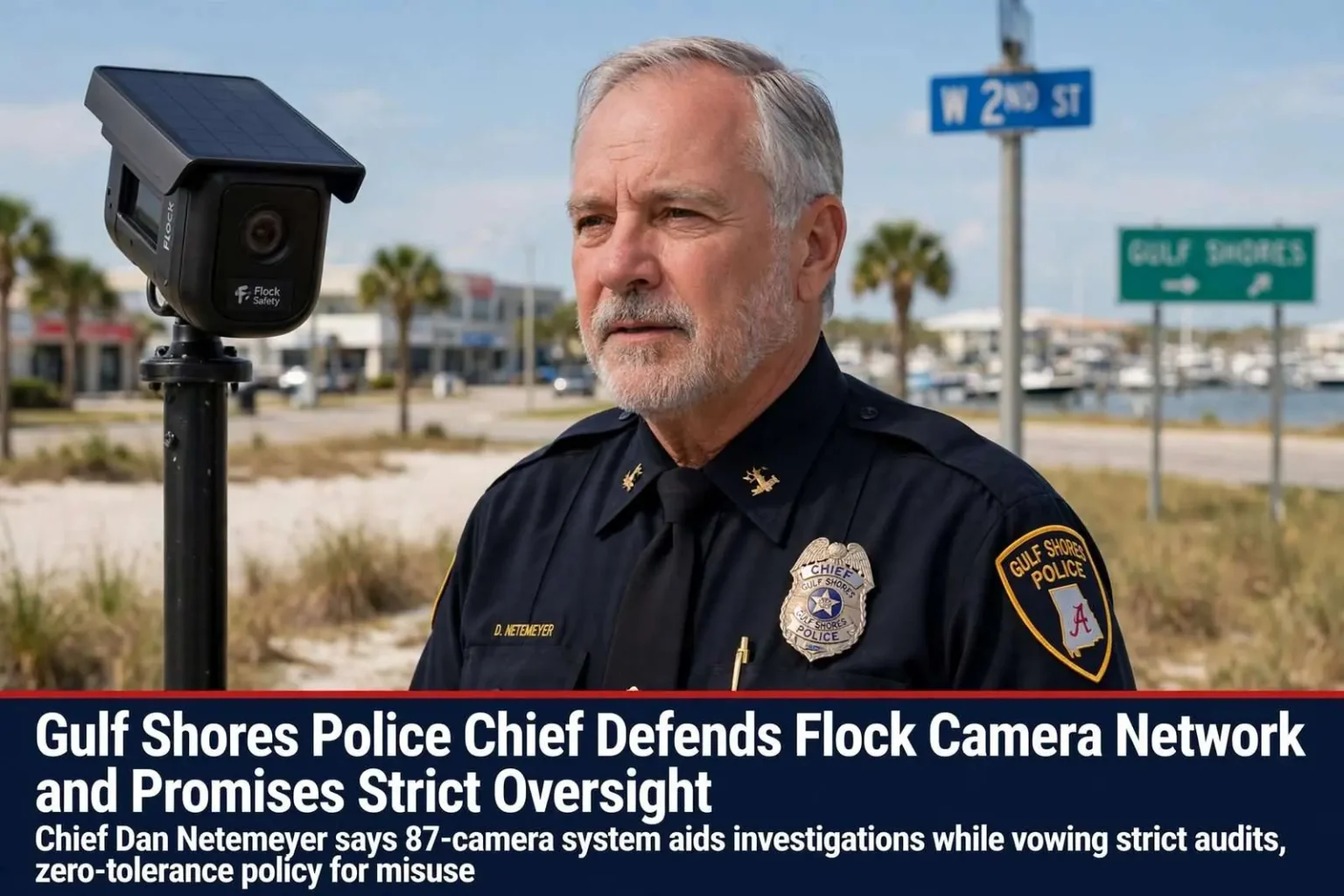
After weeks of questions and concerns from Gulf Shores residents about the city’s growing network of Flock Safety cameras, Police Chief Dan Netemeyer is defending the technology while acknowledging that safeguards against misuse are essential.
The city currently has 87 Flock cameras throughout Gulf Shores after the City Council approved an $81,000 purchase of cameras and software. The system is designed primarily to capture license plates and vehicle characteristics and to alert law enforcement when it detects vehicles connected to investigations or law-enforcement hotlists. Flock’s technology can also allow investigators to search for specific vehicle characteristics and other visual details.
The cameras were approved before growing national scrutiny over the privacy implications of the system and the handling of the information it collects. Flock Safety officials completed full training with the Gulf Shores Police Department this week.
Results so far
City officials say the system is already proving useful. The cameras have assisted with investigations involving stolen property and stolen vehicles and have helped police locate at least two people with dementia.
But as residents have brought their concerns to the Gulf Shores City Council, questions about privacy, access and potential misuse have remained at the center of the debate.
Netemeyer, a retired FBI agent, said some of the concerns circulating about the technology are based on misinformation. At the same time, he acknowledged that improper use by law enforcement officers is a legitimate worry.
“I did 24 years in the FBI, six of which were working public corruption, and we used to have cases of misuse of government computer systems that we would work and indict people all the time,” Netemeyer said. “This is nothing new.”
Policies, audits and zero tolerance
Netemeyer said Gulf Shores has established policies governing how officers can use the system and that he has zero tolerance for unauthorized searches.
“This community knows its police department. This chief knows his officers and the officers know this chief,” he said. “We have zero tolerance on any type of misbehavior with regard to these systems that we were entrusted to protect the citizens of this city with.”
According to the city’s Flock Safety information page, officers are required to have authorization and an active incident number before conducting a query. The city says searches are logged and subject to regular audits, and unauthorized access is grounds for termination and prosecution. Netemeyer added that Flock Safety also operates its own auditing system designed to identify potential misuse.
Gulf Shores has a year-round population of just over 17,000, but millions of tourists visit the beach community each year — a unique challenge for a relatively small police department. Netemeyer hopes Flock can help fill the gaps.
“We are a destination city,” he said. “Allow your police department to have the advantage of knowing if criminals, registered sex offenders or stolen vehicles are coming into this town to allow us to do our jobs more effectively and keep this city safe.”
What the cameras do — and don’t do
The city says Flock cameras are not used for automated speeding or red-light enforcement and do not use facial-recognition technology. The city’s FAQ also states that non-evidentiary vehicle data is automatically deleted after 30 days unless it is preserved as evidence in an active criminal investigation.
Those safeguards, however, have not eliminated concerns among residents about the amount of surveillance technology being deployed throughout the city, and Netemeyer said he understands that residents need answers as the department gains experience with the system.
A transparency portal is coming
In the next few weeks, the Gulf Shores Police Department plans to launch a new transparency portal intended to give residents a closer look at how the technology is being used. Netemeyer said the portal will provide information about crimes solved using the system, searches conducted by officers and the number of license-plate reads.
The city says residents with questions about camera locations, privacy or oversight can contact the city or police department directly.
“I’d be glad to speak to anybody about them, because the big problem that I see that’s going on is the misinformation that’s out there on these cameras,” Netemeyer said. “These are a tremendous tool in our belt that allows us to serve this community in a better way.”
What Automated License Plate Readers Actually Do
Flock Safety’s cameras belong to a broader category of technology known as automated license plate readers, or ALPRs, which have become one of the fastest-growing tools in American policing over the past decade. Unlike traffic or red-light cameras, ALPRs are not designed to issue citations. Instead, they continuously photograph passing vehicles, use optical character recognition to log license plate numbers along with a timestamp and location, and compare each plate in real time against law enforcement databases — commonly called “hot lists” — that include stolen vehicles, vehicles connected to active warrants, and vehicles flagged in Amber or Silver Alerts for missing children or vulnerable adults. When a scanned plate matches an entry on one of those lists, the system immediately alerts an officer, which is the basic mechanism behind cases like the two dementia-related searches Gulf Shores officials cited. Because the cameras also record general vehicle characteristics — color, make, and distinguishing features like roof racks or bumper damage — investigators can search historical data using those descriptors even when they do not have a specific plate number, which is the search capability that tends to draw the most public scrutiny.
A National Debate Playing Out in Small Cities
Gulf Shores is far from alone in navigating public pushback over Flock camera deployments. Cities and towns across the country have seen similar debates unfold at city council meetings over the past two years, as Flock Safety’s network has expanded into thousands of communities nationwide. The recurring concerns tend to cluster around a few themes: whether the historical vehicle-movement data the cameras generate could be used to track an individual’s daily patterns over time rather than just flag a specific wanted vehicle in the moment; whether local police departments might share captured data with federal agencies or out-of-state law enforcement for purposes voters in a given city did not anticipate when cameras were approved; and whether the sheer density of camera coverage effectively creates a passive surveillance net over an entire town regardless of whether any individual vehicle is ever suspected of wrongdoing. Some cities have responded by scaling back camera deployments or imposing stricter local ordinances on data sharing, while others, like Gulf Shores appears to be doing, have leaned into policy safeguards, audit requirements, and public transparency measures as a way to keep expanding the technology while addressing resident concerns directly.
The Fourth Amendment Question Courts Are Still Sorting Out
The legal status of ALPR data sits in a somewhat unsettled area of Fourth Amendment law. Courts have generally held that photographing a license plate visible on a public street does not constitute an unreasonable search, since there is no reasonable expectation of privacy in a plate number displayed for anyone to see while driving on a public road. But some legal scholars and civil liberties organizations have argued that the cumulative, long-term storage and searchability of that data raises different concerns than a single photograph — an argument that echoes the reasoning courts used in cases involving cell-site location data, where the U.S. Supreme Court found that aggregating enough individually public data points over time could itself become a search requiring a warrant. That unresolved tension is part of why many ALPR vendors and police departments, including the policies Gulf Shores describes, have adopted voluntary safeguards like short data-retention windows, audit logs, and authorization requirements even in the absence of a clear constitutional mandate requiring them — treating the policy question as a matter of public trust and department policy rather than waiting for courts to settle the underlying legal question.
Data Retention and Audit Practices as an Industry Standard
The 30-day automatic deletion window and query-authorization requirements Gulf Shores has adopted mirror what has become something close to an industry norm among agencies using Flock’s system, in part because the company itself has built these features into its standard product in response to the broader public debate. Flock Safety markets an audit-trail feature that logs every search an officer conducts, including the reason entered and the outcome, specifically so that departments and, increasingly, the public can review how the system is actually being used rather than relying on assurances alone. Departments that pair a defined retention period with mandatory case-number justification for each search are generally seen by transparency advocates as taking a more responsible approach than departments that allow unrestricted browsing of historical plate data, and that distinction is often what separates communities that manage to avoid prolonged public controversy over the technology from those that do not.
Policing a Tourist Destination
Gulf Shores’ particular circumstance — a police force sized for a year-round population of roughly 17,000 that must also manage the public safety demands of a coastal destination drawing millions of visitors annually — is a challenge shared by beach towns and resort communities up and down the Gulf Coast and beyond. Seasonal population surges of that scale strain patrol staffing, traffic management, and investigative capacity in ways that a comparably sized inland city rarely faces, since the visiting population is transient, largely unfamiliar to local officers, and driving vehicles registered far outside the department’s usual jurisdiction. Technology that can quickly flag a stolen vehicle or a wanted individual’s car among the thousands of out-of-state plates passing through town on a given weekend addresses a practical staffing problem that resort communities have historically struggled to solve through personnel alone, which is part of why coastal tourist destinations have been early and frequent adopters of ALPR networks compared with similarly sized inland municipalities.