
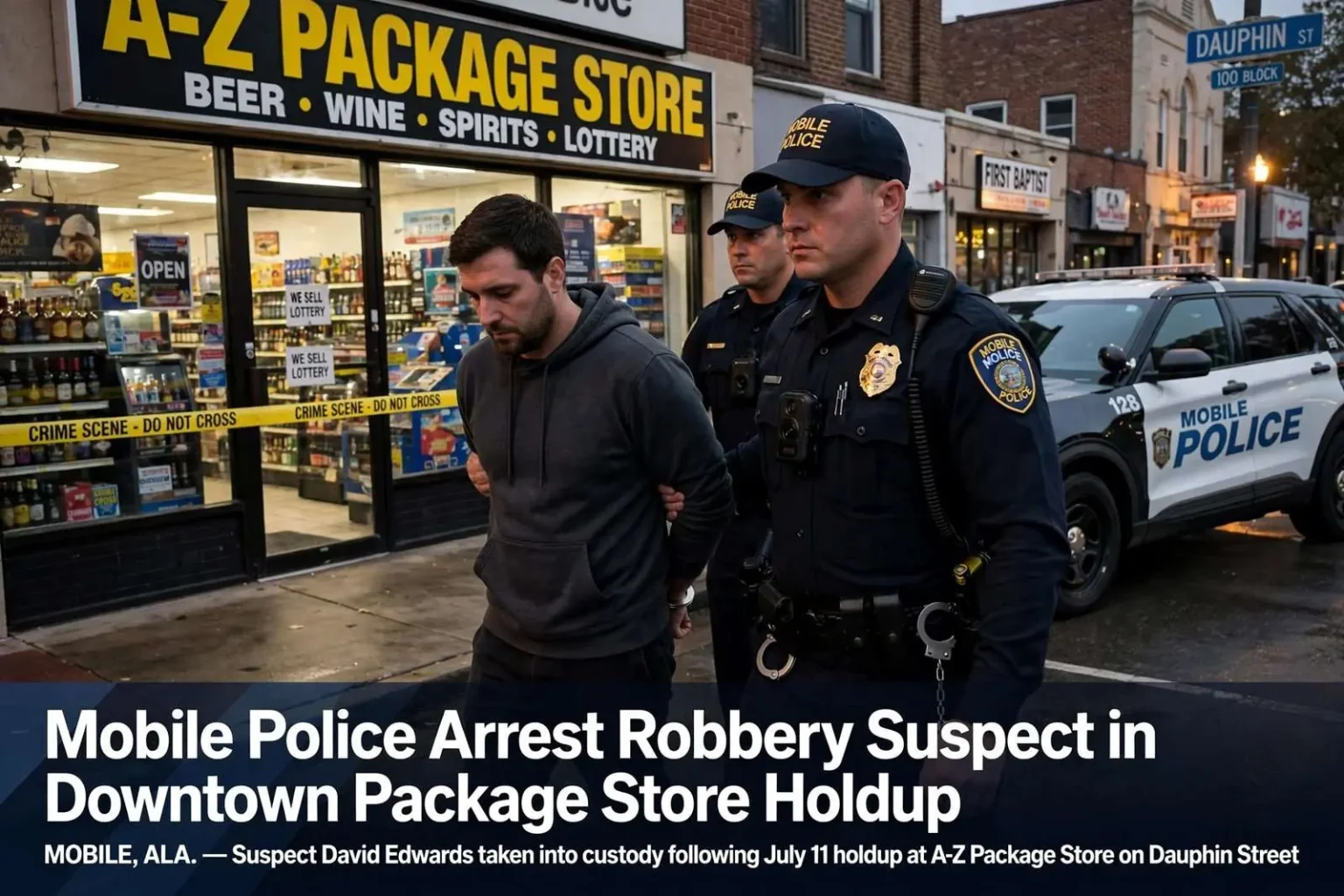
MOBILE, Ala. — A suspect in an armed robbery at a downtown Mobile business is now in custody. Investigators with the Mobile Police Department say David Edwards was arrested and charged in connection with a July 11 holdup at the A-Z Package Store on Dauphin Street, closing one thread of a case that began with two masked men and ended with a detective’s work in the weeks that followed.
According to investigators, two armed men entered the business, demanded money from those inside, and then fled on foot. A victim described the men walking into the store and making the demand before running off with an undisclosed amount. The robbery took place in the middle of the evening in a stretch of Dauphin Street that sits at the western edge of downtown, where package stores, small businesses and churches line the corridor between the central business district and the neighborhoods to the west.
Armed holdups of small retail businesses are among the most dangerous crimes police investigate, both for the people behind the counter and for the neighborhoods around them. A robbery of that kind unfolds in seconds, leaves witnesses with a snapshot of faces and movements, and turns on whether detectives can connect what the witnesses saw to a name.
The charges Edwards faces
Edwards has been charged with first-degree robbery, a felony under Alabama law that carries a potential sentence of up to life in prison when a deadly weapon or the threat of one is involved. The first-degree designation is reserved for the most serious robbery circumstances — the use or threatened use of a dangerous weapon, or serious physical injury to a victim — and it separates a street robbery from the felony-murder-adjacent terrain of armed holdups that turn deadly.
Robbery in the first degree is a Class A felony in Alabama, the same class as murder and first-degree assault, and the sentencing range reflects that. A person convicted of the charge faces a potential life sentence, and in practice the exposure shapes how these cases are prosecuted and defended from the earliest court appearance onward.
Records indicate Edwards has prior arrests on charges including theft, marijuana possession, and disorderly conduct. Prior arrests are not convictions, and they will not decide the robbery case, but prosecutors and judges routinely consider a defendant’s record at bond hearings and sentencing, and a history of theft-related charges becomes part of the story a court weighs.
The second suspect question
The investigation remains active, and police have not said whether a second suspect connected to the robbery has been identified. The original account described two armed men entering the store, which means at least one person described by investigators has not been charged. Detectives have released no description of that individual publicly and have not said whether they have a name.
That gap is common in robbery cases built on witness accounts. Victims and witnesses see the men for seconds, often under stress and poor lighting, and physical descriptions may be vague or incomplete. Detectives compensate with surveillance video from the store and surrounding buildings, canvassing of the neighborhood, and the slow process of running what they collect through informants, databases and follow-up interviews.
The arrest of one suspect weeks after the July 11 robbery suggests that process produced results. Robbery warrants in Mobile typically follow rather than precede an investigation, because prosecutors want a case solid enough to survive a bond hearing and an eventual trial when the evidence rests heavily on eyewitness testimony.
The store, the street and the victims
The A-Z Package Store sat on a stretch of Dauphin Street that has seen its share of armed robberies over the years, part of a commercial corridor where small businesses operate with limited staff late into the evening. Package stores are frequent targets for armed robbery across Alabama — they handle cash, they stock high-value inventory, and they are often staffed by one or two people at a time.
The people inside during the holdup experienced the crime at its most intimate: men walking through the door, a demand for money, and a weapon making the demand credible. No injuries were reported in the robbery, but the aftermath of an armed holdup — for the clerk who faced the weapon and the customers who happened to be inside — tends to outlast the incident itself. Witness victims of armed robbery commonly describe the weeks afterward as the harder part: the interviews, the lineups, the court dates, and the lingering caution about every stranger who walks through the door.
The amount taken was not disclosed, which is typical in pending cases. Investigators withhold details that only the robbers would know, both to protect the integrity of witness identification and to keep the facts that could confirm or exclude a suspect out of public circulation while the case is being built.
How a robbery case moves through court
Edwards’ case will begin in Mobile County District Court, where first-degree robbery cases are held for preliminary hearing and bound over to a grand jury if the evidence supports indictment. Given the Class A felony charge, the case would eventually be resolved in Mobile County Circuit Court, either by plea or by trial.
Bond is typically set at the first appearance, and for first-degree robbery it is usually substantial — a recognition of both the seriousness of the charge and the sentencing exposure that comes with a conviction. Conditions of release in armed robbery cases commonly include no contact with victims and no presence at the business where the crime occurred.
Where the case stands
Police have asked anyone with information about the case to contact the Mobile Police Department or CrimeStoppers. The CrimeStoppers program in Mobile allows tipsters to submit information anonymously and, in cases that lead to arrests, offers rewards — a mechanism detectives rely on heavily in robbery cases, where the difference between an unidentified suspect and a charged one is often a single call from someone who recognizes a face or a detail.
For the business and its customers, the arrest answers the first question after any armed robbery: whether anyone will be held accountable. The second question — whether the second man described by witnesses will be identified — remains open, and investigators say their work on the July 11 holdup at the A-Z Package Store continues.
Downtown robbery patterns
Robberies of downtown businesses tend to follow patterns detectives know well: quick entry, a demand backed by a weapon, a short time on scene, and an escape on foot into nearby streets or a waiting vehicle. The speed of the crime is the point — it minimizes the chance of resistance and leaves little for responding officers to intercept — but it also produces the evidence trail that later convicts: camera footage from the store and neighboring buildings, descriptions from witnesses, and sometimes property that can be traced.
Mobile police investigate robberies of businesses across the city through a dedicated robbery detail, and detectives assigned to those cases work backward from the scene: securing video before it is overwritten, re-interviewing witnesses while memories are fresh, and connecting the holdup to similar cases in the area. When a robbery fits a pattern — same method, same time of day, same corridor — linking the cases can put more evidence behind each individual charge.
What first-degree robbery means in Alabama
Alabama’s robbery statute sorts offenses into three degrees, and the first-degree tier carries the state’s most serious non-homicide exposure short of a handful of crimes. A first-degree robbery involves force or the threat of force plus either a deadly weapon, serious injury to the victim, or the theft of a vehicle. It is the weapon that typically puts a holdup in the first-degree category, and it is why the charge carries a possible life sentence rather than the shorter ranges that apply to strong-arm robberies.
The classification also affects every stage of the case. Class A felonies are handled in circuit court rather than district court, bail is set higher, and a conviction cannot be treated as a minor entry on a record. For a defendant like Edwards, with prior arrests already on file, the charge’s weight is compounded at bond hearings and in any eventual sentencing recommendation.
The role of the public
Police emphasized that the investigation is ongoing, and the public’s role in cases like this one is straightforward: anyone who saw the two men on July 11, was in the store or near it that evening, or has information about the second suspect can contact the Mobile Police Department or leave an anonymous tip with CrimeStoppers.
Anonymous tips have resolved countless robbery investigations in Mobile over the years, and the program’s structure — no names taken, rewards paid through a code system — is designed for exactly the kind of case where a witness may know the suspect personally and be reluctant to be seen cooperating with police.
The arrest of David Edwards on a first-degree robbery charge marks the first public accounting for the July 11 holdup at the A-Z Package Store. Whether a second arrest follows will depend on the same combination that produced the first: witnesses willing to talk, video that survived, and detectives who kept working the case after the initial leads ran out.
