Gulf Shores Turns a Fourth of July Mess Into a Beach Recycling Success Story
After a councilman called the shoreline's post-holiday condition atrocious, a Gulf Shores beach recycling pilot pulled 3,000 pounds of aluminum from the sand in roughly three weeks.
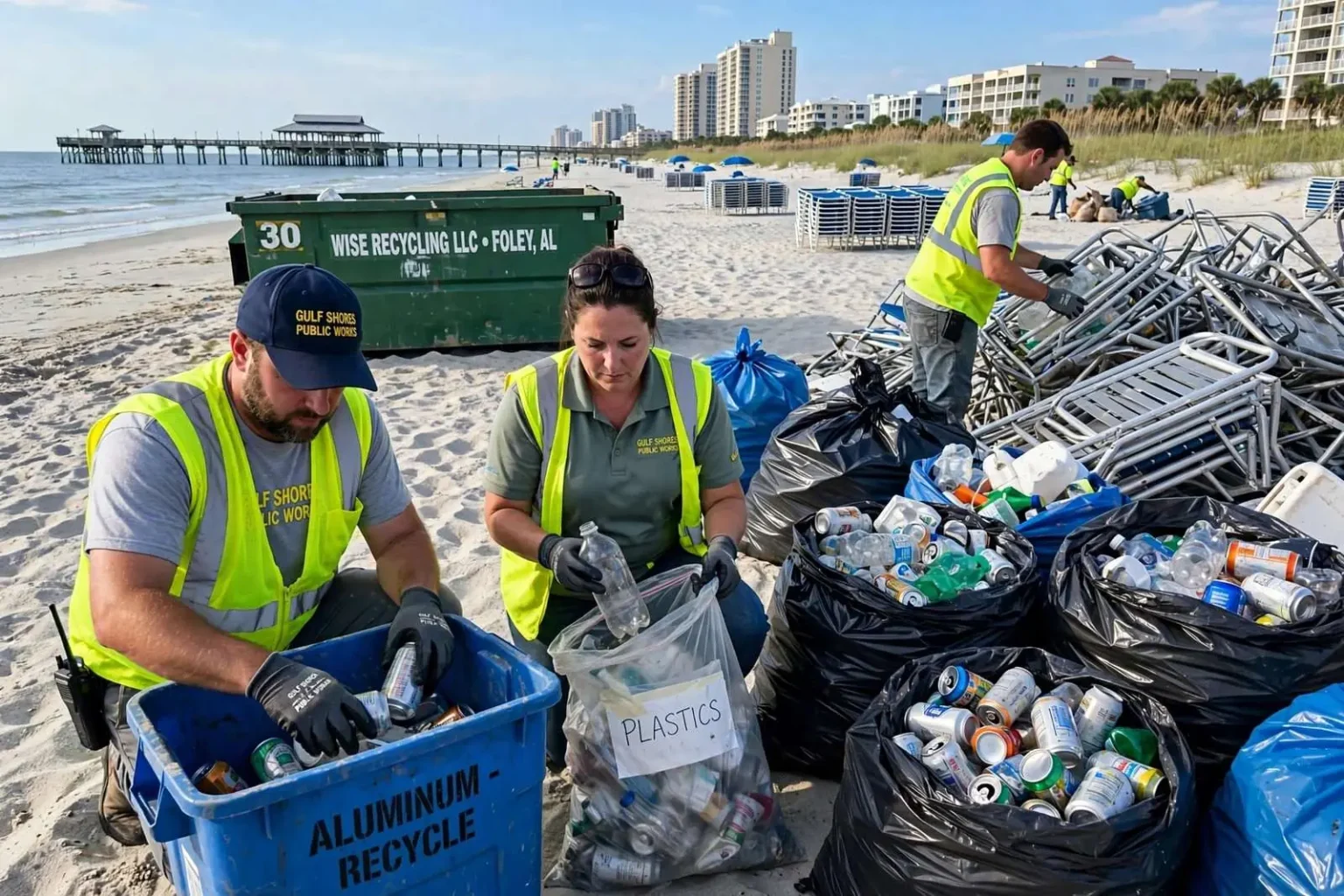
What began as frustration over an “atrocious” stretch of sand after the Fourth of July holiday turned, over the course of a single summer month, into one of the more encouraging experiments the city of Gulf Shores had undertaken along its coastline. City leaders reported that a new trash-sorting and recycling pilot run by the Public Works Department was already producing results that surprised even the people who designed it.
The pilot grew out of an entirely ordinary problem: Gulf Shores’ beach is one of the most visited stretches of sand on the Alabama coast, and the Fourth of July week is its busiest stretch of the year. What visitors leave behind — cans, bottles, broken chairs, abandoned umbrellas — had been treated as garbage for as long as the city had collected it. The experiment tested a different idea: that most of what tourists discard on the sand is not trash at all, but material with a market value that simply needed someone to sort it.
A Shoreline Under Pressure
Councilman Jason Dyken had voiced concern about the condition of the beach following the busy holiday, and the numbers behind that frustration were not hard to understand. The city maintained two trash cans every 100 feet along its public beach, one for regular garbage and one for aluminum, yet most beachgoers did not recycle. Compounding the challenge, the majority of the city’s coastline was lined not with public access but with private condominiums and homes, leaving crews to contend with an almost endless stream of discarded material.
Gulf Shores sits on a narrow barrier island where the public beach clusters around the foot of State Highway 59, while the sand east and west of it is privately developed wall to wall with high-rise condominium towers and beach houses. That geography shapes the city’s cleanup problem in two ways: the public beach generates the densest volume of waste per foot, while the private stretches generate a dispersed stream of discards that crews must sweep without convenient access points. Either way, whatever blows, drifts or is carried off private sand ends up in the same public collection system.
To confront the problem, the Public Works Department launched a pilot program the previous month built around more frequent pickups across a much larger footprint. The expanded coverage stretched from about the Gulf State Park pier westward roughly two and a half miles to West 11th Street, the point where high-density condos give way to the beach houses of West Beach.
That footprint covered the heart of the city’s tourist beach — the pier area, the boardwalk access points and the dense condo corridor — before tapering off where the development pattern changes. Extending frequent pickups over two and a half miles of sand required more labor hours than the old schedule, and it was the willingness to spend those hours daily that set the pilot apart from routine trash service.
How the Crews Made It Work
Assistant Public Works Director Noel Hand explained that the city partnered with beach service company employees who already gathered trash from around their rental chairs and umbrellas. City crews then collected that additional material and hauled it to a sorting site about a block from the beach, where every bag was picked through by hand.
The partnership exploited an asset the city already had: the beach service crews that set out and retrieve rental chairs and umbrellas for visitors every day had long been gathering litter as a side task, without anywhere better to put it than the regular cans. By routing their collection into the recycling stream instead, the city multiplied its pickup capacity without hiring a single additional worker. The hand-sorting operation — labor-intensive by design — turned mixed beach waste into clean, saleable streams: aluminum separated from plastic, metal furniture separated from both.
The early returns impressed the council. During a Monday work session, Councilman Steve Jones praised the department, noting that on peak beach days crews were collecting roughly 100 bags of material daily and finding that about 70 percent of it was recyclable. In just over a three-week span, Hand reported, the city had recovered approximately 3,000 pounds of aluminum cans alone.
“The way the department heads and employees came up with a way to improvise and make this work on short notice is nothing short of remarkable,” Jones said. “I’m very impressed with what I saw.”
The aluminum figure deserves its own arithmetic. Three thousand pounds of cans in three weeks works out to roughly 140 pounds a day recovered from the sand — the equivalent of more than 30,000 individual aluminum cans pulled out of the waste stream in a single month, material that would otherwise have been buried at the county landfill. Multiply that across a full summer season and the scale becomes obvious even before any expansion.
More Than Cans and Bottles
The program reached beyond the obvious. In addition to aluminum cans and plastic bottles, crews recycled tent frames and metal chairs that vacationers frequently abandoned on the sand once their trips ended. Hand said the sorting effort had substantially reduced the volume of trash being trucked to the landfill.
Canopy tents and folding chairs are a peculiar hazard of the modern Gulf Coast beach: cheap, bulky and difficult to dispose of, they are left standing on the sand at checkout or abandoned when their owners decide they are not worth hauling home. Cities across the coast spend significant money removing them, because abandoned gear becomes airborne debris in storms and a hazard to nesting shorebirds and sea turtles. Recovering their metal frames for recycling — rather than trucking them whole to the landfill — converts a disposal problem into a small revenue stream.
“It’s mind boggling what we’re achieving and seeing down there,” Hand told the council. “I think this is an eye-opener of what we have going on and we like what we see.”
The financial picture reinforced the enthusiasm. Public Works Director Mark Acreman noted that the city earned $640 for every ton of aluminum it recycled, and he framed the entire effort as a matter of scale.
Wise Recycling LLC of Foley was impressed enough by the sorted volume that it provided the city a 30-yard container at no cost.
The arrangement captured the logic of commodity recycling markets. Buyers such as Wise pay only for material that is clean, sorted and delivered in quantity — and they extend better terms, equipment and prices to suppliers who produce steady volume. A city that once sent commingled beach trash to the landfill had become, in the span of a month, a supplier whose sorted aluminum earned free equipment and premium pricing.
Crews were collecting roughly 100 bags of material on busy days, with about 70 percent proving recyclable.
Nearly 3,000 pounds of aluminum were recovered in a little over three weeks.
“It’s all about volume,” Acreman said. “The larger volume we have the more cooperation we’ll get from Wise and like companies. What Noel has done is the tip of the iceberg and if we expand this it’s going to open up other opportunities because of the volume.”
Acreman’s “tip of the iceberg” framing pointed to the plastics, cardboard and other materials the pilot had not yet targeted. A resort city generates commercial recyclables as well as beach waste — from restaurants, condos and event venues — and a sorting operation proven on the beach could, in principle, be extended to that stream. Every added ton strengthens the bargaining position with buyers and improves the economics of the next step.
What Came Next
Jones cautioned that a larger version of the program would require a separate, off-the-beach sorting facility. City Administrator Steve Griffin said the council would have the chance to weigh an expansion during upcoming budget discussions, pricing out both the potential revenue and the expenditures as part of the 2015 planning effort.
The caution acknowledged the pilot’s central constraint: hand-sorting a hundred bags a day works on a trial basis in a borrowed space a block from the sand, but a permanent operation would need a dedicated building, equipment and staff — real money that would have to be weighed against the commodity revenue it produced. The 2015 budget cycle gave the council a natural vehicle for that decision, since capital items and new positions are priced and debated together before the fiscal year begins.
“What Noel and the different departments have put together is something that we can price out and determine what the revenue potential might be as well as the expenditures,” Griffin said. “I really like this idea.”
Gulf Shores’ interest in the program also reflected the city’s broader position along the Alabama coast. As a destination whose economy depends on visitors finding a clean, attractive beach, Gulf Shores has consistently invested in shoreline management — from renourishment projects that rebuild sand lost to storms, to strict post-storm cleanup, to the public safety presence that patrolled the crowded Fourth of July week that started the whole discussion. A recycling program that keeps the sand cleaner while cutting landfill costs and generating a modest return fits squarely into that tradition.
The pilot also carried a quieter lesson about municipal operations. The city had not commissioned a study or hired a consultant; a department head improvised a partnership with the beach service industry, borrowed a plot of land, and proved the concept with existing employees in under a month. Council members praised exactly that quality — the ability of a small city’s public works operation to test an idea cheaply before committing to it in the budget.
Whether the sorting operation moved from pilot to permanent would depend on the numbers the administration assembled: what an expanded program would cost in equipment and personnel, what the aluminum, plastic and scrap metal streams would realistically return, and how much landfill tipping fee the city could avoid. But the direction was clear from the work session’s tone. What had begun in July as a complaint about an “atrocious” holiday mess ended, in August, with a council talking about volume contracts, sorting facilities and revenue — and a beach that was measurably cleaner for the effort.