Fairhope Plans to Truck Thousands of Tons of Sand to Eroded Bayfront Beach
Fairhope moved ahead with plans to truck more than 5,000 tons of sand to a badly eroded stretch of bayfront beach near Magnolia Beach Park, hoping to finish before the Fourth of July.
A Bayfront in Need of Repair
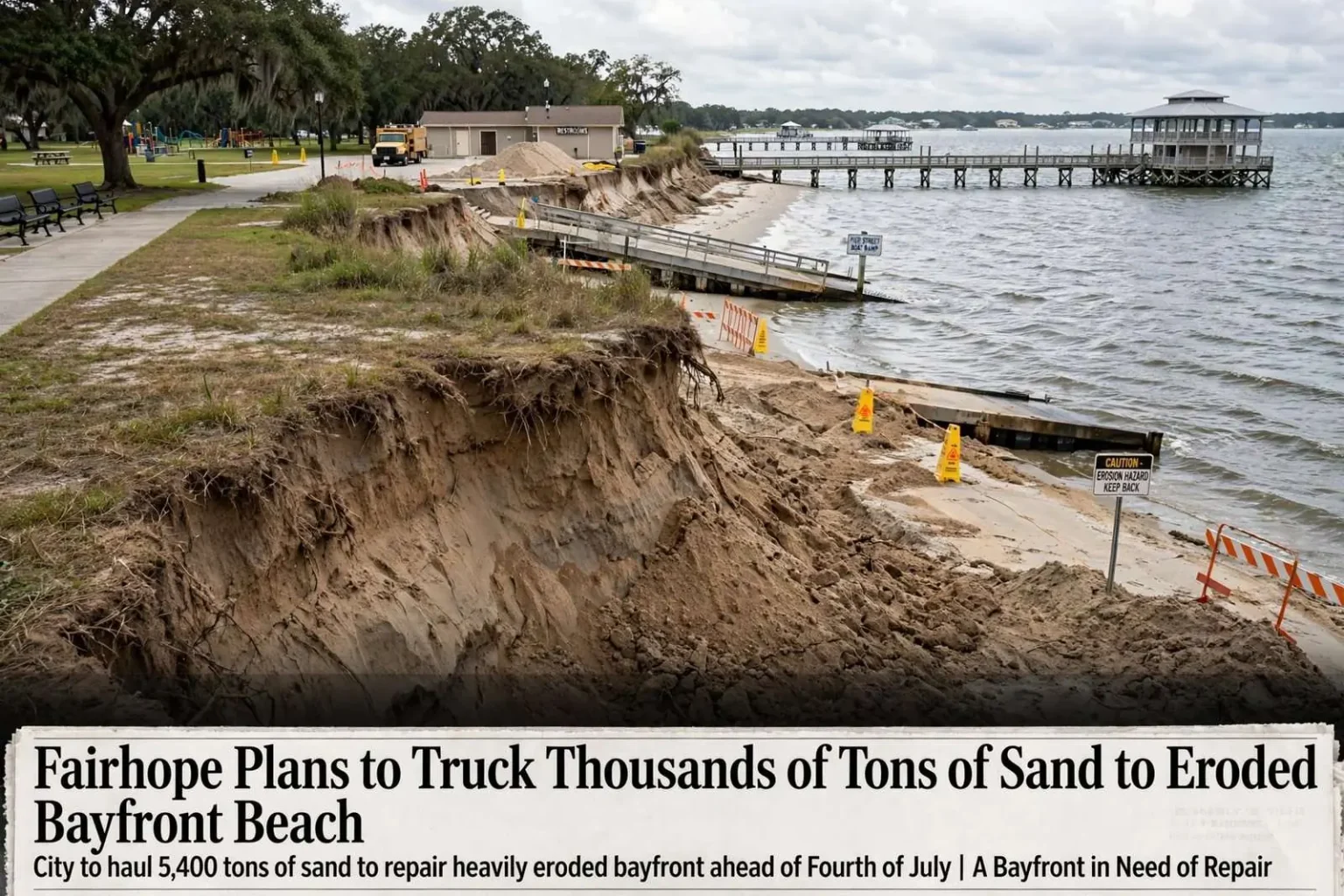
Fairhope moved ahead in June 2014 with plans to repair a heavily eroded section of its bayfront beach, preparing to truck more than 5,000 tons of sand to the shoreline between the Pier Street boat ramp and the Pecan Avenue pier. The stretch of beach, one of the most visited public spaces on the eastern shore of Mobile Bay, had worn down to the point that city officials were fielding safety complaints alongside the usual aesthetic ones.
In mid-April, the city had hired civil engineer Scott Douglass of Fairhope-based South Coast Engineers LLC to investigate the extensive erosion near Magnolia Beach Park and recommend solutions. Douglass, a coastal engineer with long experience studying the beaches of the Alabama Gulf Coast and Mobile Bay, was tasked with diagnosing why the shoreline had slipped so far and what a realistic fix would look like for a bay beach that faces very different forces than the Gulf-front strands down the coast.
The Plan
Public Works Director Jennifer Fidler said it had been determined that sand would need to be trucked to the beach, with renourishment likely necessary every two to three years. Unlike a Gulf beach, the eastern shore of Mobile Bay takes its punishment from wind-driven chop, boat wakes and storm runoff rather than ocean surf, and the sand placed on the shoreline was expected to gradually migrate and thin out over a cycle of a few years.
“The plan that we have includes buying sand and delivering sand between Pier Street boat ramp and the Pecan Avenue pier,” Fidler told the City Council on Monday night. “And we’re looking at over 200 loads of sand.”
Each load, she said, would carry roughly 20 cubic yards. At 200 to 250 trips, that amounted to as much as 4,000 to 5,000 cubic yards, or about 5,400 tons of sand. The math mattered for residents along the route, since a convoy of that size means a steady parade of dump trucks through downtown streets for the length of the project — a fact of renourishment work that beach towns up and down the coast know well.
The city planned to receive bids that Friday on the cost of purchasing and hauling the material, with hopes of bringing a low bid to the council for approval at its June 23 meeting. Purchasing the sand and moving it were bid together so the city could compare total delivered cost rather than juggling separate suppliers and haulers on a compressed schedule.
Racing the Calendar
Time was a factor. “The mayor would like to have it done before the Fourth of July,” Fidler said. “So if we do that, we really have to move.”
The deadline was not arbitrary. The Fourth of July holiday is one of the busiest stretches of the year for the Fairhope bayfront, when the municipal pier, the parks and the beach draw large crowds for fireworks and family outings along Mobile Bay. A shoreline too eroded to use comfortably would be most conspicuous precisely when the most people were there to see it.
Mayor Tim Kant said he had been told the project could cost about $100,000 but was one that had to be done. Residents had been raising safety concerns for months. “We knew we had to do something,” Kant said. “It got to where it’s not safe. A child might fall off the top of the hill.”
The safety worry at the heart of the complaint was the drop-off itself. As sand washed away, the beach had steepened into an exposed scarp — a small cliff of loose material between the flat park ground above and the water below. For children running between the playground and the shoreline, the edge posed exactly the kind of hazard the mayor described, and city staff had been monitoring it through the spring.
The beach had last been replenished nearly a decade earlier, according to Fidler. In the years since, the shoreline had absorbed numerous storms and the daily wear of being one of the most-visited public spaces in Baldwin County, with no major infusions of sand in the interim. The long gap between renourishment projects was one reason the erosion had progressed far enough to demand an emergency-style response rather than routine maintenance.
Building Dunes
Once the work was approved, the contractor would dump sand behind the Pier Street boat launch restrooms, and city crews would fill in the eroded areas to create a terraced, dune-like landscape. Shaping the sand into terraces rather than simply pushing it flat serves a practical purpose: stepped dunes slow the wind that scours a bay beach and give the shoreline a more natural profile for visitors to walk down.
“There will be two different terraces,” Fidler said, explaining that the stepped design would help the new sand hold its shape against wind and weather once crews finished the grading work.
Why Bay Beaches Erode
The erosion along Fairhope’s shoreline is a familiar story for communities on Mobile Bay. The bay’s eastern shore takes the brunt of southeast winds, which push water and chop across the open water and onto the beaches near the city’s downtown. Storm systems — from summer squalls to winter fronts and the occasional tropical system — can strip feet of sand from the shoreline in a single event, and the narrow beaches never fully recover on their own because there is no natural supply of new sand washing in from upstream.
That is why engineers who work on bay beaches talk about renourishment as a cycle rather than a cure. Sand placed on the shoreline is expected to last a few years before thinning again, which is precisely what the two-to-three-year maintenance window described to the council anticipated. Communities along the bay, from Daphne to Fairhope to the shorelines further south, have wrestled with the same trade-off between the cost of periodic renourishment and the value of having a usable public beach.
In Fairhope’s case, the value is hard to overstate. The beach below the bluff is inseparable from the city’s identity — the municipal pier jutting into the bay, the rose garden and parks on the bluff above, and the visitors who come from across the region to watch the sunset over Mobile Bay. The downtown merchants who depend on pier traffic have long treated the beach as infrastructure as real as any road.
What Happens Next
With bids set to be opened at the end of the week and council approval targeted for June 23, the city was aiming to have trucks rolling and sand on the beach within weeks. The work itself, once started, moves quickly by the standards of coastal projects: no dredges or pipelines are needed, just a supply of compatible sand, a line of dump trucks and city crews with graders to shape what arrives.
Residents can expect the stretch between the Pier Street boat ramp and the Pecan Avenue pier to look substantially different by the height of summer — a wider, gentler shoreline stepped down to the water in two terraces instead of dropping away in an eroded bank. Keeping it that way will be an ongoing job, with the city now planning for sand to return every two to three years rather than waiting nearly a decade between infusions as it did the last time.
For a city that has built much of its appeal on the bond between its bluff-top parks and the bay below, the project was framed less as an upgrade than as basic upkeep — the price of keeping a beloved public beach safe, walkable and ready for the July crowds that arrive every year.
The People Behind the Numbers
Projects of this size live or die on the details, and Fairhope’s staff had clearly done the arithmetic. Two hundred or more dump truck loads, each carrying about 20 cubic yards, add up fast — roughly 4,000 to 5,000 cubic yards of sand in all, or about 5,400 tons pressed into the shoreline between the two piers. Public Works crews were already being penciled in to shape and grade the material as it arrived, converting what a contractor dumps behind the boat launch restrooms into the finished terraces residents will actually see.
Engineer Scott Douglass’ recommendations gave the city the confidence to move quickly. A beach built to a considered design, with the right sand grain and the right profile for the wave climate on Mobile Bay, holds up far longer than a pile of material pushed against an eroded bank. That distinction is what separated this project from a stopgap, and it is the reason the city could tell residents with a straight face that the sand would still be there through more than one summer.