Lillian Neighbors Sue to Block Fire Station Planned for Their Street
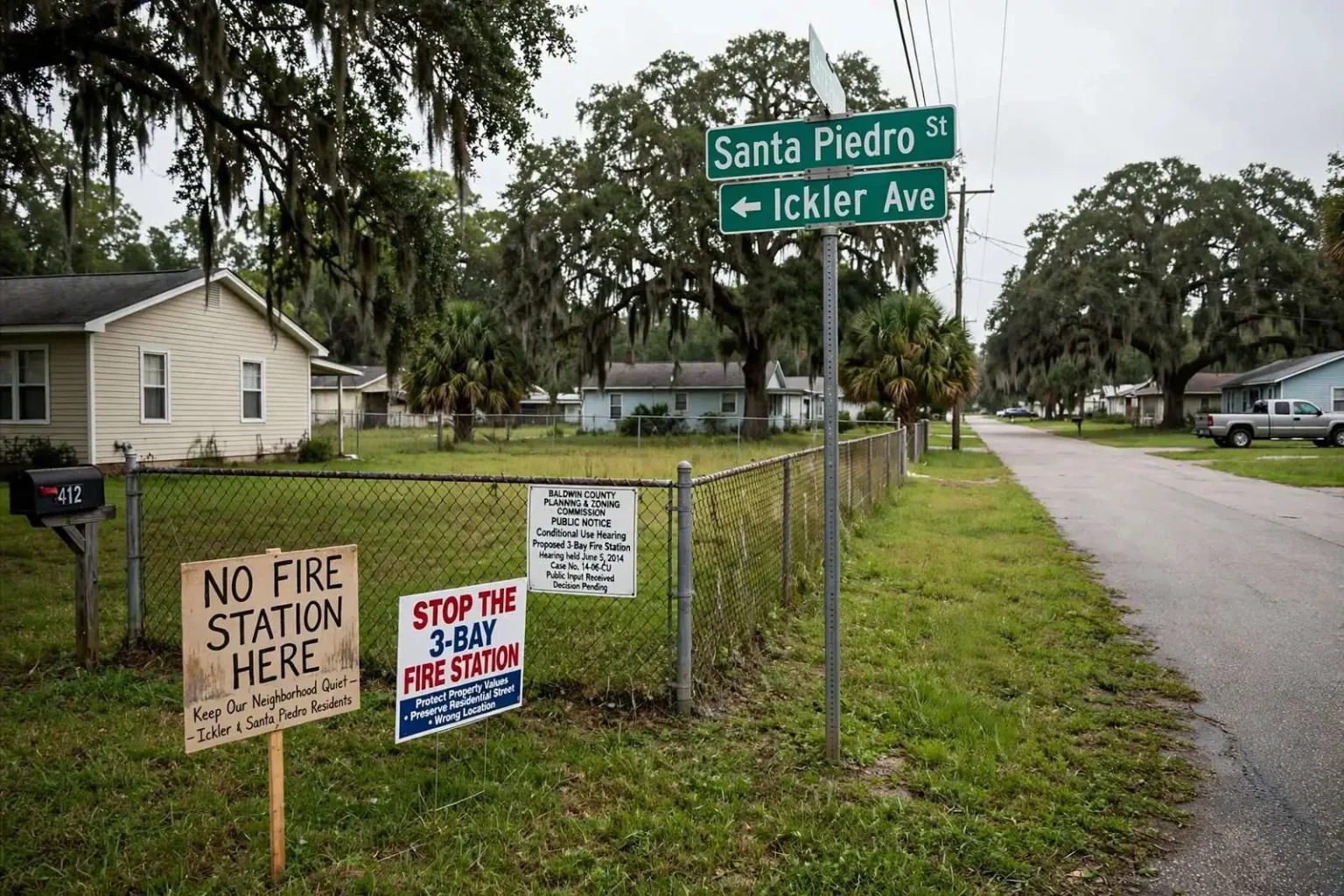
Five neighbors sued Baldwin County to stop a Lillian fire station planned at the corner of Santa Piedro Street and Ickler Avenue, citing noise and concerns about falling property values.
A group of Lillian residents went to court in June 2014 to block the local volunteer fire department from building a new station on their residential street, arguing that the project would disturb the neighborhood and lower property values. The fight pitted a small, close-knit community in southeast Baldwin County against an institution most residents support in principle — a reminder that even broadly popular public services can provoke sharp disputes when their physical footprint lands on a particular street.
Gene Howe and four neighbors — two on Ickler Avenue and two on Santa Piedro Street — opposed the Lillian Volunteer Fire Department’s plan to build a three-bay station on 1.4 acres at the corner of Santa Piedro and Ickler. The corner sits in the heart of Lillian’s residential area, where the streets around it are lined with the kind of modest homes that draw retirees and families to the far southern reaches of the county, many of them drawn by the quiet of a community that sits near Perdido Bay and the Florida line.
For the neighbors, the objection was not to the idea of a fire station but to the specifics of this one, on this corner, in the middle of their street. A three-bay station means garage doors opening for emergency runs at all hours, trucks rolling past front porches, and the lights and noise that accompany a volunteer department whose members respond from home whenever a call comes in. Those realities, they argued, belong in a commercial corridor or on a larger tract — not at a residential crossroads.
Why the department wants to move
The department already operated a station at 34180 Widell Ave., about three-tenths of a mile from the disputed corner, but fire officials said the two-bay Widell Avenue building was no longer large enough for its needs. Volunteer departments in Baldwin County have spent years trying to keep pace with the county’s rapid growth, and Lillian is no exception: as new homes spread across the area, call volumes rise, equipment multiplies, and buildings that served a smaller community decades ago run out of room. A third bay means space for another apparatus, and space for more apparatus means faster, better-protected coverage for a growing service area.
Howe stressed that his objection was not with the firefighters themselves. “I don’t have any animosity toward them,” said Howe, who had lived on Ickler Avenue for four years. “I appreciate what they do. I just don’t think they have given us the consideration that they should when deciding where to locate.”
His words captured the awkward position the dispute created. In communities like Lillian, the volunteer fire department is a civic anchor — the organization residents call in an emergency and the one whose fundraisers they attend. The neighbors taking the department to court were, in many cases, the same people who had supported it for years. What they wanted, they said, was a seat at the table before the sirens moved in next door.
The lawsuit
The five neighbors filed suit in Baldwin County Circuit Court against the Baldwin County Planning and Zoning Commission, which had approved a conditional use request for the station on June 5 over the neighbors’ objections. The property is zoned for residential use, which is precisely why the department needed the conditional use in the first place — a mechanism Alabama counties use to allow land uses that do not fit a zoning category outright but may be acceptable case by case, subject to conditions and public hearings.
The lawsuit alleged the county had not done everything it should have before approving the request. Conditional use approvals carry an obligation to weigh the effect of a proposed use on the surrounding area, and the neighbors argued that obligation was not met when it came to their street. Rather than attacking the fire department directly, the suit targeted the county’s process — the way the decision had been reached, and the questions the residents believed had gone unanswered.
The residents asked a judge to stay the decision until the county could determine whether the station would unduly decrease neighboring property values and whether it would be compatible with the surrounding area. A stay would freeze the approval while the court considered the case, preventing the department from moving forward with construction and keeping the zoning question open until the compatibility issues had been formally examined.
David Conner, the county’s attorney, defended the process. “I think the Planning Commission was well within its power and authority to make the decision that it made based on the evidence that was presented,” he said.
Conner’s defense reflected the standard courts apply in zoning disputes. Alabama courts generally extend substantial deference to local planning bodies, which are presumed to act within their discretion when evidence supporting a decision has been presented at a public hearing. Overturning such a decision requires showing more than disagreement — a challenger must show the body acted arbitrarily, capriciously or without the authority it claimed, a high bar that makes most zoning lawsuits an uphill climb.
The property-value question
Before the June 5 meeting, the county’s chief appraiser, Walt Lindsay, had been asked whether a nearby fire station would affect neighboring property values — the question at the center of the neighbors’ fears and of their lawsuit. Property values are both an economic and a legal concern in zoning cases: a use that demonstrably depresses surrounding home values is one measure of incompatibility, and residents who watch the county’s appraisals closely know that even a perception of decline can affect what a house will bring when it goes on the market.
For the residents of Ickler Avenue and Santa Piedro Street, the concern was compounded by the character of their neighborhood. Homes near the disputed corner are the largest asset most families own, and a street that becomes known for sirens and floodlights can lose some of the quiet that made it attractive in the first place. Whether a fire station actually produces such an effect is a matter of debate in planning circles — some studies suggest well-integrated stations have little measurable impact, while neighbors in disputed cases often see the risk as obvious — but the residents’ point was that the county had never properly resolved it before voting.
Fire protection and growth in Baldwin County
The dispute unfolded against the backdrop of a county that has grown faster than almost any other in Alabama. Baldwin’s population boom has pushed development south and east toward communities like Lillian, Elberta, Robertsdale and Foley, straining the volunteer fire departments that provide first-line protection across the county’s unincorporated areas. Unlike city departments, volunteer companies depend on a rotating roster of residents who leave their homes when the tones sound, and their stations double as gathering places as often as garages.
Insurance considerations add another layer. Fire protection grades, which help set homeowners’ insurance rates, depend partly on the distance between stations and the properties they protect, and departments argue that modern, well-placed stations hold those grades down. In fast-growing rural-suburban areas, the trade-off is real: better coverage requires new stations, and new stations must go somewhere — increasingly, near the new neighborhoods they were built to serve.
That tension is what made the Lillian case worth watching beyond one corner in one community. Across Baldwin County, and across south Alabama generally, growing volunteer departments periodically face the same question the Lillian residents posed: when a needed public facility and an established neighborhood collide, who decides where it lands, and how much weight does the neighborhood’s objection carry? The Planning Commission answered one way in June 2014; the neighbors asked a judge to answer another.
What comes next for the corner
With the lawsuit pending, construction plans for the three-bay station sat in limbo. A stay would leave the department’s Widell Avenue station in service as the primary station for the area — the two-bay building the department had outgrown, but the only one it had. For the firefighters, the delay meant continuing to make do with cramped quarters; for the neighbors, it meant the corner they fought to protect remained exactly as it was.
The case also served as a civics lesson of sorts for the community. Zoning decisions in Baldwin County are made in public hearings where any resident may speak, and the record of those hearings — who spoke, what evidence was presented, what questions were answered — becomes the foundation on which any court challenge stands. The Lillian neighbors’ suit turned on precisely that record, arguing that what the commission heard was not enough to justify what it approved.
Whatever the court decided, the episode made one thing plain: in a fast-growing county, the siting of even the most welcome public buildings is no longer routine. The fire department needed room to grow; the neighbors needed their street to stay a street. The corner of Santa Piedro and Ickler became the place where those two needs, both legitimate, had to be reconciled — first by a planning commission, then in circuit court.