The $85 Million Baldwin Beach Express Is Ready to Open, Linking I-10 to the Coast
The four-lane, $85 million Baldwin Beach Express was set to open with a ribbon cutting, connecting Interstate 10 to the Foley Beach Express and offering a new hurricane evacuation route.
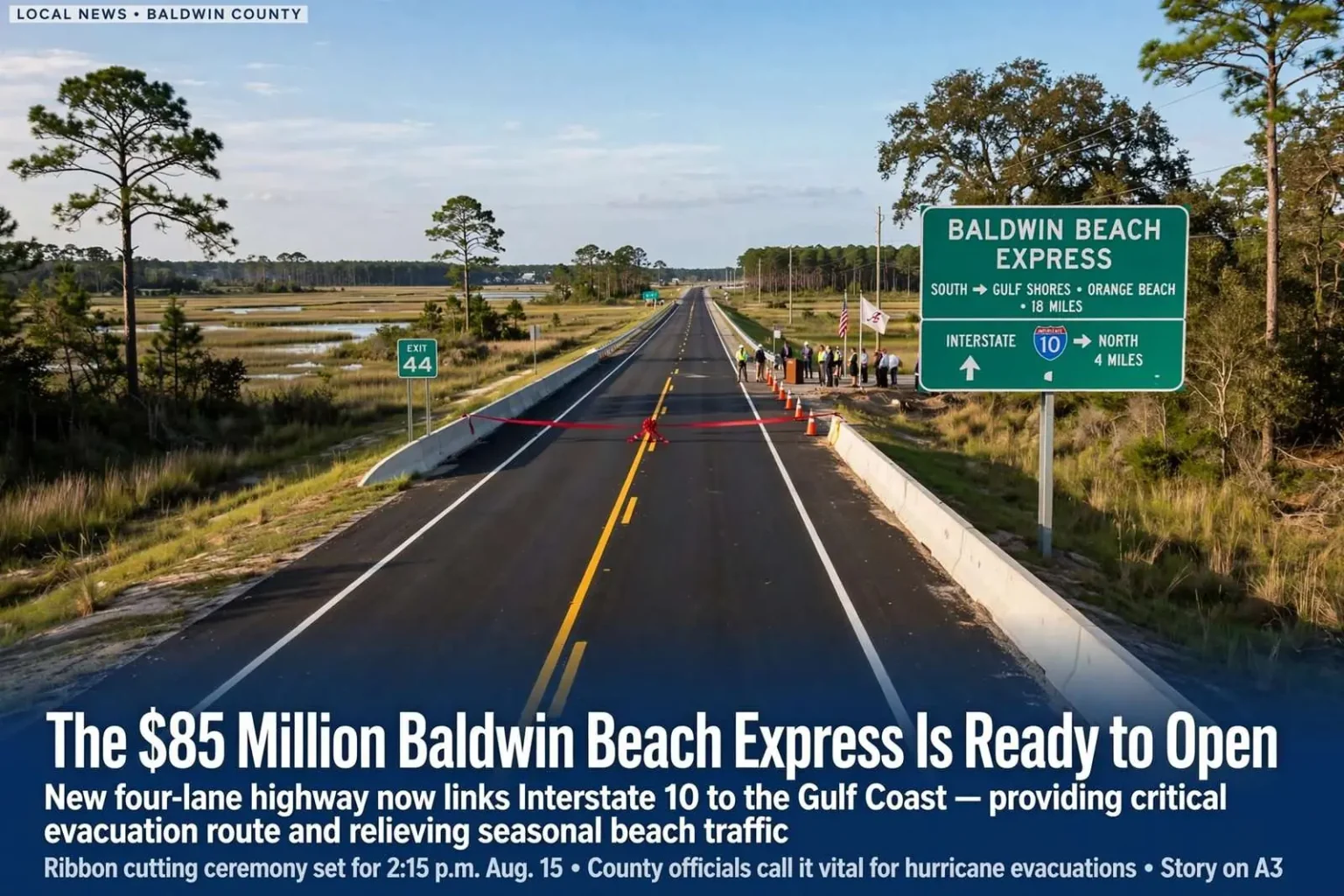
One of the largest road projects in Baldwin County’s recent history was ready to carry traffic. The four-lane, $85 million Baldwin Beach Express was set to open, giving drivers a new north-south connection between Interstate 10 and the beaches of the Gulf Coast — and giving the county a modern evacuation route it had long lacked on its fastest-growing corridor.
The project ranked among the most significant road investments the county had seen in years, both in cost and in reach. Baldwin County has been among Alabama’s fastest-growing counties for two decades, and its road network — much of it built for a far smaller population — has struggled under the seasonal weight of beach traffic funneling toward Gulf Shores and Orange Beach. The Beach Express was designed with that reality in mind: to move large volumes of vehicles efficiently between the interstate and the coast, at highway speed, without threading through towns along the way.
Construction crews had been visible along the route as far back as May 2013, and the opening marked the moment when years of earth-moving, bridge work and paving translated into an actual road. For commuters, beachgoers and freight haulers alike, the new highway offered something the old network could not: a direct, high-capacity line between two of the region’s most important corridors.
A ribbon cutting to mark the milestone
The Alabama Department of Transportation planned a ribbon cutting ceremony for 2:15 p.m. on Aug. 15, according to Cal Markert, the Baldwin County engineer. The event would formally open a highway that had been years in the making, with state and local officials gathered to mark the completion of a project that reshaped how traffic moves across the central part of the county.
The new road extends from Interstate 10 to the Foley Beach Express, tying together two major corridors and creating a more direct path for travelers heading toward the shore. The connection matters because the two roads serve complementary roles: I-10 carries cross-regional and interstate traffic across the top of the county, while the Foley Beach Express runs south toward the beach communities. Until the link opened, drivers moving between them depended on older two-lane and four-lane roads that pass through commercial areas, signal lights and school zones.
ALDOT’s role reflected the scale of the undertaking. Projects of this size involve right-of-way acquisition, utility relocation, drainage design and miles of new paving, all coordinated between state engineers and county officials. The ribbon cutting represented the end of that coordination — and the beginning of the road’s real test, which would come the first summer weekend when thousands of vehicles pointed themselves toward the Gulf.
More than a shortcut to the beach
For Markert, the significance of the project reached beyond convenience for vacationers, though that benefit was substantial in a county whose economy leans heavily on beach tourism. “It’s going be awesome,” Markert said of the road’s opening. “Over time it’s going to help get people to and from the beach. It will give us a hurricane evacuation route.”
That evacuation function carried particular weight along the Gulf Coast, where the threat of tropical storms and hurricanes is a seasonal reality. A modern, four-lane route capable of moving large volumes of traffic away from the coast represented an important addition to the region’s emergency planning, offering residents and visitors another way inland when conditions demanded a rapid departure. During an evacuation, every additional lane-mile counts: the region’s older routes — U.S. 98, Alabama 59, U.S. 31 — were never designed to carry the entire coastal population north at once, and congestion on those roads during hurricane warnings has long been a planning concern for emergency management officials in both Baldwin and Mobile counties.
The math of an evacuation is unforgiving. Baldwin County’s permanent population has swelled for decades, and on a summer weekend the beaches add tens of thousands of visitors to the count. When an evacuation order comes, all of those people move in the same direction at the same time. A four-lane, limited-access highway aimed squarely at the coast-to-interstate corridor gives emergency planners a pressure valve — a route that can carry beach-area traffic north without forcing it through the intersections of Foley, Robertsdale and Summerdale, where a single stalled vehicle can back up traffic for miles.
The road’s design also matters for everyday resilience. Wide shoulders, modern drainage and grade separated from local cross traffic mean the highway stays usable in the heavy rain that accompanies even minor tropical systems, when older roads across the county are prone to ponding and closure. In a region where the season runs from June through November, infrastructure that performs well in bad weather is not a luxury — it is part of the baseline.
A key piece of the region’s road network
The Baldwin Beach Express fit into a larger effort to improve mobility across a fast-growing county. By connecting Interstate 10 to the Foley Beach Express, the new highway knit together the interstate system and the existing beach-bound corridors, reducing pressure on other routes during the busiest travel periods. The relief was expected to reach beyond the new road itself: every vehicle that chooses the Beach Express is a vehicle not idling on Alabama 59 through Foley or on the surface streets of Robertsdale, which means shorter trips for residents who never touch the new highway at all.
Length and design: a four-lane highway running from Interstate 10 south to the Foley Beach Express, built to interstate-grade standards and intended to carry the county’s heaviest traffic loads for decades. The route crosses a corridor of wetlands, farmland and new development, and its interchanges were designed to connect with the local road network that has grown up along the I-10 corridor and south toward Foley.
For local officials, the project was also an argument about the county’s future. Baldwin’s growth has been fed by its accessibility — to the beaches, to Mobile across the bay, to the Pensacola job market to the east — and growth in turn feeds traffic. Roads like the Beach Express are how the county tries to stay ahead of that curve, adding capacity before congestion becomes the thing people mention first when describing the place.
What it means for drivers and residents
For the everyday driver, the Beach Express promised a simple benefit: time. A trip from I-10 to the beaches that once meant navigating signal lights and commercial strip development through central Baldwin could instead run at highway speed the whole way south. For residents of Foley, Elberta, Summerdale and the surrounding communities, the new alignment offered an alternative to the local roads that double as beach-traffic arteries — a way to get to the grocery store in July without sitting in a line of cars bound for the sand.
For the beach economy, the improved access cut both ways in the best sense. Easier travel makes a Gulf Shores or Orange Beach trip more attractive to families in Montgomery, Birmingham and beyond, and every hour trimmed from the drive is an hour spent at the beach instead of on the road. At the same time, the county’s tourism leaders have long understood that a coast that is easy to reach but hard to leave develops a reputation problem; a high-capacity route in and out helps with both ends of the trip.
Freight and commuting traffic stood to benefit as well. Baldwin County’s growth has made it an economic extension of the Mobile metro area, with thousands of residents crossing Mobile Bay daily and commercial traffic moving between the port city and the coastal communities. A direct four-lane connection between I-10 and the Foley Beach Express gives those movements a cleaner path, keeping heavy vehicles off streets never built for them.
A corridor years in the making
The road’s opening was the culmination of a planning and construction effort that residents had watched take shape for years, with crews and equipment visible along the route since at least May 2013. Projects of this scale move through years of study, design, right-of-way purchase and construction before the first car ever rolls, and the Beach Express was no exception. Its completion added Baldwin County to the short list of places on the Gulf Coast with a purpose-built evacuation and beach-access highway linking the interstate directly to the shore.
Transportation planners describe roads like this as spine routes — the few corridors that carry the heaviest loads and around which everything else organizes. With the Beach Express open, Baldwin County’s spine now runs from I-10 south to the coast in a straight, high-capacity line, complemented by the older federal and state highways that serve the towns along the way. The county engineer’s assessment captured the practical view: over time, the road would do exactly what it was built to do, moving people to and from the beach and moving them out of harm’s way when a storm demands it.
For the residents of one of Alabama’s fastest-growing counties, the opening of the $85 million Baldwin Beach Express was both a finish line and a starting point — the end of a long construction story, and the beginning of a new chapter in how the Gulf Coast handles the traffic, and the storms, that come with life beside the Gulf.