A Mobile Businessman’s Book Reopened a Long Fight Over a Family Trucking Company
Tommy Fulton scheduled a signing in Magnolia Springs for 'An Act of Congress,' his account of the succession battle that put his family's Finch Companies in court against a future congressman.
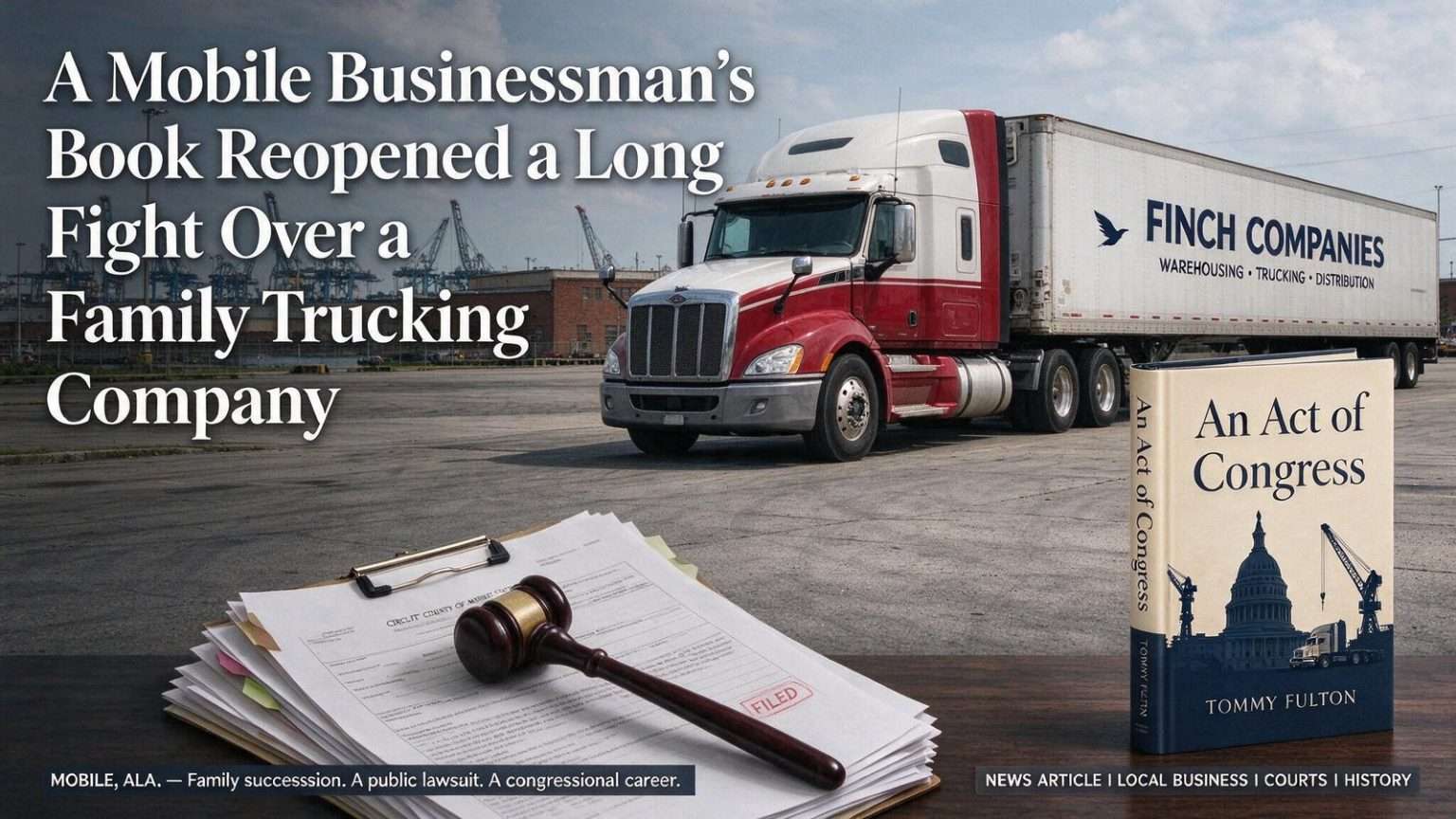
MAGNOLIA SPRINGS — Mobile businessman Tommy Fulton was set to sign copies of his book, An Act of Congress, on Saturday, Feb. 7, at Jesse’s Restaurant in Magnolia Springs from 11 a.m. to 2 p.m. — a genteel setting for a book about a fight that was anything but.
The book is Fulton’s account of what happened when a family business changed hands without a plan. He became the third-generation president of his family’s company and dealt firsthand with the difficulties inherent in passing a closely held business from one generation to the next.
The fight behind the book
The dispute at the center of the story was, for South Alabama, an unusually public one. The Fultons and former U.S. Rep. H.L. “Sonny” Callahan battled over ownership of Finch Companies, a warehousing and trucking concern, nearly two decades before the book appeared.
Callahan was the nephew of Fulton’s grandparents on his mother’s side, and had lived with the Finch family from about the age of 12. With the death in 1964 of Tom Finch, Fulton’s grandfather, Callahan assumed the presidency of Finch Companies. When Callahan was elected to Congress in the mid-1980s, Fulton took over as president of the firm.
Callahan filed suit in 1991 and took over the companies. The verdict in his favor, however, was overturned on appeal to the Alabama Supreme Court. The parties reached a settlement in 1994, and the Fultons returned to work at Finch Companies, Inc. on March 1, 1994.
The arc of that litigation — a family split, a jury verdict, a reversal on appeal and a negotiated peace — played out across years of court filings in Mobile, and it left both sides with a version of events they carried for decades. For Fulton, the decision to write the book came after enough time had passed that the story could be told from documents rather than from raw grievance.
A congressman and a courtroom
The Callahan name was, at the time, among the most prominent in South Alabama. He represented Alabama’s First Congressional District — Mobile, Baldwin and the surrounding counties — for nine terms, from 1985 until his retirement in 2003, rising to chair the House Appropriations subcommittee on foreign operations.
That a sitting congressman had spent years in litigation with his own extended family over a Mobile trucking company was the kind of story that circulated quietly in local business circles for years before anyone wrote it down. Fulton wrote it down. An Act of Congress, he says, is a recollection of true events supported by thousands of pages of court documents, letters, audio recordings and firsthand accounts from those involved.
The First District that Callahan served stretched across the same geography where the dispute played out — the port city of Mobile, the growing suburbs and resort towns of Baldwin County, and the small communities in between. Constituents who knew Callahan from appropriations fights in Washington largely had no window into the family conflict unfolding in the courthouse, and the book closes part of that gap.
Fulton’s signing stop in Magnolia Springs placed the story back in Baldwin County, where Jesse’s Restaurant has long been a gathering place for the coastal towns along Fish River. The venue underscored the book’s local audience: family-business owners, retirees who remembered the case, and readers drawn to a courtroom drama that unfolded in their own backyard.
A family company’s long history
Finch Companies’ roots ran deep in Mobile’s warehousing and trucking economy, the kind of enterprise that grew up alongside the port and the rail lines feeding it. Third-generation leadership is a milestone most family firms never reach, and Fulton’s inheritance of the presidency was itself the product of an earlier unplanned transition — his grandfather’s death in 1964 handing the company to a nephew by marriage rather than through a designed succession.
That pattern repeated when Callahan went to Congress and Fulton, the next generation, stepped into the president’s office. Each handoff in the company’s history had been forced by circumstance rather than chosen by planning, and the book argues that the 1991 lawsuit was the predictable product of decades of ambiguity about who owned what and who would lead.
Written as a warning
The book was pitched less as score-settling than as a cautionary tale for family enterprises. Dick Bruso, founder of Heard Above the Noise and a past president of the Colorado chapter of the National Speakers Association, called it “a remarkable and compelling real life story that is a must read for every family-owned or closely-held business.”
“In fact, financial advisors, attorneys, accountants, and other professionals serving such businesses need to put this incredible book at the top of their reading lists, as well,” Bruso said.
The publisher’s description makes the argument explicit: unless a family plans deliberately for succession, “disaster is probably waiting.” Any succession expert, it notes, could identify a dozen moments in the story when either side might have made a wiser choice. The book’s stated purpose is to persuade the next family to make those choices before the lawyers arrive.
The cautionary framing puts the book in a genre with a substantial professional audience. Estate attorneys and financial planners along the Gulf Coast spend much of their practice on exactly the problems the book dramatizes — closely held companies whose value lives in the family’s name, whose shares are scattered among relatives with different levels of involvement, and whose leadership transitions happen at moments of grief or political ambition rather than by design.
The dozen “wiser choices” the publisher teases are recognizable to anyone who has watched a family firm break apart: conversations postponed until they became confrontations, ownership percentages left undefined, roles assigned by habit rather than by agreement, and grievances allowed to harden into litigation strategies. Fulton’s account, drawing on the documentary record of the actual case, gives those abstractions names, dates and courtroom exhibits.
Why it resonated on the coast
Family firms are the backbone of the economy in Mobile and Baldwin counties — the shipping agents, the seafood houses, the timber operations, the trucking and warehousing companies that have been handed down through three and four generations. Nearly all of them face the same question Fulton wrote about, and most of them face it without ever having discussed it aloud.
The Gulf Coast’s business history makes the theme especially pointed here. The region’s enduring companies were built on assets that reward patience — port facilities, fishing fleets, timberland, warehousing networks — and patience is precisely what succession planning requires and what families in transition often lack. A company that survives one forced handoff may not survive the second, when the heirs’ generation has more members, more distance from the founder and more lawyers.
That a book signing on the subject took place at a restaurant in Magnolia Springs, in the middle of exactly that kind of country, gave the occasion a certain fitness. The story it told had begun in Mobile, passed through the Alabama Supreme Court and touched the career of a congressman — and it ended, as such stories often do, with a family trying to explain itself.
What the book does not do
Fulton has been careful in interviews to frame the work as recollection rather than rebuttal, grounded in the paper trail of the litigation rather than in private score-settling. The settlement that returned the Fultons to Finch Companies in 1994 resolved the ownership fight, but like most family settlements it resolved the assets without resolving the relationships, and the book is in part an account of what those years cost on both sides of the family tree.
For readers outside the family and the local bar, the draw is the rare documentation. Disputes this personal usually leave nothing public beyond docket numbers; this one left thousands of pages, audio recordings and participants willing to talk, which is what allowed a book to exist at all.
Succession planning’s basic lessons
Advisers who work with Gulf Coast family businesses draw a consistent set of lessons from cases like Fulton’s, and the book’s narrative maps onto all of them. Start the conversation while the founder is alive and able to lead it, because a will read after a funeral fixes ownership but not trust. Put the plan in writing, including who leads, who owns and who exits, because memory and handshake agreements fail under stress. Separate the roles of owner, manager and family member, because conflating them is what turns a business disagreement into a family rupture.
The Finch Companies case illustrates each failure in sequence. Tom Finch died in 1964 without — by Fulton’s account — a designed succession, and the company passed to Callahan, a relative by marriage who had lived with the family since boyhood. Callahan’s move to Congress in the mid-1980s forced another transition, this one to Fulton, without any documented agreement about ownership in the background. By 1991, the unresolved question of who actually owned the company had become a lawsuit, and the family’s history was being argued by lawyers instead of settled by a plan.
The litigation itself had an unusual shape for a family dispute. A jury verdict handed the companies to Callahan, a result that would have ended most family businesses’ stories. The Alabama Supreme Court’s reversal reopened the question, and the 1994 settlement restored the Fultons to the firm they had lost — an outcome few plaintiffs in ownership fights ever see. That the reconciliation happened at all, more than three years after the suit was filed, is the part of the story succession professionals find most worth teaching: the alternative was a family name attached to a company one branch had taken from another for good.
The reading public for a courtroom story
Book signings along the Eastern Shore draw a predictable mix, and an event like Fulton’s drew more than one kind of reader. There were the local-business owners who recognized the companies and the names, the courthouse regulars who remembered the litigation, and the readers who follow Callahan’s long career in Washington and wanted the story behind the public figure. The Feb. 7 signing at Jesse’s ran through the lunch hour, the kind of midday window that works for a Baldwin County audience of retirees and business people.
For all of them, the book’s premise holds a certain local irony. An Act of Congress is a title that works twice — a reference to the federal legislation that shapes a region built on the port, and a nod to the man whose seat in Congress gave the family dispute its improbable second act. The story beneath the title is a Mobile story: a warehousing firm, a courthouse fight, a settlement signed on March 1, 1994, and a family that spent nearly two decades deciding how to tell it.
Whether the book changes any family’s behavior is the measure its publisher proposes, and Fulton’s stated hope is that it reaches the next generation before the lawyers do. The warning in its pages was assembled from real court files in Mobile and a real company on the city’s waterfront; the lesson, its author argues, is available to any family willing to have the conversation years earlier than the Finches ultimately did.