After Fairhope Meeting, Mobile Baykeeper Pushes Baldwin County to Rein In Data Centers and Solar Farms
Mobile Baykeeper presented its Baldwin County smart growth recommendations at a Fairhope meeting this week, pressing for tighter rules on solar farms and data centers as the county's rapid growth strains its waterways.
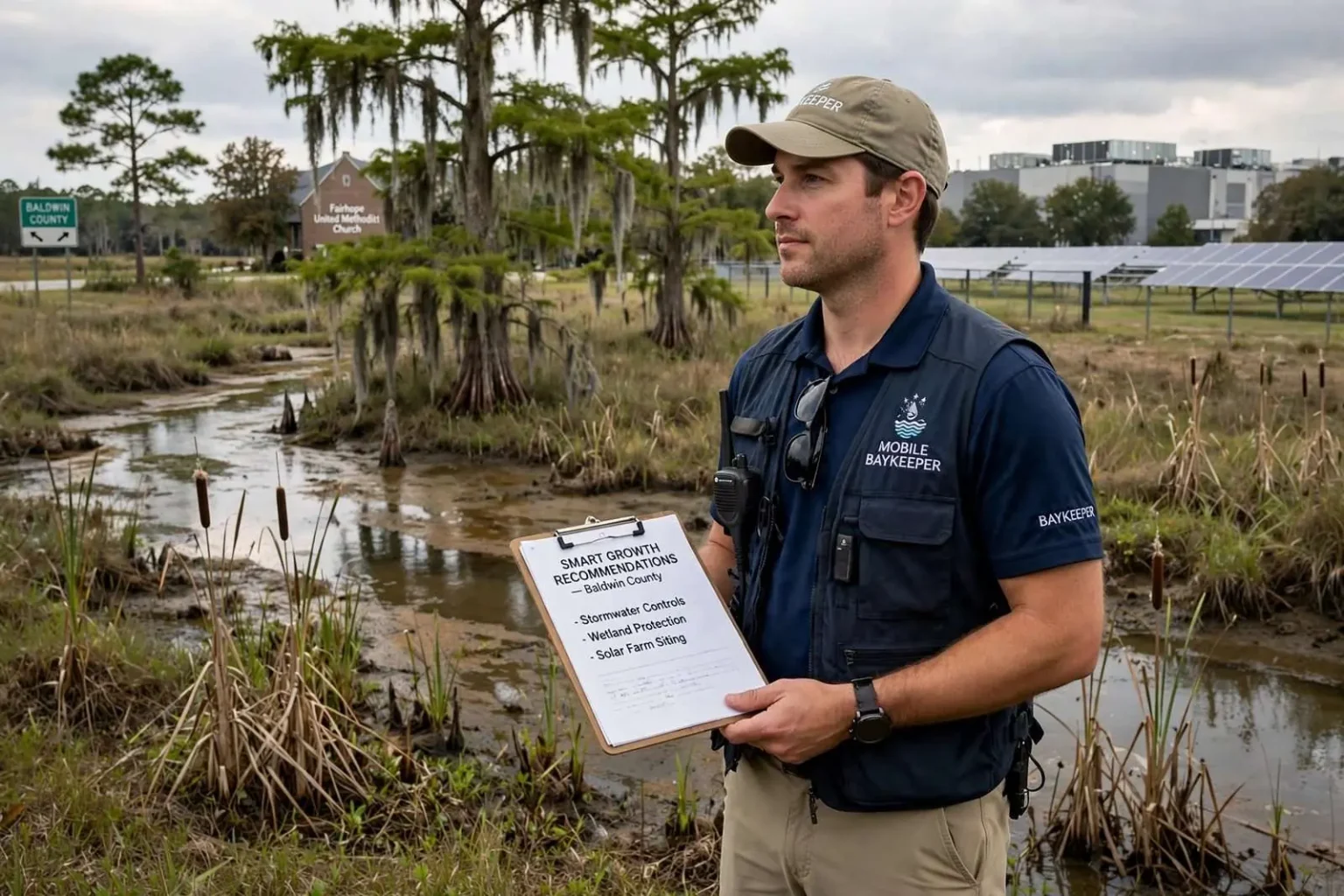
Mobile Baykeeper spent the last year asking Baldwin County residents what growth actually feels like from their back yards. This week, the environmental nonprofit brought the answers — and its proposed fixes — to Fairhope.
The Details
- When: Thursday, July 16, 6 p.m. to 7 p.m.
- Where: Fairhope United Methodist Church
- What: Presentation of policy recommendations addressing regional growth and waterway health
What Residents Told Them
The meeting capped a series of “Smart Growth” sessions Baykeeper held over the past year in Silverhill, Gulf Shores and Fairhope, gathering information from residents about area growth and water concerns.
What came back was consistent and specific.
“Residents spoke about worsening flooding, muddy runoff washing into creeks and bays, sewage infrastructure struggling to keep pace with new development, disappearing wetlands, increased traffic, and waterways that are becoming harder to fish, swim, and enjoy.”
Five Themes Kept Coming Back
According to a report detailing the results of those sessions, five issues surfaced repeatedly:
- Stormwater runoff and erosion
- Sewage infrastructure failures and underreporting
- Inadequate environmental review of residential developments
- Waterway health
- Community engagement
Data Centers and Solar Farms Enter the Conversation
At the meeting, Baykeeper broadened its focus beyond stormwater and sewage to include the type of large-scale energy infrastructure now being proposed across the region. The group presented policies touching on infrastructure planning, stormwater control, wetland protections, land use and permitting, along with specific protections aimed at solar energy projects and data centers, an issue the organization says has become a statewide concern among environmental groups.
Mobile Baykeeper said it has been tracking a proposed solar farm in Stockton as part of that work. The organization’s recommendations call for building solar farms only on land that has already been disturbed, rather than on wetlands, forests or working farmland, and for developers to cap water use and prove their projects’ impact before breaking ground. The group also wants upfront cleanup funding secured before construction, noise limits placed on projects, and a rejection of “speculative” grid capacity claims used to justify new development.
The Pitch: Not Anti-Growth
Baykeeper went out of its way to frame the recommendations as compatible with development rather than opposed to it. William Strickland, the organization’s executive director, put it plainly.
“Smart growth isn’t about saying no to growth. It’s about ensuring that new development works with our unique ecosystem and waterways so that Coastal Alabama remains a great place to live for generations to come.”
Strickland said Baykeeper has already laid groundwork by talking with developers and elected officials, and that the next step is building a unified voice in the community that includes both groups.
“Developers don’t necessarily want less regulations,” Strickland said. “Some of them want more but they have to be applied evenly.”
He added that consistent enforcement, not simply more rules, is what will ultimately protect the region’s waterways.
“If we can have stronger regulations and penalties from the regulators that change behavior, then we’ll start to see our waters being safer to swim in,” Strickland said.
“It’s Going to Take More Than Just the People in This Room”
Cade Kistler, who holds the title of Baykeeper for the organization, urged attendees to spread the word beyond the meeting itself, pointing to Baldwin County’s rapid population growth as the underlying pressure driving the group’s push.
“It’s going to take more than just the people in this room. As you guys know, Baldwin County has now grown over 230,000 people, I think is the statistic, and so, we’ll need you to talk to your neighbors and your friends and family, ask them to do the same. Then we’re going to track it and we’re not going to stop working on it, whether it takes some short period of time or whether it takes much longer,” Kistler said.
Baykeeper asked meeting participants to reach out directly to the Baldwin County Commission and shared a letter outlining its priorities for commissioners to consider.
“Adopting these measures would demonstrate a commitment to responsible growth – growth that protects property, supports long-term economic stability and safeguards Mobile Bay and its surrounding ecosystems,” the letter states.
Why This Matters in Baldwin County Right Now
Baldwin is among the fastest-growing counties in Alabama, and the pace has put real strain on systems that were sized for a smaller population. Every acre of pasture that becomes a subdivision changes how water moves across the landscape — rain that once soaked into soil now runs off roofs, driveways and streets, picking up sediment on the way to the nearest creek. That is the mechanism behind the “muddy runoff” residents describe.
Residents who want to review Mobile Baykeeper’s recommendations, including the letter shared with the Baldwin County Commission, can find more information about the organization’s policy work at mobilebaykeeper.org.
About Mobile Baykeeper
Mobile Baykeeper grew out of a citizens’ group, Mobile Bay Watch, formed in 1997 to push back against pollution in the bay. In 1999 the group affiliated with Waterkeeper Alliance, the international network of local water-protection organizations, and took the Baykeeper name, becoming the first Waterkeeper organization in Alabama. In that network, the “keeper” title belongs to a staff advocate who patrols and speaks for a specific body of water, which is why Kistler’s formal title is Baykeeper while Strickland leads the organization as executive director.
Update: Baykeeper is quantifying the toll of the county’s growth as it pushes its recommendations into the county’s ongoing comprehensive plan update. The organization says Baldwin County has grown by roughly 200% since 1980 and now ranks as the sixth-fastest-growing county in the nation. Nearly 2,000 acres of wetlands have disappeared since 1985 while paved surfaces have roughly doubled, reducing the land available to naturally absorb rainfall, and more than 10 million gallons of sewage spills have been reported since 2021 alongside a long-term decline in Mobile Bay seagrass habitat.
“When the way of life that people come to Baldwin County to expect changes, it results in worse economic outcomes as well,” Strickland said. “This is an economic issue.”
Spanish Fort Mayor Brad Bass, who attended the Fairhope meeting, said balancing growth with environmental protection will be one of the county’s biggest challenges going forward. “People are moving here regardless if we want them to or not,” said Bass, who took office in August 2025. “We’ve just got to be responsible with how we’re doing it.”
Bass said Spanish Fort is already weighing similar measures in its own comprehensive planning process, including preserving commercial zoning where appropriate, encouraging more permeable surfaces in new developments and improving stormwater management, and that the county commission’s current review of its comprehensive plan makes this “an ideal time” to incorporate Baykeeper’s recommendations.