Fairhope Council Approves Soccer Complex Redesign With $3.5 Million Budget
Fairhope's City Council authorized a redesign of its long-delayed soccer complex under a $3.5 million budget after a rejected bid stalled the project.
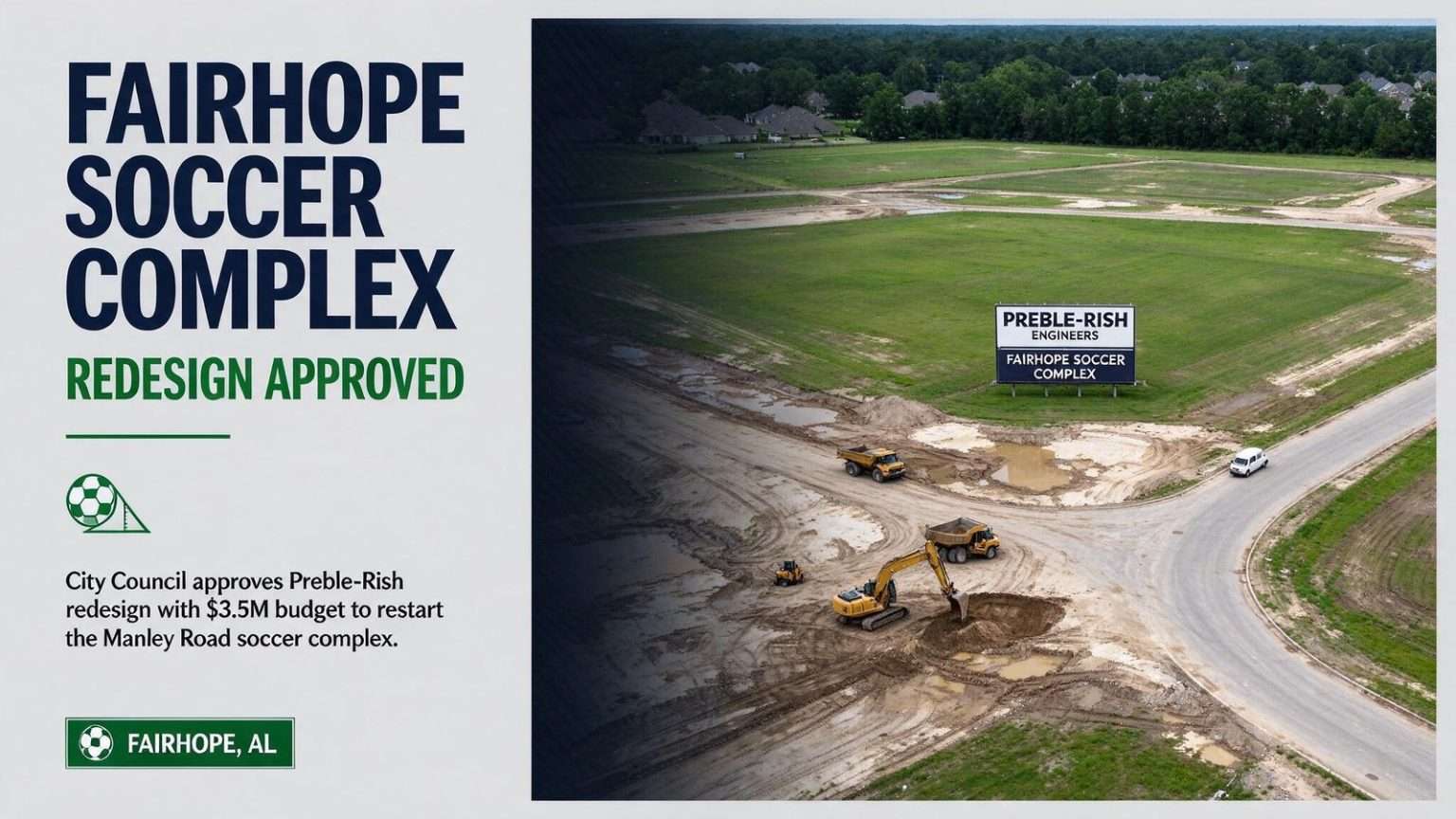
Fairhope’s long-awaited soccer complex on Manley Road is moving forward again after the City Council voted Monday to have engineering firm Preble-Rish redesign the project under a new $3.5 million budget. The decision marks the latest turn in a saga that has stretched across multiple budget cycles, and it restores momentum to a project that has become one of the most closely watched capital undertakings in this fast-growing Baldwin County city. For the youth soccer leagues and families who have waited years for regulation fields close to home, the redesign represents the most concrete sign of progress in months.
The vote followed months of city interviews with construction management firms interested in the project, though council members and Mayor Tim Kant signaled during Monday’s discussion that the city now intends to manage construction itself rather than hire an outside firm. The shift toward self-management reflects a calculation that Fairhope’s own public works capacity, combined with a careful bidding strategy, can deliver the complex at a price no outside manager could guarantee. It also keeps a layer of management fees out of a budget that has already been squeezed once.
The project has been stuck in cost negotiations since late July, when Summerdale-based Summit Industries LLC submitted the lone bid for the 10-field complex at $5.49 million, more than double the roughly $2 million the city had originally budgeted. That bid covered only grading, drainage, parking lots and the soccer fields themselves, leaving out sidewalks, fencing, irrigation and lighting, which means the true finished cost would have climbed even higher than the bid itself. For a city that had planned carefully around its original estimate, the number landed like a bucket of cold water.
The City Council rejected the bid on Aug. 11, sending Kant and council members back to the drawing board to find ways to bring the price within reach. Single-bid situations like the one Fairhope faced are a familiar frustration for public buyers, particularly in a Baldwin County construction market where demand for site work has run hot. When only one contractor prices a job, the city has no competitive leverage, and the bid that arrives tends to reflect the builder’s full risk calculation rather than a market-tested price.
The gap between the original estimate and the lone bid illustrates how quickly site work pricing has moved in Baldwin County. Grading and drainage packages in particular have been bid upward across the region as subdivision construction, commercial projects and road work compete for the same excavators, dump trucks and crews. A 10-field complex requires moving enormous volumes of earth, and contractors pricing that work in a hot market build in cushions that a city cannot negotiate away without competition.
City officials have not hidden the frustration of the summer. Months spent interviewing construction management firms produced plenty of interest, but no path that both protected the budget and guaranteed delivery, and the Aug. 11 rejection of the Summit Industries bid made clear that no council majority was willing to chase a $5.49 million price tag for a project budgeted at less than half that. The redesign vote effectively resets the procurement, keeping the design work and discarding the pricing.
How the City Reached the New Budget
Under the city’s fiscal year 2014-15 budget, $3 million had already been set aside for the complex. Council members added another $500,000 ahead of Monday’s vote to reach the new $3.5 million total. Kant said some council members had pushed for a budget as high as $4.5 million, but the final number reflects what the city determined it could spend this year without taking on new debt.
“I looked at how much the city could actually afford spending this year without borrowing any money, and that was the most that I could actually come up with to move forward with the soccer fields,” Kant said. The pay-as-you-go approach has become a point of pride in Fairhope’s budgeting, where officials have preferred to fund capital projects from reserves and current revenue rather than finance them through bonds, preserving the city’s capacity to absorb the rapid growth that continues to push its population upward along the eastern shore of Mobile Bay.
The council’s refusal to borrow for the project also reflects a philosophy about growth. Cities that finance recreational amenities with debt take on obligations that outlast the officials who approved them, and Fairhope’s leadership has consistently argued that the city can have the complex it can afford now and expand it later as revenue grows. The $3.5 million budget, built entirely from money the city already has, is the practical expression of that argument, even if it means the finished product will arrive in stages rather than all at once.
The city has owned the roughly 40-acre site at the intersection of Manley Road and Baldwin County 13 since 2009, when it purchased the land for $875,000. The acreage sits in the corridor between Fairhope’s established neighborhoods and the county road network that connects them to Spanish Fort and Daphne, making it a practical location for families hauling kids, cleats and coolers to weekend games. In the years since the purchase, the vacant parcel has stood as a visible promise to the city’s youth sports community.
Preble-Rish, which had already been paid about $90,000 for the original design, will now rework those plans to fit the reduced budget. Redesigning around a lower number typically means prioritizing the elements that make fields playable and safe first, then phasing in the amenities. The firm’s familiarity with the site should speed that work, since surveying, drainage analysis and layout decisions from the original design can be carried forward rather than repeated from scratch.
City Crews and Split Bids
In the process, officials decided city crews would handle a portion of the construction work themselves to hold down costs, and agreed to break the project into multiple bid packages rather than seeking a single contractor for the entire job. The approach puts Fairhope’s public works employees on grading, clearing and other tasks suited to in-house capability, while private contractors bid on specialized work that requires equipment or certifications the city does not maintain.
Fairhope’s decision to lean on its own crews is not unusual for a city of its size, and it carries a civic benefit beyond the savings. Public works employees who help build the complex will maintain it afterward, and the city retains direct control over the quality of the base work, the grading and drainage that determine whether fields drain well after a Gulf Coast rain. Anyone who has watched a youth soccer season wash out along the coast understands why officials put drainage first in their thinking.
Splitting the work into phases is intended to widen the field of interested contractors and increase competition on each piece of the project, a strategy city officials hope will avoid a repeat of the single, over-budget bid that derailed construction plans earlier in the year. Smaller bid packages allow local grading contractors, fencing companies and electrical firms to compete for the work they do best, instead of one large contractor wrapping every trade into a single price. For a city the size of Fairhope, that broader participation can shave real money off a project of this scale.
The phased strategy does carry trade-offs. Multiple bid packages mean multiple procurement cycles, more coordination between separate contractors sharing one site, and a longer construction timeline than a single-contractor job would likely have. City officials are betting that the savings from competition and in-house labor outweigh the added management burden, particularly with the mayor and council now committed to supervising the schedule themselves.
What the Complex Means for Fairhope
The demand behind the project is not abstract. Baldwin County has ranked among the fastest-growing counties in Alabama for years, and Fairhope’s schools and youth leagues have absorbed wave after wave of new families moving across the bay from Mobile or down from other states. Weekend soccer in the area has long meant traveling to fields in other communities, and the city’s existing parks struggle to accommodate the mix of baseball, softball, football and soccer seasons that compete for the same turf.
A 10-field complex at Manley Road and Baldwin County 13 would also position Fairhope to host regional tournaments, an economic consideration that cities across the Gulf Coast have increasingly taken seriously. Weekend tournament traffic fills hotels, restaurants and shops, and municipalities that built such complexes a decade ago have watched them become steady generators of visitor revenue. Whether Fairhope’s redesigned complex can eventually serve that role depends on funding for lighting and other tournament-grade amenities, but the layout of the site leaves room for the city to grow into that ambition over time.
For now, the immediate goal is simpler: get the rebid process moving so that work on the long-promised soccer complex can finally begin. With the redesign in Preble-Rish’s hands, the council’s budget fixed at $3.5 million, and a bidding strategy built to avoid last summer’s mistake, city officials believe the pieces are finally aligned. The families who have spent years driving past the empty field on Manley Road have heard timelines before, but this week, for the first time in months, the project has a price the city says it can actually pay.