Alabama Agrees to $65 Million in Public Access Upgrades at Gulf State Park to Settle Federal Lawsuit
Alabama has settled a federal lawsuit over its use of BP oil spill restoration funds at Gulf State Park, agreeing to spend $65 million over 20 years on public beach and trail access after a nonprofit group challenged the project's heavy focus on a new hotel and conference center.
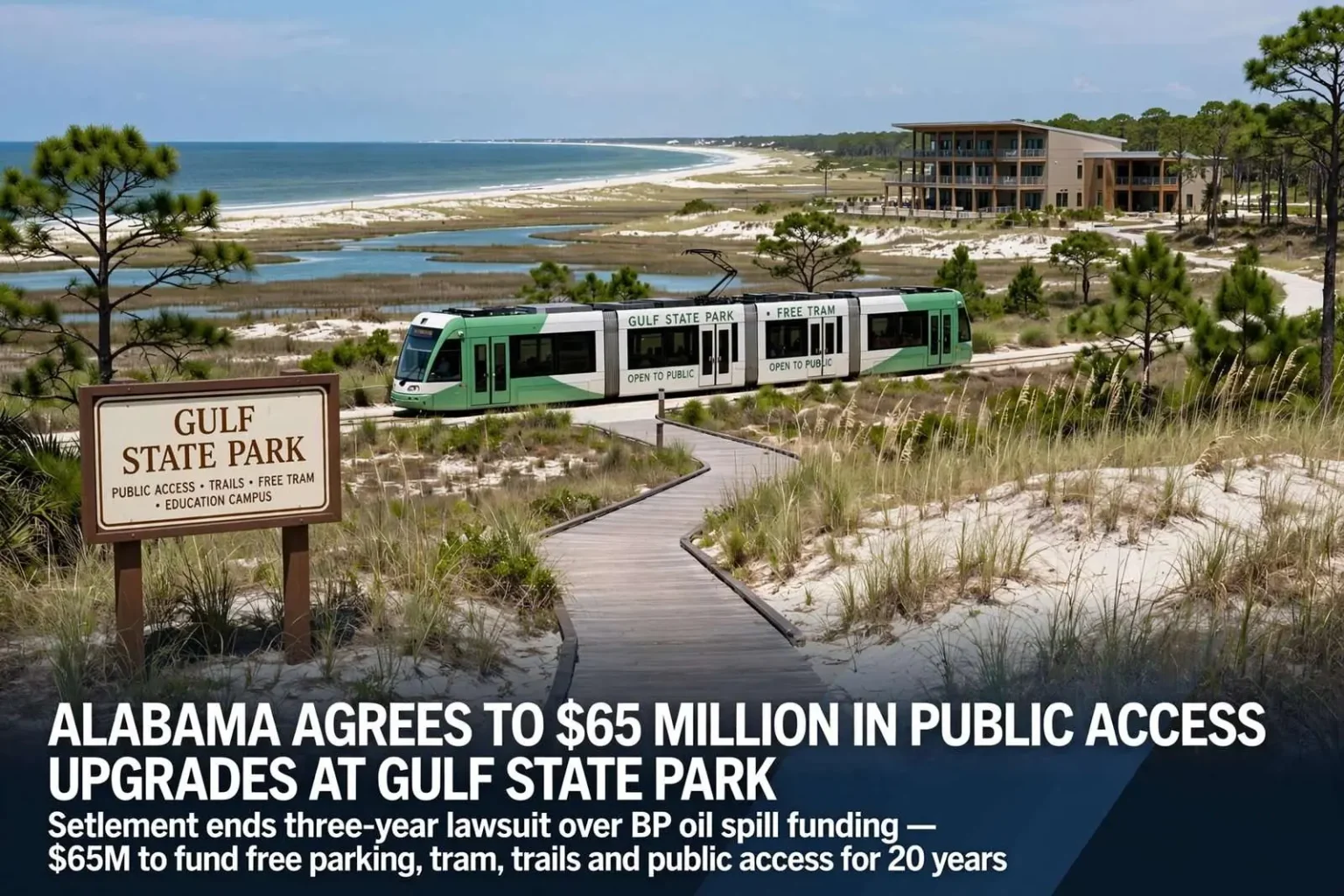
A three-year legal fight over how the state of Alabama spent tens of millions of dollars in BP oil spill recovery money at Gulf State Park has come to a close, with state officials agreeing to dedicate $65 million over the next two decades to public access improvements at the Baldwin County park.
The settlement resolves a lawsuit brought by the Gulf Restoration Network, a nonprofit environmental group, against the federal trustees who approved the use of Natural Resource Damage Assessment funds for the Gulf State Park Enhancement Project. Those funds, generated in the aftermath of the 2010 Deepwater Horizon oil spill, are meant to pay for early restoration projects tied to environmental and public damages caused by the disaster.
At issue was how the project’s roughly $58.5 million budget was divided. Of that total, about $48 million went toward constructing a new lodge and conference center at the park, while only about $10 million was set aside for public access amenities such as trails, parking and educational facilities. The Gulf Restoration Network argued that split shortchanged the public benefit the restoration funds were supposed to provide.
The dispute reached a turning point last year when a federal judge ruled that early phases of the project had not followed the legal requirements governing how NRDA funds can be used. That ruling temporarily halted work on the project and set the stage for negotiations that ultimately produced the settlement.
The bigger restoration picture
Since the 2010 spill, a group of trustees representing several federal agencies and the five Gulf Coast states affected by the disaster has overseen the NRDA process, directing roughly $1 billion in early restoration spending. BP received credit against its overall spill liability for those contributions, reducing the total owed under the $20.8 billion settlement finalized in federal court in Louisiana in 2016.
Gulf State Park sits at the center of that accounting because it received one of the single largest early-restoration allocations in Alabama. The park stretches along roughly two miles of sugar-white beach between Gulf Shores and Orange Beach, encompassing dunes, lakes, pine flatwoods and one of the largest lodging operations on Alabama’s coast — which is precisely why a fight over a hotel there became a test case for what restoration money can lawfully build.
What the settlement requires
Under the terms reached in the Gulf State Park case, the state has committed to spending $65 million over the next 20 years on projects such as dune maintenance, free public parking, walking and pedestrian trails, research and education facilities, and a free tram system connecting different areas of the park.
The agreement also guarantees continued public access to restrooms in the lodge as well as beach access through the building itself, and it blocks construction of a north-south connector road through the park for the next two decades.
An attorney representing the Gulf Restoration Network said the settlement ensures that money intended to benefit the public will actually be used for that purpose going forward. The group’s executive director called the outcome a win for Alabama residents, noting that it locks in decades of free beach and park access at a time when the state has scaled back services at other public facilities.
For the conservation organization, the resolution vindicated the underlying legal theory of the case: that NRDA funds are restitution for injuries the public suffered, and that spending them predominantly on revenue-generating hospitality assets stretches the law’s purpose. The judge’s earlier ruling had already validated part of that argument; the settlement converts the legal principle into two decades of enforceable commitments.
The Alabama Department of Conservation and Natural Resources, which was added to the lawsuit in 2015 because of its oversight role on the project, did not immediately respond to a request for comment. The agency’s commissioner has previously said he was pleased with the settlement, telling reporters it addressed concerns raised in the lawsuit while ensuring the park’s public access features would be properly maintained.
That posture reflected the state’s practical position throughout the litigation. Conservation officials had always described the lodge as a self-sustaining engine for the park’s finances, and the settlement lets that argument be tested in operation — so long as the public access guarantees are met on schedule and the connector road stays unbuilt.
Construction rolls on
Construction at Gulf State Park has continued throughout the litigation. Crews have been building a roughly 350-room hotel that will include a beachfront ballroom, pool, restaurant and bar, with the project on track to open in the fall. State leaders have described the new lodge and conference center as a major addition to Alabama’s tourism offerings along the Gulf Coast.
The hotel replaces the original lodge that once stood at the site before Hurricane Ivan destroyed it in 2004, and its return has been billed as restoring a signature piece of the park’s history. Tourism officials in Baldwin County — the heart of the state’s beach economy — count convention business among the highest-value visitor segments, and a beachfront conference center gives Alabama a facility it has lacked since the original building was lost.
What it means for park visitors
For the hundreds of thousands of people who visit Gulf State Park each year, the settlement’s terms translate into concrete, everyday features: parking that costs nothing, trails maintained for two decades, a tram that carries visitors between the beach, the campground and the learning campus without a car, and a lodge whose doors remain open to non-guests who want a restroom, a meal or a walk to the water.
Free parking is arguably the most consequential of the commitments. Beach access along the Gulf Coast increasingly runs through paid lots and private developments, and the cost of a day at the water rises with every gate. Guaranteeing free parking at one of Alabama’s most visited parks preserves a form of access that matters most to the visitors least able to absorb new fees.
The blocked connector road carries its own ecological weight. A north-south route through the park would have sliced through habitat that links the dunes to the freshwater lakes and pine woods inland, fragmenting the landscape that makes the park both a recreation destination and a conservation area. Keeping the road off the map for 20 years effectively settles the question for a generation of planners.
A template for the coast
The Gulf State Park Enhancement Project remains one of the most closely watched uses of BP restoration money in Baldwin County, and the settlement is expected to shape how future NRDA-funded projects along the Alabama coast balance development with public access and environmental restoration.
That influence will reach beyond this park. Alabama will receive multiple streams of spill-related funding over the coming decades, from early restoration allocations like this one to larger economic-damage payments distributed under the settlement finalized in 2016. Every project that proposes lodging, restaurants or other revenue-generating construction on restoration dollars will now be measured against the standard this case set: public benefit is not an afterthought, and when it is shortchanged, the courts and the public will notice.
For the Gulf Restoration Network, the outcome demonstrates the leverage a small organization can exercise over hundreds of millions of dollars in public money. For the state, it purchases certainty — two decades of defined obligations in exchange for the ability to finish and operate its flagship tourism project without further litigation. And for the public that owns both the park and the money that rebuilt it, the deal converts an abstract legal fight into amenities that can be walked, ridden and used, free of charge, for the next 20 years.
The litigation’s course offers a lesson in how restoration money is governed. NRDA is not a general discretionary fund; it is a compensation scheme with defined legal requirements, administered by trustees who represent the public’s claim against the polluter. When a project financed through that scheme emphasizes economic development over restoration of the injured resources, the mismatch is not merely a policy disagreement — it can be a legal violation, as the federal court’s interim ruling demonstrated.
Environmental groups along the Gulf watched the case closely for exactly that reason. The five affected states are all allocating billions in spill money, and each faces pressure to direct it toward visible, revenue-producing landmarks rather than marsh restoration, oyster reefs or water-quality projects whose benefits are real but quieter. A ruling and settlement that forced a state to guarantee $65 million in public access spending — and to fund dune maintenance and a free tram system alongside a 350-room hotel — establishes precedent that development-heavy proposals carry enforceable public-interest strings.
The tram, trails and education facilities also serve the park’s own stated mission. Gulf State Park has long operated as both a recreation destination and a teaching landscape, with its dune lakes, maritime forest and beach ecology drawing school groups and researchers as well as vacationers. The settlement’s required investments push the park further toward that dual identity, ensuring the restoration money leaves behind not just beds and banquet space but a public that understands what the 2010 spill cost and what the coast’s recovery looks like.