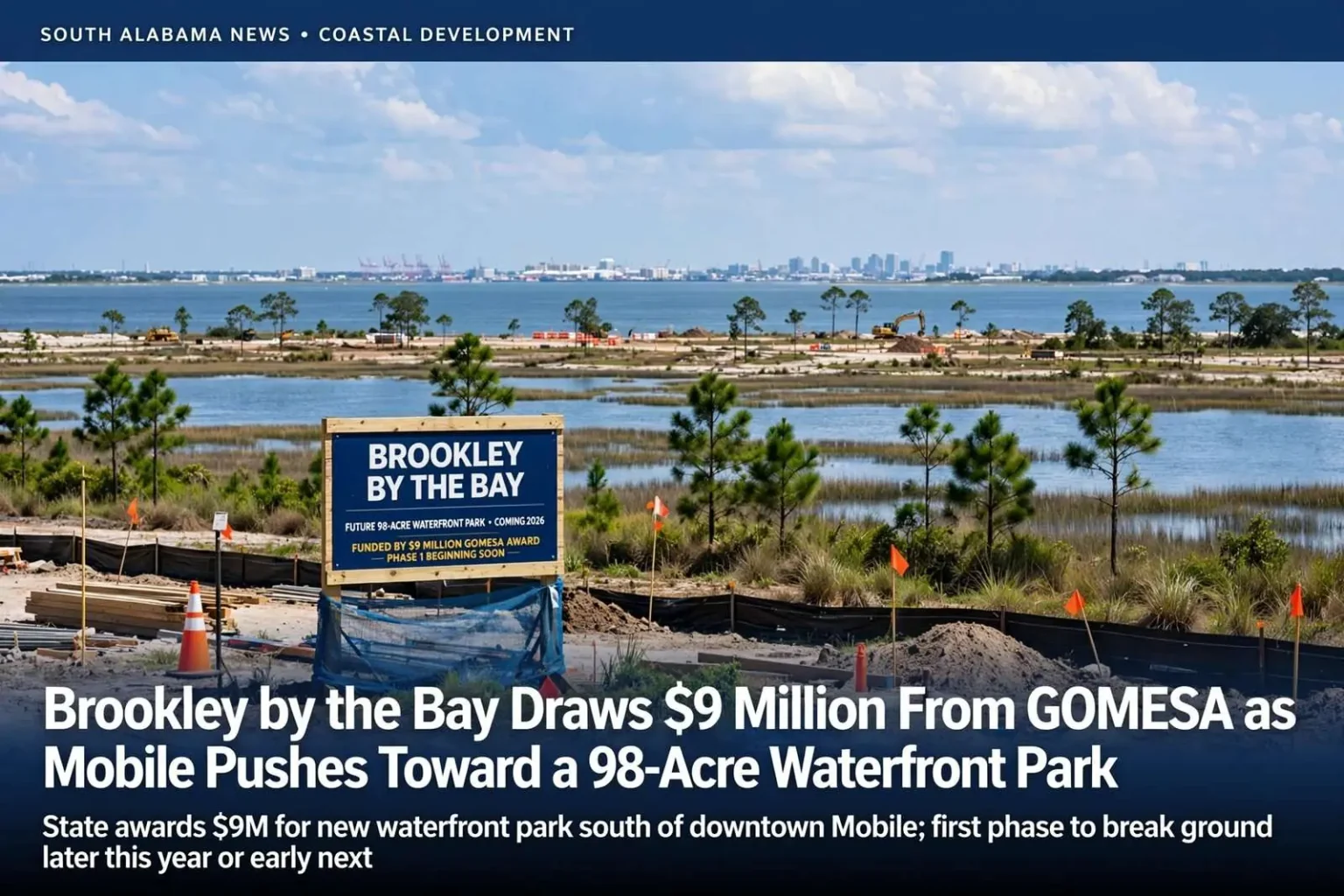
Brookley by the Bay Draws $9 Million From GOMESA as Mobile Pushes Toward a 98-Acre Waterfront Park
Gov. Kay Ivey dedicated $9 million toward the planned park south of downtown. With a $5 million city match, groundbreaking could come late this year or early next.
Alabama’s most popular tourism draw remains its beaches in Gulf Shores and Orange Beach, which help attract roughly 8 million visitors to the state’s coastal region each year.
For beachgoers who want to avoid the crowds and traffic of south Baldwin County, there are alternatives. Dauphin Island, known for its 14 miles of uninterrupted shoreline and its bird-watching, offers a quieter option on Alabama’s only barrier island. Bayfront Park, just north of Dauphin Island, includes a small public beach. Fairhope Municipal Beach, with about a half-mile of shoreline along Mobile Bay, is another.
Within two years, Mobile could join that conversation in a significant way.
The $9 Million
“It will be an exciting place for tourism in Mobile,” said City Council President C.J. Small, whose district includes the future site of Brookley by the Bay — a planned 98-acre waterfront park south of downtown Mobile within Mobile Aeroplex at Brookley.
The project received a major boost last month when Gov. Kay Ivey dedicated $9 million toward the development. The funding represented 17% of the overall amount distributed among 21 coastal Alabama projects receiving oil and gas lease revenue through the Gulf of Mexico Energy Security Act of 2006.
Capturing 17% of a multi-project funding round is a substantial share, and it signals where the state placed this project among competing coastal priorities.
Phase One
The city will contribute an additional $5 million, allowing the beachfront project to move toward a groundbreaking later this year or early next.
Construction on the first phase is expected to take about one year and includes utility installation, road construction and development of the beach area.
That sequence is typical for a greenfield park site. Utilities and access roads have to exist before anything the public interacts with can be built, which is why the visible portion of a project like this tends to appear late in a construction schedule that has already been underway for months.
Phase Two Hinges on a Federal Grant
The project’s second phase depends on the city securing a $7.5 million federal grant. The Mobile City Council authorized pursuing that grant on Tuesday, and the city is committed to approximately $7 million in matching funds.
The highlight of the second phase would be new hiking trails and an amphitheater overlooking Mobile Bay.
“If we get the grant, both of these opportunities dovetail well together,” said Jennifer Greene, the city’s director of programs and project management.
A $50 Million to $60 Million Vision
The overall project, to be completed in multiple phases, is expected to cost between $50 million and $60 million, Greene said.
Mobile Mayor Spiro Cheriogotis said Brookley by the Bay is among his administration’s top priorities, and that he hopes portions of the park will be open to the public before his first term ends in 2029.
“My top priority is to get that open and so the public can enjoy access to the water,” Cheriogotis said. “I’m thankful that through GOMESA, and other (revenue sources) we can start construction on that.”
Why It’s Being Built in Pieces
Cheriogotis said the city is approaching the project “one piece at a time,” beginning with the park’s southern end. The second phase, if funded, would focus on the northern section near Arlington Park. A third phase includes construction of an educational facility, Greene said.
“It’s why we phased this project out,” Cheriogotis said. “It’s hard to spend $50 million at one time as a city.”
Phasing also allows the city to align construction with funding as it becomes available, rather than waiting to assemble the full amount before breaking ground — a practical necessity when a substantial share of the money comes from competitive grants awarded on their own timelines.
Designed With Public Input
Brookley by the Bay has been years in the making as part of Mobile’s effort to reconnect residents with public waterfront access. Community workshops held in 2022 and 2023 generated input from more than 300 residents about what they wanted in a future waterfront destination.
Greene said many of those ideas, particularly those offered by children, are being incorporated into the design. Planners also interviewed approximately 350 children, whose feedback shaped plans for an interactive play area.
Not a Typical Splash Pad
“It’s not your typical splash pad,” Greene said of the planned attraction. “Children wanted to play with the water, move the water. We’ve got dams and mushrooms that shoot water in the air. They also wanted to climb trees and be in the forest. The experimental play area has fantastic treetop areas that they go into. And the entire park will be (handicap) accessible.”
The distinction Greene draws is meaningful in playground design. A conventional splash pad sprays water at children; a play area with dams and diverters lets them control it. The second design supports longer, more inventive play, and it is the kind of feature that emerges from actually asking children what they want rather than selecting from a catalog.
What It Would Mean for Mobile
For a city on a bay whose residents have historically had limited public access to its shoreline, the project represents a change in kind rather than degree. Mobile’s waterfront has been dominated by port, industrial and aviation uses, which is precisely why 98 acres of publicly accessible shoreline within the city limits is being treated as a signature initiative.
South Alabama News will report the groundbreaking date and the outcome of the federal grant application as they are announced.
Update: City Applies for a National Park Service Grant for Phase 2
The City of Mobile has announced it is applying for an Outdoor Recreation Legacy Partnership grant from the National Park Service’s Land and Water Conservation Fund to fund construction of Phase 2 of the Brookley by the Bay project.
The Land and Water Conservation Fund is a long-standing federal program that channels revenue, much of it from offshore energy leasing, into public parks and outdoor recreation. Its Outdoor Recreation Legacy Partnership component is aimed specifically at creating or substantially improving parks in urban areas that lack adequate outdoor recreation space — a category that fits a waterfront park intended to give Mobile residents regular access to the bay for the first time.
City officials said the grant would provide the resources needed to begin construction on Phase 1 of the bayside park, opening it to regular public use.
The application follows the $9 million award from Gov. Kay Ivey’s office through Gulf of Mexico Energy Security Act funds. Stacking a competitive federal grant on top of a state award is the standard way a project of this scale advances: each source covers a portion of the work, and an existing state commitment strengthens the case in a competitive federal round.
A Separate Study on a Public Marina
The city is also moving forward with an agreement with Covington Civil & Environmental, LLC for a feasibility study to determine where in the city a public marina or boat docking facility would be most suitable.
A feasibility study of that kind typically examines water depth and access, upland space for parking and staging, environmental and permitting constraints, projected demand and construction cost. It is a precursor to site selection rather than a commitment to build, and its findings would shape where — and whether — a public marina moves forward.
The Full List of GoMESA Awards
Beyond Brookley by the Bay, three projects received $5 million each: the Alabama Port Authority’s Upper Mobile Bay Wetlands Creation Construction Project, which will place new wetlands south of the Causeway using suitable material dredged from the Port of Mobile; the Mobile County Commission’s Byrnewood Boat Ramp and Public Access project in Theodore; and the City of Daphne’s Jubilee Recreation and Fishing Pier Construction at Bayfront Park.
The rest of the award list includes the University of South Alabama’s Outdoor Classroom for Habitat Conservation and Stormwater Management ($3 million); ADCNR’s Boggy Point Boat Launch Renovations ($2.95 million); Fairhope’s Flying Creek Nature Preserve Phase 3 ($2.5 million); ADCNR’s Weeks Bay Reserve Public Access Improvements Phase 2 ($2.5 million); Saraland’s Walter Cofield Park and Boat Launch Improvements Phase 1 ($2.5 million); Dauphin Island’s East End Exploration and Visitor Center ($2.2 million); ADEM’s collection of ambient water quality data in coastal watersheds ($2 million); Magnolia Springs Town Center ($2 million); Semmes Amphitheater and Nature Park ($1.6 million); Elberta Public Park Improvements ($1.6 million); Orange Beach Shooting Complex Clubhouse ($1.5 million); Bay Minette Kids Park Improvements ($900,000); Riviera Utilities’ Coastal Wastewater Resiliency Improvement Project ($800,000); the Perdido Bay Water, Sewer and Fire Protection District’s Elberta Youth Sportsplex and Hurricane Protection Project ($660,000); Perdido Beach’s comprehensive drainage improvements ($400,000); Chickasaw’s Brooks Park Boat Launch ($400,000); Bayou La Batre’s Rolston Pier Extension ($310,000); and GoMESA administration ($519,529).
“Alabama’s coast is one of our state’s greatest treasures, and we have a responsibility to protect it while ensuring Alabamians and our visitors can enjoy all it has to offer,” Ivey said in a statement announcing the awards. ADCNR Commissioner Chris Blankenship said the projects “continue a long list of important environmental and quality of life improvements in Coastal Alabama.” Ivey noted that more than $310 million in GoMESA projects have now been awarded during her administration. The funding comes from GoMESA’s formula, which allows Gulf states and eligible coastal subdivisions to share 37.5 percent of qualified revenues from Outer Continental Shelf oil and gas leases, with the Alabama Department of Conservation and Natural Resources administering the state’s share.