Daphne Lands $5 Million GoMESA Grant for a New Bayfront Park Fishing Pier
Daphne has secured a $5 million GoMESA grant for a new fishing pier at Bayfront Park, planned to reach about 1,200 feet into Mobile Bay as phase two of a roughly $16 million waterfront redevelopment whose amphitheater opens in April 2027.
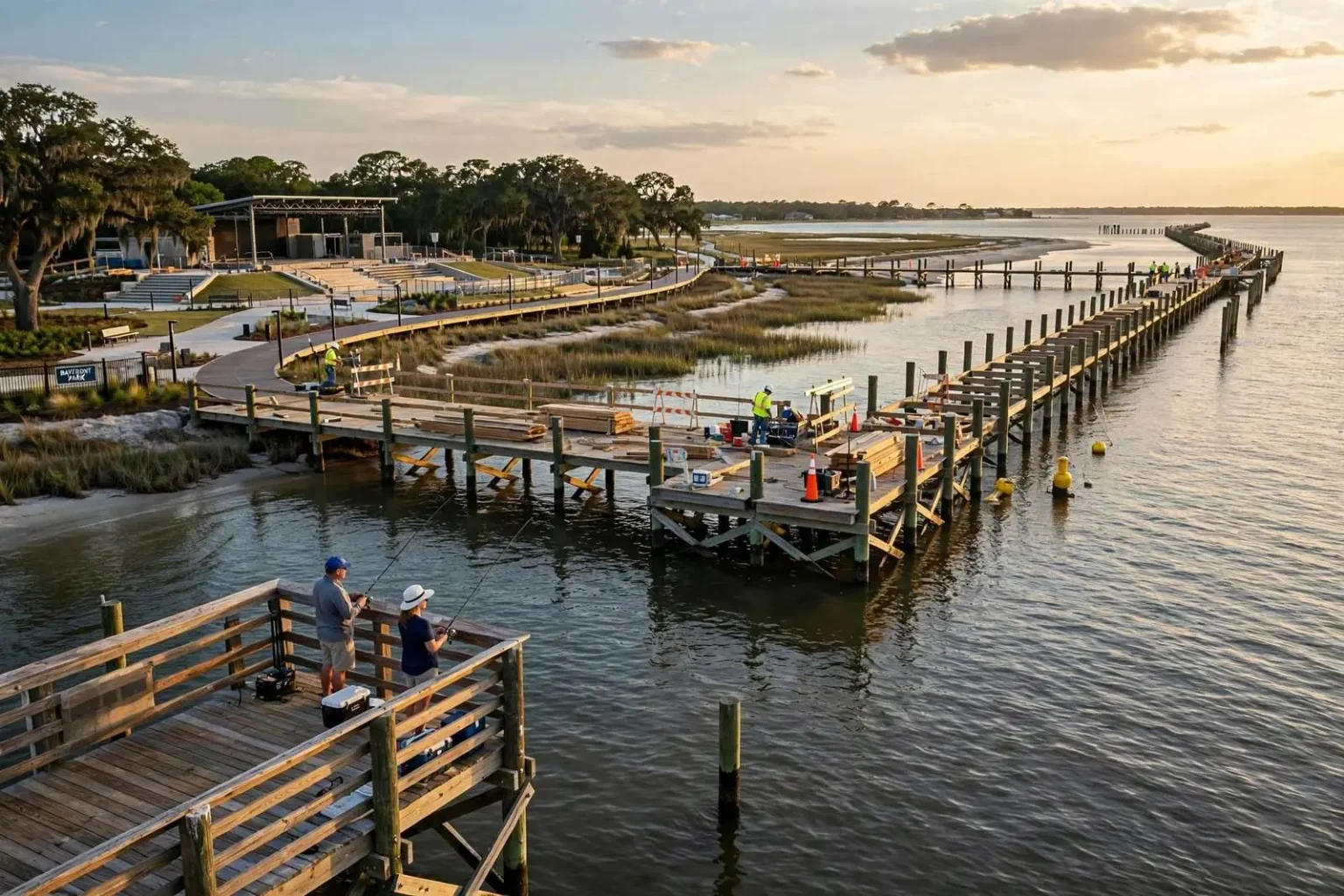
DAPHNE — Daphne has received a $5 million GoMESA grant to build a new public fishing pier at Bayfront Park, adding another major piece to the city’s larger waterfront redevelopment push along Mobile Bay. For the self-styled Jubilee City — a nickname drawn from the Mobile Bay jubilees that drive fish and crabs into the shallows along the Eastern Shore — the award is a second marquee project on a shoreline already in the middle of a considerable transformation.
The award comes through the Gulf of Mexico Energy Security Act, better known as GoMESA, the federal revenue-sharing program that returns a share of offshore oil and gas lease proceeds to Alabama, Louisiana, Mississippi and Texas. In Alabama, those dollars are administered by the Alabama Department of Conservation and Natural Resources and are directed toward coastal conservation, water quality and public access projects. Baldwin County and its municipalities have used the funding stream for everything from beach nourishment to parks and public safety facilities.
The grant is not local tax money but a share of federal offshore revenue — the lease bonuses, rents and royalties collected from federal waters and returned to the four participating Gulf states. For a pier in Daphne the linkage is direct: energy activity offshore helps pay for the public shoreline the Eastern Shore uses for fishing and recreation, and the project makes fewer demands on the city’s general fund than a purely municipal build would.
A longer pier and a walking loop
Mayor Robin LeJeune said the pier still has to be designed and permitted, but the hope is to extend the structure further out into Mobile Bay and connect it to a sand bar that ties into the park’s walking trail.
“So then you can actually make a full loop with the ability to walk and really enjoy the bay, and so that’s the initial concept that we have,” LeJeune said. “If you go out there now with all the improvements we’re doing to Bayfront, the pier kind of gets lost. It’s very small.”
Troy Strunk, Daphne’s executive director of city development, described the project as something residents have wanted for years and put a target length on it.
“A brand new pier, something that Daphne has desperately needed for a long time,” Strunk said. “We’re hoping that it’s going to be about 1,200 feet out into Mobile Bay and be a great complement to the brand new Bayfront Amphitheater.”
At roughly a quarter of a mile, a 1,200-foot structure would carry anglers well past the shallows and into deeper water, a meaningful difference for anyone hoping to reach speckled trout, redfish or flounder without a boat. It would also give walkers and photographers an unobstructed vantage point over one of the most photographed stretches of water on the Eastern Shore. Anglers have long complained about the limited reach of the existing structure, especially at low tide.
An older pier already stands at the park, but city leaders acknowledge it has reached the end of its useful life. “We want to bring the water to the people and the citizens and the residents of the Eastern Shore,” Strunk said. “There is an existing pier down there, but it’s old and definitely in need of repairs. We’re looking forward to getting this project underway.”
Phase one is already under construction
Construction is already underway on the first phase of the Bayfront Park overhaul, which includes a new amphitheater, a restroom building, a splash pad, and boardwalk connections from the Daphne recreation building to the amphitheater area. When complete, the amphitheater is expected to offer lawn or folding-chair seating for about 2,500 people. Site work and underground utilities for the amphitheater are well advanced, with vertical construction on the stage house and back-of-house buildings expected later this fall.
“We are right on schedule. We look to open in April 2027,” LeJeune said. The April 2027 target would let the city debut the amphitheater in time for spring events on the Eastern Shore and ahead of the busy summer tourism season that follows.
How the money adds up
The new $5 million award builds on $7.2 million in earlier GoMESA funding that helped pay for the first phase. LeJeune said the city is covering the remainder of the roughly $16 million total cost, and that Daphne had already invested about $3.5 million in waterfront streetscape work before it ever sought GoMESA dollars. City officials have described the amphitheater itself as a $15 million waterfront project.
LeJeune credited that early local investment with helping Daphne stand out when it competed for the state funding.
“The governor’s office saw that we were invested in actually making this project work. So that’s when they started really helping us out with GoMESA funds and seeing the vision what we had for Bayfront,” he said. “We’re so appreciative of Governor’s Office, Commissioner Blankenship for seeing that vision.”
Daphne’s award is one of 21 GoMESA projects announced across coastal Alabama in the most recent funding round, a slate totaling more than $52 million and reaching communities in both Mobile and Baldwin counties.
Design, permitting and public input
The project remains in an early design phase, and no construction timeline has been announced. Design work is expected to take several months and to include environmental review and public input sessions, particularly around the proposed connection to the sand bar. Coastal engineers will need to weigh the project’s effect on longshore drift, on submerged aquatic vegetation in the shallows, and on the small-craft channel used by local boaters.
Permitting will likely require coordination with the Alabama Department of Environmental Management, the U.S. Army Corps of Engineers for work in navigable waters, and the state historical commission because of Daphne’s long colonial-era history along the bay. Once a final design is approved, the city will put the project out to bid, with construction likely beginning in 2027 and continuing into the following year.
City leaders said one goal under consideration is a connection between Bayfront Park and the nearby Village Point Park Preserve, which would knit together two of Daphne’s most-used public spaces along the bay. Linking the two would create a long, continuous public greenway along Daphne’s bayfront, tying the pier and amphitheater area to one of the city’s oldest and most ecologically rich preserves.
Public access on a crowded shore
Public access to Mobile Bay has become an increasingly pointed subject along the Eastern Shore, where residential growth has steadily reduced the number of places where residents can simply walk to the water’s edge. Municipal piers, boat launches and shoreline parks have taken on outsized importance as a result, functioning as both recreational amenities and as a form of civic infrastructure.
Mobile Bay supports a year-round fishery, and for residents who do not own a vessel a public pier is the most reliable way to reach speckled trout, redfish and flounder without a boat, a trailer or a launch. A pier long enough to be a destination in its own right also feeds the nearby bait shops and restaurants and the wider shoreline economy that the amphitheater, the boardwalks and the city’s nature trails are meant to build.
“With the amphitheater project, with all the boardwalks and all of the trails and now the brand new pier, the city of Daphne is just growing leaps and bounds,” Strunk said. “This is just another great park project in the city of Daphne.”
Unlike the amphitheater, which is built around scheduled shows, a fishing pier is a daily-use asset — open at dawn for anglers, at sunset for walkers, and on clear afternoons for photographers who come for the wide view of the bay. As the design advances, details like lighting, seating, cleaning stations and accessibility ramps will determine how many residents actually use it.
Part of a phased plan
Daphne has structured the Bayfront Park overhaul in clearly defined phases so that each piece can be funded, permitted and built without depending on the next phase moving forward. The amphitheater and surrounding boardwalk make up phase one, with a target opening in April 2027. The pier expansion funded by the new $5 million grant is phase two. Additional improvements to the park’s parking, signage and lighting are expected to follow as separate line items in future budgets.
Bayfront Park sits just off U.S. 98 at the eastern edge of Daphne, and the city has worked with ALDOT on intersection improvements to handle the larger crowds expected once the amphitheater opens. A new roundabout at the park’s main entrance is already complete, and additional pedestrian crossings are being added along the U.S. 98 frontage.
A destination, not just a bedroom community
Daphne is not the only Eastern Shore city investing in its waterfront. Fairhope has expanded its own municipal pier and surrounding park in recent years, and Spanish Fort has moved forward with plans for a new boardwalk along the Blakeley River. For decades, Daphne has been known primarily as a quiet residential community on the Eastern Shore, and the Bayfront Park overhaul is part of a broader effort to give the city a more defined identity as a destination.
City officials have also begun informal conversations with event organizers about programming the amphitheater, with a mix of free public concerts, ticketed regional acts, movie nights and civic events under discussion and bookings expected to ramp up following the April 2027 opening. Residents interested in following the pier’s progress can expect additional detail as the design phase advances and the city moves toward permitting and construction.