Laguna Cove Nature Park Construction Reaches Halfway Point, Opening Pushed to Early 2027
Construction on Gulf Shores' 53-acre Laguna Cove Nature Park is now half complete, with the Deepwater Horizon-funded project set to open in early 2027, city officials say.
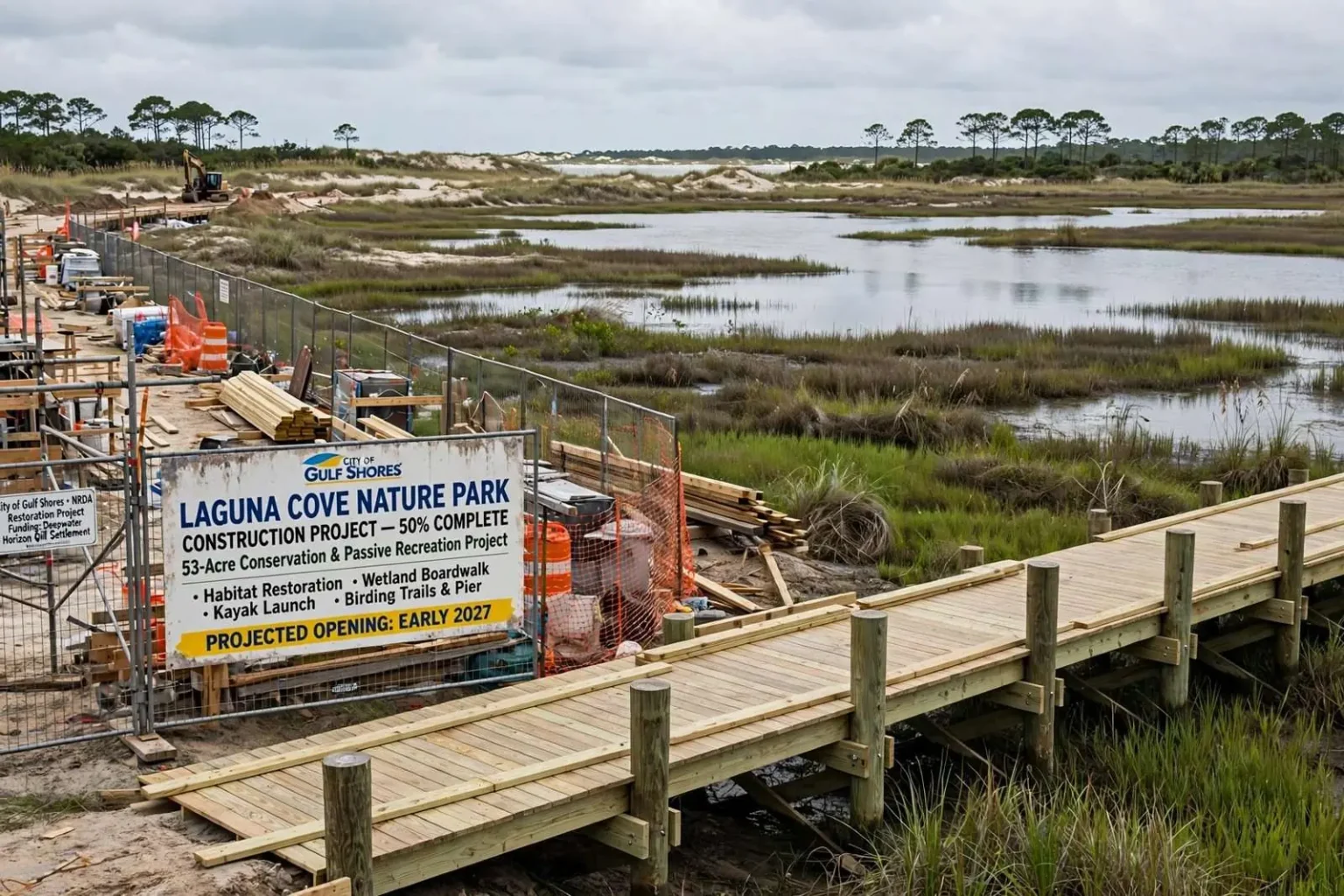
GULF SHORES, Ala. — Construction on Laguna Cove Nature Park, a 53-acre conservation and passive-recreation project along the south shore of Little Lagoon, has reached the halfway mark, with the City of Gulf Shores now targeting an early 2027 opening — several months later than earlier projections that pointed to a fall debut.
The park sits at the western end of West Beach Boulevard, where 6,100 feet of undeveloped shoreline, wetlands and secondary dunes have long been considered some of the most ecologically valuable land left along the lagoon.
Gulf Shores city spokesman Grant Brown said the west end of the lagoon was very natural and provided a great way to see nature and what was important to protect.
From Development Site to Protected Habitat
The property was once part of a development proposal, but with almost no undeveloped shoreline left along Little Lagoon, city officials say preserving it took on new urgency.
Brown said there was very little property left, so it was really important to preserve the area and keep it in public use.
The City of Gulf Shores acquired the land in 2019 using $4.4 million in Natural Resource Damage Assessment (NRDA) funding administered by the Alabama Department of Conservation and Natural Resources. The city has since received a total of $6.4 million for the project, covering acquisition, engineering and design, construction and habitat restoration, and officials have said no general-fund tax dollars are being used to cover construction costs.
That money traces back to the 2010 Deepwater Horizon oil spill settlement. Dan Bond, director of natural resources for the City of Gulf Shores, said the funding source underscores the project’s broader purpose.
Bond said the NRDA funds came from the Deepwater Horizon Oil Spill and were a great example of using oil spill funding to restore and protect critical habitat along the Gulf coast.
Restoring Habitat Damaged by Decades of Storms
Beyond preserving open space, the project is designed to repair wetlands and dunes battered by storms dating back to Hurricane Ivan in 2004. Of the property’s 53 acres, 51 are set to be restored and permanently preserved, including wetlands and beach dunes.
Planned habitat improvements include osprey nesting structures and sand fencing to encourage dune growth and wildlife use, while new wetlands and submerged aquatic vegetation are expected to improve water quality throughout the Little Lagoon watershed.
Bond said protecting the important natural area would enhance water quality and habitat for the Little Lagoon watershed while providing passive public recreation opportunities.
What Visitors Can Expect
Once complete, the low-impact park will give residents and visitors rare public access to the lagoon’s western shoreline. Planned amenities include an ADA-accessible kayak launch, a pier extending out over Little Lagoon for walking and fishing, birding trails, wetland boardwalks, shade pavilions and a small walkway network through the site.
Bond said the park would offer many low-impact recreational opportunities, including a kayak launch, birding trails, wetland boardwalks, and shade pavilions.
Brown added that people could see what was being protected, value it, and keep it protected.
Construction Status
Crews are currently focused on site infrastructure and boardwalks. Curbing and concrete work are progressing, and the eastern boardwalk is nearly complete, with additional boardwalk construction continuing in the coming weeks. Asphalt Services is building the park under a $2.6 million contract, with design services provided by Goodwyn, Mills & Cawood.
With the project now about 50% complete, city officials say Laguna Cove Nature Park is on pace to open to the public in early 2027.
How NRDA Funding Works
Under the federal Oil Pollution Act of 1990, parties responsible for an oil spill must pay to restore the natural resources it damaged, through a process known as Natural Resource Damage Assessment. BP’s 2016 settlement over the Deepwater Horizon spill included up to $8.8 billion for NRDA restoration, which state and federal trustees allocate to projects across the five Gulf states, including land acquisitions such as Laguna Cove.
Related coverage from South AL News
- Crews Make Progress on Daphne's Bayfront Park Amphitheater, Still on Track for Spring 2027 Opening
- St. Louis Street 'Complete Streets' Project Reaches Halfway Point in Downtown Mobile
- Wolf Creek Park Grant: Foley Gets $163,620 for Boardwalk, Observation Tower
- Mobile County Targets Early 2025 Reopening for $9.5 Million Bayfront Park Overhaul