St. Louis Street ‘Complete Streets’ Project Reaches Halfway Point in Downtown Mobile
Mobile's 6 million St. Louis Street 'Complete Streets' project has moved into blocks eight and nine, with milling between Hamilton and Claiborne streets and a midweek closure between Hamilton and Franklin.
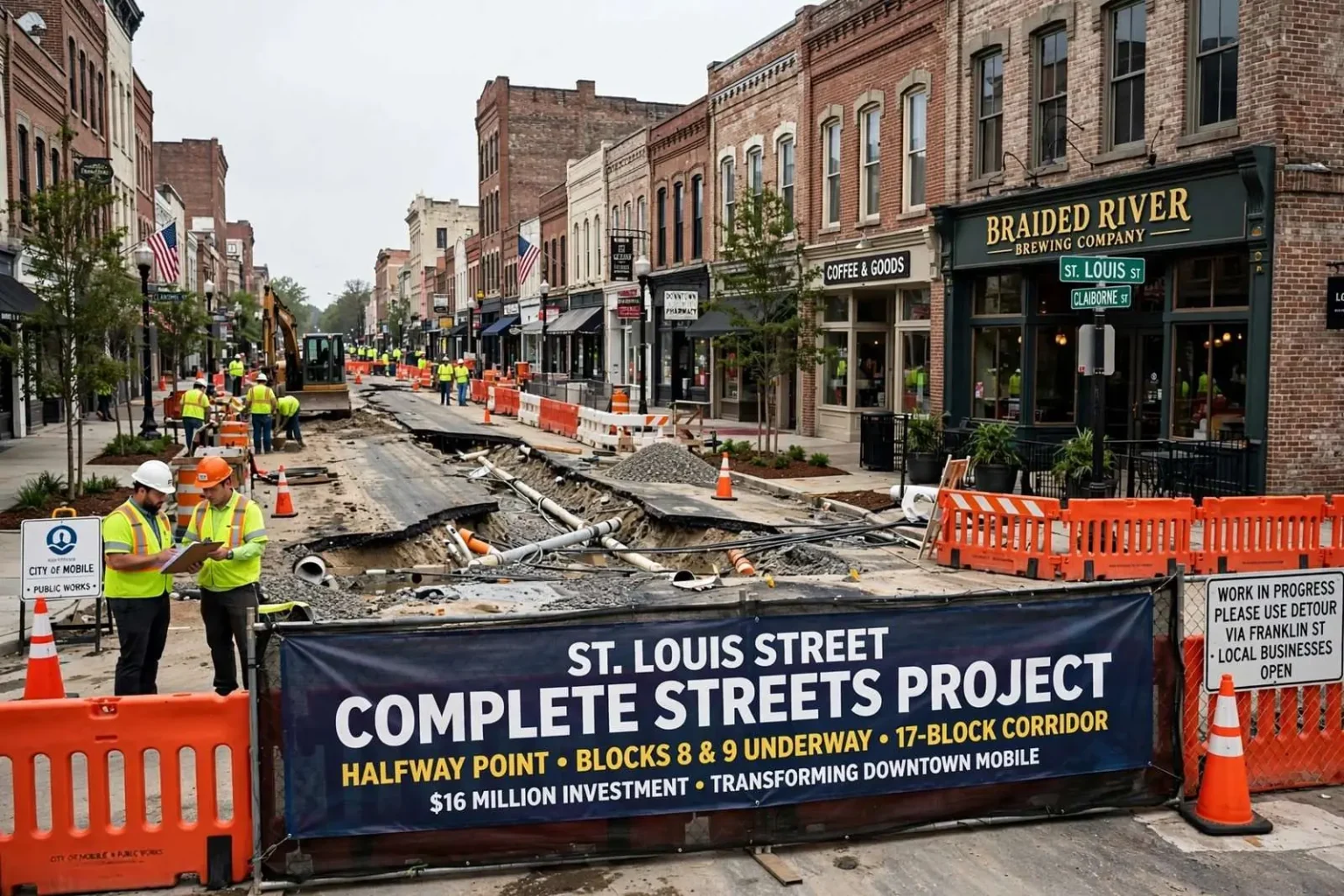
Mobile’s ambitious effort to remake one of downtown’s most traveled business corridors has reached the midpoint of construction, with crews now shifting into blocks eight and nine of the 17-block St. Louis Street ‘Complete Streets’ project. City officials marked the occasion with a public update at Braided River Brewing Company, framing the milestone as evidence that a project years in the planning is now visibly reshaping one of Mobile’s most historic commercial districts.
The $16 million investment goes well beyond simple resurfacing. Crews are rebuilding the roadway from the ground up, adding new landscaping, updated street lighting, ADA-compliant crossings, and upgrades to the water, sewer, and gas lines that run beneath the corridor. The project is also intended to improve stormwater drainage along a stretch of downtown that has periodically struggled with ponding during heavy rain. At the same time, Alabama Power and other utility providers are relocating overhead infrastructure, including power lines and fiber-optic cable, off the street and out of the sightlines that pedestrians and drivers share along the corridor.
“I am incredibly pleased to see this project reach the halfway point,” Mayor Spiro Cheriogotis said at the update. “This is a transformational effort that will not only improve the way people travel through downtown but will also update critical infrastructure in the area that will help us create a city that stands the test of time. I want to commend our dedicated city staffers and construction crews who’ve worked with businesses and residents along the corridor to minimize disruptions and lend support when needed. This has truly been a team effort, and the results have been outstanding so far. I can’t wait to see the end product.”
A Block-by-Block Approach
Rather than closing the entire corridor at once, the project has proceeded using a block-by-block construction method designed to limit the disruption felt by the businesses, residents, and visitors who depend on St. Louis Street. That approach has allowed the majority of the roadway and its connecting side streets, including key intersections, to remain open and accessible for most of the construction timeline. For a corridor that anchors one of downtown Mobile’s most popular business districts, keeping traffic moving even during active construction has been treated by city officials as just as important as the underlying infrastructure work itself.
That strategy reflects lessons that many mid-sized cities have learned the hard way during large downtown streetscape overhauls: a full corridor shutdown can choke off foot traffic to restaurants, retailers, and bars for months at a time, sometimes doing lasting damage to businesses that a project is ultimately meant to help. By moving in stages, Mobile’s construction team has tried to keep customers flowing to the shops and restaurants that line St. Louis Street even as work continues nearby.
Funding a Multi-Agency Effort
The project’s financing reflects the range of public agencies with a stake in downtown Mobile’s infrastructure. Funding comes in part from federal resources distributed through the Gulf Coast Ecosystem Restoration Council, known as the RESTORE Council, which channels money collected under the Resources and Ecosystems Sustainability, Tourist Opportunities, and Revived Economies of the Gulf Coast States Act of 2012 — commonly called the RESTORE Act. That law directs a portion of penalties tied to the 2010 Deepwater Horizon oil spill toward environmental and economic restoration projects across the Gulf Coast, and Mobile has used it as a recurring funding source for several major infrastructure upgrades in recent years.
Additional funding for the St. Louis Street project comes from the Alabama Department of Transportation, the Mobile Metropolitan Planning Organization, the Mobile Area Water and Sewer System, and the City of Mobile itself. That patchwork of state, regional, and municipal money is typical of large streetscape projects, which often bundle together transportation dollars, environmental restoration funding, and utility system upgrades into a single, more efficient construction effort rather than tearing up the same street multiple times for separate projects.
What Complete Streets Means for Downtown
The ‘Complete Streets’ design philosophy behind the project prioritizes creating a corridor that works for pedestrians, cyclists, and drivers alike, rather than a roadway designed primarily to move automobile traffic. In practice, that means wider and more accessible sidewalks, marked and protected crossings, better lighting for nighttime safety, and landscaping intended to make the corridor more inviting for people on foot. Moving overhead utility lines underground or off the streetscape entirely also opens up sightlines and reduces the visual clutter that can make a commercial corridor feel less walkable.
For a city working to keep its downtown vibrant amid competition from suburban shopping and dining options, those design choices carry real economic stakes. Streetscape investments of this kind are often justified in part by their potential to raise surrounding property values and support new private investment in surrounding buildings, even though the construction period itself can be disruptive for existing tenants.
What Comes Next
With blocks eight and nine now underway, the project remains on track to work its way through the remaining blocks of the 17-block corridor. City officials have not published a specific end date for the full build-out, but they have continued to emphasize the block-by-block model as the mechanism that will ultimately allow the corridor to reopen in full while minimizing the disruption felt by any single stretch of businesses for an extended period.
City leaders have framed the St. Louis Street project as one piece of a broader push to modernize downtown Mobile’s aging infrastructure while making the area more walkable and appealing to both residents and visitors. As construction moves past the halfway mark, officials say they expect the visible pace of progress to continue, with utility relocation, drainage upgrades, and streetscape improvements proceeding in tandem through the corridor’s second half.
A National Movement Toward Complete Streets
Mobile’s project is part of a design philosophy that has spread across hundreds of American cities over the past two decades. The National Complete Streets Coalition, formed in 2005, has worked with municipalities nationwide to adopt policies requiring that roadway redesigns account for pedestrians, cyclists, transit riders, and people with disabilities alongside motor vehicle traffic, rather than treating a street purely as a conduit for cars. That shift in engineering philosophy has been driven in part by research showing that narrower travel lanes, better lighting, and clearer pedestrian infrastructure can reduce crash rates in downtown commercial districts, even as they slow average vehicle speeds.
For legacy downtown corridors like St. Louis Street, which were originally built decades before Complete Streets principles existed, a full rebuild offers a rare opportunity to retrofit that older infrastructure rather than making incremental patch repairs that leave outdated design in place. That is one reason the project bundles utility work, drainage upgrades, and streetscape redesign into a single extended construction effort instead of tackling each element separately over a period of years.
Balancing Construction Disruption With Long-Term Gains
Business corridors undergoing major streetscape construction commonly face a difficult tradeoff: the improvements that ultimately make a district more attractive to shoppers and diners can, in the short term, discourage exactly the foot traffic those businesses depend on. Cities that have completed similar Complete Streets overhauls in other downtown districts have often reported a temporary dip in visible activity during construction, followed by increased pedestrian traffic and new private investment once the work is finished and the corridor reopens in full. Mobile’s block-by-block phasing approach for St. Louis Street reflects lessons drawn from those experiences elsewhere, aiming to spread out the disruption rather than concentrating it across the entire corridor at once.
The scale of Mobile’s investment — $16 million across underground utilities, drainage, lighting, and streetscape design — also reflects how much more expensive Complete Streets retrofits have become as they incorporate stormwater management alongside traditional paving and sidewalk work. Coastal cities like Mobile face particular pressure to build drainage capacity into any major street reconstruction, given the increasing frequency of high-intensity rainfall events along the Gulf Coast in recent years.
How the RESTORE Act Funds Gulf Coast Projects
The federal dollars flowing into the St. Louis Street project trace back to one of the largest environmental settlements in American history. After the 2010 Deepwater Horizon disaster killed 11 workers and spilled millions of barrels of oil into the Gulf of Mexico, BP and other responsible parties eventually paid tens of billions of dollars in civil and criminal penalties, natural resource damages, and economic claims. Congress passed the RESTORE Act in 2012 specifically to ensure that a substantial share of those Clean Water Act penalties would flow back to the five Gulf Coast states most affected by the spill — Alabama, Mississippi, Louisiana, Texas, and Florida — rather than disappearing into the U.S. Treasury’s general fund, which is where such penalties had traditionally gone. The law created the Gulf Coast Ecosystem Restoration Council to oversee a portion of that money and directed it toward projects that restore natural resources or support long-term economic diversification in coastal communities that depend on tourism, fishing, and the oil and gas industry. Because Mobile sits directly on Mobile Bay and was affected by oiling along its shoreline and economic disruption during the spill response, the city has repeatedly qualified for RESTORE funding, using it not just for environmental restoration but for infrastructure projects like St. Louis Street that officials argue strengthen the broader economic resilience of the waterfront and downtown business districts the spill once threatened.
Downtown Mobile’s Longer Revitalization Push
The St. Louis Street overhaul does not stand alone. It fits into a pattern that has played out in downtown Mobile over roughly two decades, as city leaders and private investors have worked to reverse decades of mid-20th-century decline that hollowed out many Southern downtowns once suburban shopping centers and highway bypasses pulled retail and residents away from historic city centers. Mobile’s downtown has seen a steady succession of adaptive-reuse projects converting former commercial and warehouse buildings into apartments, breweries, restaurants, and event spaces, with Braided River Brewing Company — the site of the city’s halfway-point announcement — itself an example of the kind of small business that has moved into the district in recent years. Municipal streetscape investment is a common companion to that kind of private redevelopment, because cracked sidewalks, outdated drainage, and aging utility lines can discourage the sort of ground-floor retail and residential investment that revitalization efforts depend on. Urban planners often describe this relationship as a virtuous cycle: public infrastructure spending signals long-term commitment to a district, which in turn gives private developers more confidence to invest in buildings nearby, which then generates additional tax revenue that can support further public improvements. Mobile officials have pointed to that dynamic explicitly in describing why the St. Louis Street corridor, one of downtown’s primary connectors between the business core and surrounding neighborhoods, was chosen for such an extensive rebuild rather than routine repaving.
ADA Compliance and the Cost of Retrofitting Older Streets
The project’s ADA-compliant crossings reflect a broader challenge facing older American downtowns. Sidewalks and intersections built decades before the Americans with Disabilities Act became law in 1990 routinely lack curb ramps, detectable warning surfaces, and crossing widths that meet current accessibility standards, and federal law requires municipalities to bring such infrastructure into compliance when they undertake substantial reconstruction of the public right-of-way. Retrofitting a historic corridor like St. Louis Street to meet those standards is typically far more expensive than building compliant infrastructure into new construction from the outset, since it requires re-grading sidewalks, relocating utility vaults and drainage structures, and sometimes narrowing travel lanes to make room for wider pedestrian space. That cost is one reason municipalities increasingly bundle ADA upgrades with drainage and utility work, spreading the expense of digging up a street across multiple infrastructure goals rather than treating accessibility as a separate, stand-alone project years down the line.
Update: Milling underway between Hamilton and Claiborne; closure coming midweek (Sept. 22, 2026)
The St. Louis Street Complete Streets project is moving into its next phase, with work now focused on blocks eight and nine of the 17-block corridor.
Crews have started milling between Hamilton and Claiborne streets, grinding away the old asphalt base layers in that section of the downtown business corridor. Milling is the step that clears the worn pavement so the roadway can be rebuilt.
The city plans to close St. Louis Street between Hamilton and Franklin streets midweek. The Franklin Street intersection will stay open for now, so drivers can still cross St. Louis Street there.
Drivers heading to businesses in that stretch should plan to use nearby parallel streets while the block is closed and watch for crews and equipment around the work zone. The closure follows the block-by-block approach the city has used throughout the project, which keeps most of the corridor and its side streets open while work moves from one block to the next.
Mayor Spiro Cheriogotis said the project continues to make steady progress as crews shift into new blocks. He credited the city’s Programs and Project Management team, led by Director Jennifer Greene, for working closely with residents, business owners and the contractor throughout construction to keep the work moving.
“I couldn’t be more excited to see the finished product,” Cheriogotis said. “I know it will change the way our residents navigate this area of downtown.”
When the work is complete, city leaders expect a safer, more walkable St. Louis Street that handles stormwater better, along with a thorough makeover for one of downtown Mobile’s major corridors.