Two Cities, Two Paths: Semmes and Fairhope Weigh Breaking Away From Their County School Systems
Fairhope is asking lawmakers for a referendum after 83% of survey respondents opposed leaving BCPS. Semmes, where 61% backed separation, is annexing school properties and commissioning a feasibility study.
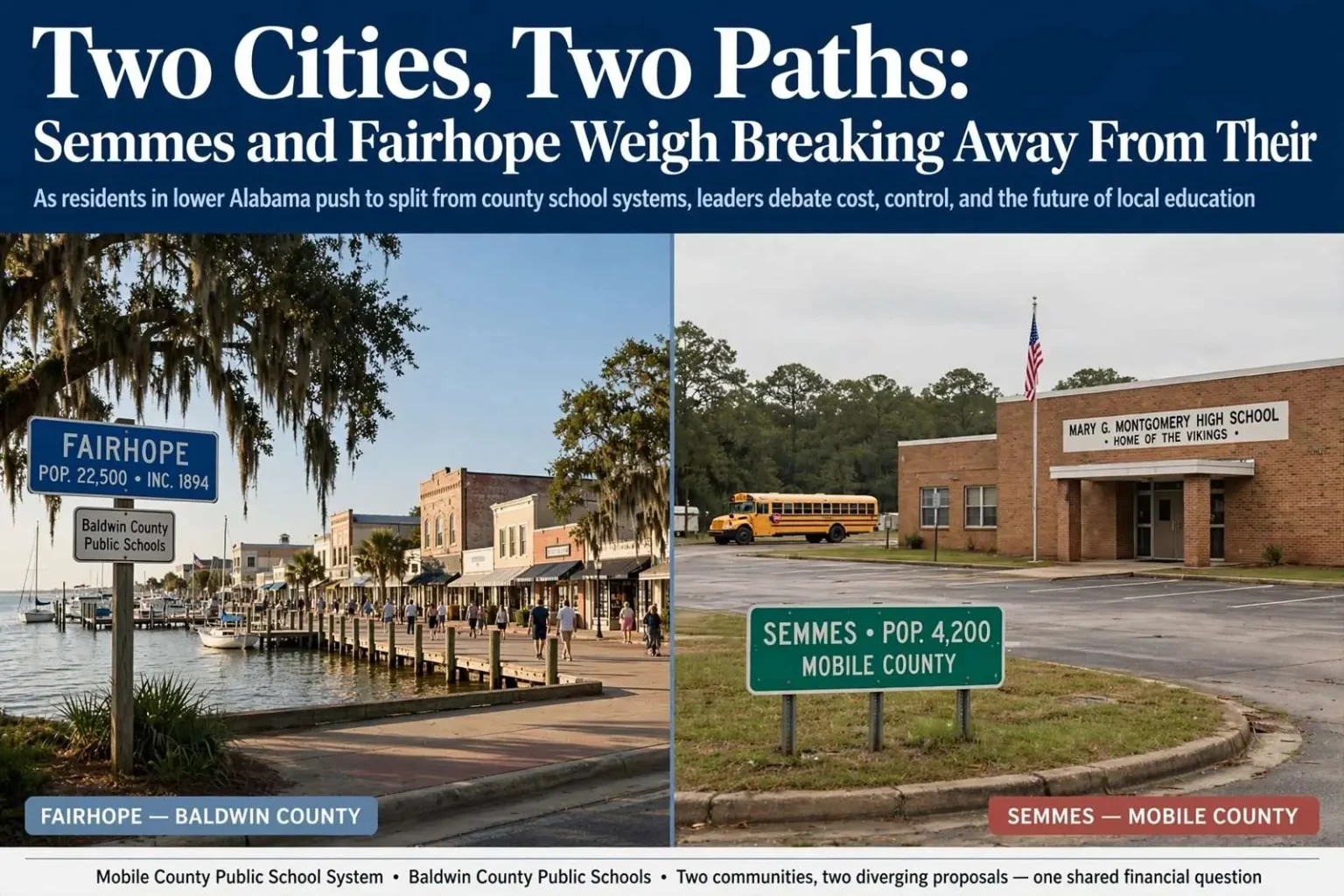
Two cities in lower Alabama appear headed toward a fork in the road as groups of residents in both push municipal leaders to split from their respective county school systems.
Where Fairhope leadership is turning to state lawmakers to carve a path toward giving residents a clear voice on the idea, leaders in Semmes are gathering data to assess the feasibility of a local school system and annexing several school properties.
“For us right now, we’ll just continue moving forward,” Fairhope Mayor Sherry Sullivan said. “When this comes back up, [Fairhope residents] will have all the resources and tools available.”
“At this point, it’s not a matter of if, it’s a matter of when,” Semmes Mayor Brandon Van Hook said.
Different Reasons, Same Financial Wall
What separates the two cities’ interest in leaving their systems — the Mobile County Public School System for Semmes and Baldwin County Public Schools for Fairhope — are the circumstances and reasons for leaving in the first place, Sullivan and Van Hook said.
Both cities, however, would face similar financial challenges that could stop the idea before it advances.
They Would Not Be the First
If the cities separated, they would join several others that have done so within the past 20 years.
In Mobile County, Semmes would be the fourth city to leave MCPSS. Saraland left in 2008, and Chickasaw and Satsuma followed in 2012. In Baldwin County, Fairhope would be the third, with Gulf Shores leaving in 2019 and Orange Beach in 2022.
That pattern is itself part of the argument on both sides. Supporters point to the precedent; opponents point out that each departure narrows the tax base of the county system left behind.
What the County Systems Say
Representatives from BCPS and MCPSS did not respond to several questions by press time.
BCPS Superintendent Marty McRae did say he was glad Fairhope is staying in BCPS after Sullivan canceled two public interest meetings in August.
“The citizens of Fairhope have spoken and spoken loudly,” McRae said. “We are happy that the Fairhope family isn’t changing, and the Baldwin County Public Schools system family is staying together.”
The issue, however, is hardly settled.
Fairhope: A Minority Push for Local Control
In Fairhope, the share of residents pushing for independence is considerably smaller than in Semmes. That group is focused largely on the city having primary control over curriculum and finances.
Amy Thompson, an education independence advocate in Fairhope, made that case during an August town hall where most speakers opposed leaving BCPS. She called the idea a “natural progression” toward more local control of education.
“This is not a divorce,” she said. “Our very own state constitution calls for cities that are over the population of 5,000 to separate and form their own entity. … Imagine a school board uniquely focused on our priorities, vested in our community.”
The Survey That Stopped It
According to a public survey conducted by the city of Fairhope, 83% of about 1,400 respondents said they strongly opposed leaving BCPS.
Other results found 89% are satisfied with the Baldwin County Board of Education, 81% oppose a property tax increase to create a city school system, and 52% of respondents have children in the school system.
Those numbers likely reflect performance. Fairhope’s schools rank among the best in the state under 2024-25 accountability grade rankings — a key difference between Fairhope and Semmes that Sullivan noted directly.
At the August town hall, every person who spoke opposed leaving BCPS, cautioning that separation could be costly both to residents and to education outcomes.
Semmes: A Different Set of Numbers
In Semmes, which has not held public interest meetings, Van Hook said a city survey showed residents want independent schools to improve education outcomes and establish local control.
Fifty-two percent said Semmes schools do not receive adequate investment. Sixty-four percent said city schools would be better than under MCPSS. Sixty-one percent directly supported leaving MCPSS.
“The top 10 school systems in the state are all municipal school systems, and that’s because they have more local control,” Van Hook said. “Their funding stays in their city. They’re able to invest in their kids more, and that’s what it’s all about at the end of the day.”
In the Semmes area, the Alabama Department of Education mostly reported schools as B or C schools in its most recent rankings.
A Building That Has Not Changed Since 1999
Van Hook grounded the investment argument in a specific building.
“I graduated from Mary G. Montgomery High School in 1999, and that school is exactly the same outside and inside that it was in 1999, except for they added one wing and then an auditorium,” he said. “That’s it. Everything at that school is the same. That’s from 1999, and so we’re not putting the money back into our community, and that’s a big problem. We’re taking money from our community, and that’s what this feasibility study will show.”
McRae, for his part, told the Fairhope town hall that BCPS has invested roughly $25 million in Fairhope facilities and education over the last five years, and plans another $8 million to $10 million over the next two years on yet-unannounced projects. BCPS is also looking for sites for a new elementary school in the area.
Fairhope’s Legislative Route
Sullivan said she has asked State Sen. Chris Elliott, R-Josephine, and State Rep. Jennifer Fiddler, R-Silverhill, to file legislation giving Fairhope residents a chance to vote on a referendum on separating from BCPS. Residents would also vote on annexing the Barnwell community into Fairhope.
City leaders initially wanted a referendum but discovered earlier this year that the city cannot hold a binding one — the power to separate rests solely with the City Council.
Elliott, who previously authored legislation establishing the exact costs Baldwin County cities pay to separate from BCPS in 2019, said he intends to file a bill creating the possibility of a referendum.
“Currently, it is a City Council decision, full stop, and that’s what’s happened in Gulf Shores and Orange Beach,” Elliott said. “I want that to remain an option, but if folks anywhere want to have that ability to call for a referendum, I think they ought to be able to do it. It’s an important issue. It affects communities very significantly.”
The Barnwell Question
The second element of Sullivan’s approach is annexing Barnwell, a community containing many Fairhope school students. She said some who opposed leaving BCPS may have done so because that community could be left outside a city school system.
“From an annexation standpoint or legislative annexation, we want to make sure we give people outside the city limits every tool they need to be part of the system,” she said.
Semmes: Annex First, Separate Later
Van Hook said Semmes is working with MCPSS to annex the schools most of its students attend before going further on leaving the county system.
The city attempted last year to have the Legislature pass a bill annexing the schools into its city limits, but it died before reaching a floor vote in either chamber.
Rusty Glover, who represents Semmes and takes office later this year in the State Senate, said he is willing to file an annexation bill this year or support similar legislation.
Van Hook said his administration is determined to have a feasibility study done sometime next year and to work with MCPSS to separate amicably. “We’re going to try to work with the school board,” he said. “We’re going to do everything the right way, and we’re going to take every step.”
What Separation Would Cost
Fairhope’s experience offers Semmes a preview.
According to a study completed by Criterion, leaving BCPS would cost Fairhope roughly $91 million. That study further claims Fairhope would have to dip into its own coffers and raise property taxes by between $4 million and $7.6 million annually.
Sullivan said the Criterion work was not a full feasibility study but a fact-check of an earlier study by the Public Affairs Research Council of Alabama, commissioned by the group pushing for separation.
The Baldwin County Board of Education, asked to review the PARCA study, found it may have underestimated certain costs. “[BCBE] just felt like that it was going to cost us a whole lot more than what the PARCA study was indicating,” Sullivan said.
The PARCA study’s central conclusion was the opposite: that Fairhope would not have to raise property taxes and could fund separation from within its own budget.
“We knew that there would be additional steps that would have to be taken as far as doing a full-blown feasibility study,” Sullivan said. “We felt just for us to move forward or for us to even explore it, we were going to have to have a third party review those numbers, which is what we did.”
The gap between the two studies is the crux of the financial debate. One says the city can absorb the cost; the other says it cannot without a tax increase — and both were produced by credible analysts working from different assumptions about what a new system must fund.
The Tax Problem
In Semmes, 25% of survey respondents supported raising property taxes to fund a city school system, while 29% directly opposed raising taxes at all.
Van Hook said that could be the largest hurdle. “We have no ad valorem tax at all, and so that includes property, anything, and deals with that. We would have to implement a property tax,” he said.
In Fairhope, several residents at the August town hall said they would not support the move if property taxes were raised — consistent with the 81% who opposed a tax increase in the survey.
Who Gets to Attend
The other unresolved question is whether students living outside city limits who currently attend those schools could continue to attend once they became city schools.
Van Hook said that issue will be evaluated once Semmes’ feasibility study is complete. Sullivan said annexing Barnwell would address part of it in Fairhope, but that at some point city lines “will matter.”
“Like I said in my Facebook post, the lines matter, and you choose where you live,” she said. “People need to realize that there are costs associated with creating school systems, costs associated with students going there, and at some point, that’s what it’s going to come down to.”
Where It Goes From Here
Sullivan predicted in her letter canceling future interest meetings that the movement would outlive her tenure as mayor.
“I may or may not be mayor when this issue comes back up, but whenever that day comes, I hope we can approach it differently,” she said, noting that debate had become borderline hostile from residents opposing separation. “I hope we can have the respectful, thoughtful dialogue that this issue and most importantly, our children deserve.”
Update: Semmes Hires an Attorney to Guide the Process
Semmes has taken a concrete step toward a standalone school system, approving the hire of local attorney Nash Campbell to advise the city while it waits on the findings of a feasibility study.
Students in Semmes currently attend schools operated by Mobile County Public Schools, including Semmes Elementary, Semmes Middle and Mary G. Montgomery High School. A community survey conducted by the city found strong appetite for change.
“The survey was overwhelming for the city of Semmes wanting to have a school system,” Semmes Mayor Brandon Van Hook said.
The Funding Problem
Van Hook said local control would come at a cost. About 95 percent of the revenue the city currently operates on comes from sales tax, and a standalone school system would require a new source of funding — most likely an ad valorem property tax.
“Of course the ad valorem question was asked. Some people wanted to know more about the ad valorem, and we’ll have some folks opposed, and then we’ll have some who will pay whatever if it gives us more local control,” Van Hook said.
Precisely how much residents might pay is one of the questions the feasibility study is expected to answer.
“I’m not a school person, I’m not an attorney, so we have to surround ourselves with the people who know what they’re doing in order for us to make educated decisions,” Van Hook said.
An Annexation Hurdle
Cost is not the only obstacle. The schools serving Semmes sit within Mobile city limits, which means the city would need to pursue annexation if it wants those properties under a new Semmes system.
“That’s one of the reasons we hired Nash, he can help guide us through this process,” Van Hook said. “Hopefully when the feasibility study is completed and we have the information needed to show that we can create and implement a school system, sustain a school system then we can get that property annexed in.”
What Comes Next
Van Hook said the goal is not simply separation from Mobile County schools but responsiveness to what families in the community have asked for.
“We want to be sure that we’re doing what’s best for our community, and honestly, first it’s for our children and their education,” Van Hook said.
The city expects results from the feasibility study by the end of November.
One point of contention in the run-up to the meetings was that the pro-separation group, which commissioned the PARCA work, did not release an unaltered version of the study before the first public interest meeting — only a two-page summary posted to the city’s website. That summary found Fairhope would have about $14,158 to spend per student, would need to spend roughly $8.6 million annually after paying off an undetermined debt service, and would serve about 2,835 students. It did not include the cost of separating from Baldwin County Public Schools. Council members Jack Burrell and Jimmy Conyers said the withheld study may have contributed to the pushback the group received, though they noted it was the group’s right not to release it.
Amy Thompson, a member of the group pushing for independence, said she was disappointed in the cancellation of the community meetings but respected the mayor’s decision, while criticizing the city’s survey as “not the kind of professional, independent poll” she would use to gauge community sentiment. Sullivan, for her part, used her announcement post to advocate for several legislative changes that could reshape any future debate — including allowing a locally imposed education tax to “follow the student,” giving city residents a vote on forming an independent system, and annexing the Barnwell area, an unincorporated community whose children attend Fairhope schools.
The numbers behind the original push
Fairhope’s exploration of a split began in earnest more than a year earlier, when the City Council approved a $20,000 study of the idea. The January feasibility study it produced estimated that only about 2,624 students would have attended city schools in the 2024-25 school year, and it put the startup cost of a new system at more than $91 million. That figure included $3 million to establish reserve funds, $35.4 million in Baldwin County school debt the city would absorb, $30.3 million in forfeited county reserve funds and $18 million in property acquisition, each piece tied to a dedicated property tax of either three or 20 years’ duration.
The study concluded that taxpayers would need to fund the system at between five and 10 mills — valued at about $738,000 per mill in the city — adding between $4 million and $7.6 million in property tax revenue per year, and that forming a municipal system would take about two years.
The public hearings that were planned
Before the survey, the city had announced a series of public meetings for Aug. 18, Aug. 23 and Sept. 9 at 5:30 p.m. in the City Council Chambers to gauge interest and feasibility. The two August sessions were later canceled, and the city’s own survey — with 83 percent of respondents opposed — took the place of that conversation.
Where council members stood at the time
Council President Jimmy Conyers, who said the idea “comes up every few years,” described himself as undecided after years of opposing the idea, noting his own family’s experience with Baldwin County schools had been excellent from kindergarten through 12th grade. Councilman Jack Burrell said he supported gauging public interest but was otherwise “on the fence”: “If it’s not broke, you know, don’t fix it,” he said. Mayor Sherry Sullivan declined to share her own view, saying that as an elected official her responsibility was to listen to the citizens.