Fairhope School Split Push Faces Pushback as Group Withholds Full PARCA Study
Fairhope's push to form its own school system drew pushback at its first public meeting, as critics say a pro-independence group has withheld the full study behind its no-tax-increase claim.
Fairhope city officials have opened a two-month public comment period on a question that has surfaced repeatedly over the past decade: should the city break away from Baldwin County Public Schools (BCPS) and form its own independent school system? Three public meetings, an online survey and a dedicated email address will give residents multiple ways to weigh in before the Fairhope City Council decides whether to pursue the idea any further.
Carlton Spinks, a member of the group Hope for Fairhope City Schools, has argued that the city’s own feasibility study overstated how much a new system would cost. “Our argument is that that expense budget that they created was overbuilt,” Spinks said. “It will not take a millage increase to start a city school to have exactly what we have.” Spinks points to the PARCA-backed study as support for that position, while acknowledging the two dueling estimates leave the true cost somewhere in between. On the question of students who live outside Fairhope city limits — about 45% of those currently enrolled in Fairhope public schools, according to the Criterion study — Spinks said supporters want those students to be able to keep attending, potentially by paying tuition, though no amount has been determined. “What we’d like to do is keep everyone intact. We’d like to keep all of our outside students enrolled in the Fairhope school system. We’re not trying to eliminate them,” he said. Spinks said supporters have been considering a split from Baldwin County Public Schools for years, and while Fairhope already has an additional three-mill property tax overlay to support its schools, he said the push for a city system is about more than money. “Currently we’re basically competing with six other feeder patterns in the county for limited resources, and that’s the truth of it,” Spinks said. “So for us to get ahead, we need to do it ourselves because in their model of equity, you know, it’s just not going to happen through a county system.”
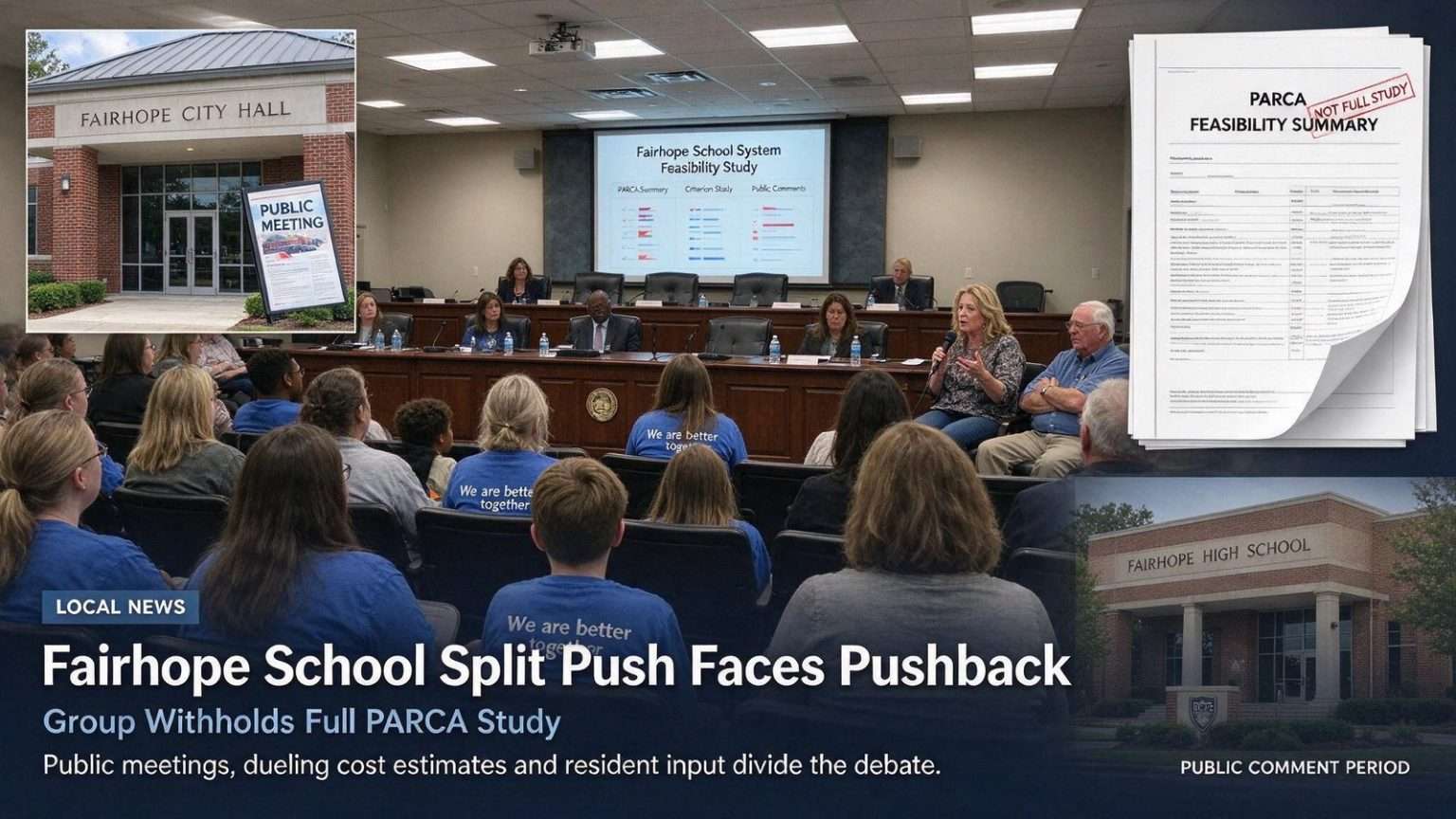
Update: The first of the three scheduled public meetings took place Tuesday night at Fairhope City Hall, drawing out parents and students eager to weigh in on the proposal. During the roughly hour-long session, only four people spoke in favor of forming an independent school system, and no one else in the room voiced support for the idea. Fairhope High School student Bethany Pierce urged residents to consider the school’s wide range of programs — including electives in music, art, fashion and financial literacy, as well as a dance program she is currently enrolled in — that she said could be put at risk if the city separated from Baldwin County Public Schools. One BCPS educator in attendance asked whether the hundreds of county-resident students who currently attend Fairhope schools would still be allowed to enroll under a city-only system, and whether new barriers would be placed in front of those children. Several parents and longtime residents echoed concerns that academic programs could be cut and that homeowners could face a higher tax burden under a new model. City officials also said Fairhope is working with state lawmakers to explore whether residents could get a direct vote on the proposal, since state law currently gives that authority to the city council rather than to voters, and pointed to a target start date of fall 2028 if the city ultimately moves forward with its own district.
The meeting also became a flashpoint over how much of the PARCA-backed study supporters have made public. Rather than releasing the full study, Hope for Fairhope City Schools has posted only a two-page summary on the city’s website, which states Fairhope would have about $14,158 to spend per student and would need to spend roughly $8.6 million annually once an undetermined debt service is paid off, for a system serving about 2,835 students. The summary does not spell out how much it would cost to separate from BCPS in the first place, though council members have said the underlying study claims Fairhope could break away without raising taxes and could even generate a surplus. Amy Thompson, who has been a public face of the push for a city system, did not return a request for comment on why the full study has not been released. Council members Jack Burrell and Jimmy Conyers told reporters after the meeting that withholding the full study appeared to be part of the reason the group faced pushback from residents, though both said it was ultimately the group’s right not to release it.
Laura Smith, a resident who has spent weeks reviewing public records tied to both the PARCA-backed summary and the city’s own Criterion feasibility study, told the meeting that neither analysis comes close to nailing down the true cost of Fairhope going independent. “This flyer (the PARCA summary) puts us millions of dollars off,” Smith said. “The Criterion study tries to be more thorough but made errors.” She pushed back on suggestions that she or other skeptics of the proposal have spread false information. “I feel frustrated by the comments that there was false information spread around, and that I know on my part, I read what they put out, and then I checked what (the flyer) told me about where it got its information,” she said. “If any of that was false, it’s because something they gave us wasn’t accurate.” Thompson, addressing the room, framed the push for a city system differently. “This is not a divorce,” she said. “Our very own state constitution calls for cities that are over the population of 5,000 to separate and form their own entity… Imagine a school board uniquely focused on our priorities, vested in our community.”
Additional residents used Tuesday’s meeting to press both sides on specifics. Amy Thompson, who supports forming a Fairhope system, also argued that a city-run district would let residents fund their own priorities rather than deferring to the county. “We would no longer be at the mercy of the county. We can vote to fund our own priorities,” she said, while acknowledging the change could mean higher taxes for residents. Not everyone in the room was convinced, however. Many attendees wore blue shirts reading “We are better together,” and several Fairhope High School students spoke against separating from Baldwin County Public Schools. Resident John Propp questioned enrollment figures cited by supporters of a new system, noting that advertised numbers for a Fairhope-only system, about 680 students, fall well short of Fairhope High School’s current enrollment of roughly 1,200, and asked where the difference would attend school. Fellow resident Shelia Propp raised additional concerns about funding and about which communities would retain ownership of existing school buildings if the city separated from the county system.
Additional feedback gathered from residents at the meeting reflected a range of views on the proposal. One resident praised the city’s current schools, saying, “I love the fact that Fairhope schools are top performing schools with a broad socio-economic student base. Our high school offers IB and AP classes, incredible athletic resources and everything in between.” Another resident raised concerns about losing access to shared resources under a standalone system, noting that “what works well for one school may not be enough to meet the needs of another, and the ability to share specialized staff across one system is an important resource that should not be overlooked.” A resident who lives outside Fairhope city limits asked what would happen to their child’s enrollment under a city-only system, while another argued the move would represent “a natural progression” rather than a break from the county, pointing to a provision in the Alabama Constitution that allows cities with populations over 5,000 to separate and form their own school systems. Still another resident said a city system could create an opportunity for a smaller elementary school in Fairhope.
City officials emphasized that opening the discussion is not a criticism of the current school system. “Fairhope has outstanding teachers, dedicated administrators, supportive parents, and students who consistently perform at a high level,” the city said in a news release announcing the process. “This discussion is not a criticism of our schools or the people who make them successful.”
Mayor Sherry Sullivan said the city has not taken a position on separating from the county system and is simply trying to gauge where residents stand. “I don’t think there’s a feeling one way or another,” Sullivan said. “Again, I think this is just a way for us to gauge public interest, to listen to the citizens and find out what they want.” She added that the city remains satisfied with its schools under county leadership: “The biggest thing that I would want folks to know is that Fairhope is absolutely happy with the current state of our schools right now. We’re happy with the administration, the teachers… but again it is our responsibility that we do our due diligence that we are offering the best educational opportunities for the children in Fairhope, and that’s all that we’re trying to do.”
A Recurring Question in Fairhope
The idea of a Fairhope-run school system is not new. In 2015, under then-Mayor Tim Kant, the Fairhope Advisory Committee asked the city council to study three options: breaking away entirely, creating a special tax district to boost funding for Fairhope schools, or remaining part of the county system. No decision was made, and similar discussions have also come up through past mayoral administrations and a community initiative known as “Good to Great.” At the time of the 2015 study, both Gulf Shores and Orange Beach were still part of the Baldwin County system.
The conversation resurfaced again in 2023, when Fairhope parents and city officials met to discuss the possibility. Baldwin County Board of Education Chief Financial Officer John Wilson said at the time that separating would likely hurt the city financially, presenting data showing that Fairhope’s 3-mill tax revenue, then about $3.5 million, would fall to roughly $2 million under an independent system.
City officials say the two reasons most often cited by residents who favor a city system are a desire for greater local control over educational decisions and a wish to improve and expand athletic facilities. Fairhope has also said that, in the past, county officials indicated they could not support facility upgrades in one community unless similar investments were made countywide, a philosophy the city says discouraged communities willing and able to invest more in their own schools from doing so. That concern led Baldwin County Public Schools to create 3-mill tax districts roughly five years ago. Fairhope became the first municipality in the county to adopt one, approving the agreement without a single revision, and Fairhope voters approved the measure with the highest margin of support of any 3-mill district in the county. Today, the Fairhope Public Schools Commission works with school principals to decide how those local dollars are spent, funding additions such as reading intervention coaches, math coaches and extra personnel. More recently, the Baldwin County Board of Education has approached Fairhope about possible partnerships to invest in the city’s athletic facilities, which city leaders describe as a positive development.
Two Feasibility Studies, Two Different Conclusions
Discussions intensified this year after a group of local parents commissioned and self-funded a feasibility study through the Public Affairs Research Council of Alabama (PARCA). That study examined per-student costs, an area the city’s own study did not focus on, and concluded a Fairhope city school system could be established without raising taxes. Supporters have so far released only a two-page summary of that study rather than the full report, and that summary does not detail what it would cost to separate from BCPS in the first place.
In response, the Fairhope City Council, which had approved spending roughly $20,000 on the effort more than a year earlier, commissioned its own six-month feasibility study from Birmingham-based Criterion K-12 Consulting Group. That study reached a very different conclusion: standing up a city system would very likely require a property tax increase.
According to the Criterion study, getting a Fairhope school system running could cost more than $91 million up front, a total made up of several components that would be financed through different property tax mechanisms: roughly $3 million for required reserve funds, funded by a three-year property tax; about $35.4 million in Baldwin County school debt the city would absorb, funded by a 20-year property tax; roughly $30.3 million in forfeited BCPS local reserve funds, also financed over 20 years; and about $18 million to acquire Baldwin County school properties not tied to existing debt, financed the same way.
Beyond those startup costs, the study found that current city revenues would not cover ongoing operating expenses for a school system. Sustaining the system would likely require an additional 5 to 10 mills in property tax, valued at about $738,000 per mill, amounting to between roughly $4 million and $7.6 million in additional annual property tax revenue, depending on how the city structured the system and how much debt it assumed.
Using Fairhope’s average home value of about $472,000, a 5-mill increase would cost a homeowner roughly $236 more a year, or about $20 a month; a 10-mill increase would run about $472 a year, or nearly $40 a month. “I believe at the end of the day that it’s somewhere in the middle, and I do believe there’s going to have to be a millage increase if we want to do it bigger and better,” Sullivan said, noting that costs would also depend on whether a city system served the full Fairhope feeder pattern or only students who live inside city limits. “Right now only 55% of the students that go to Fairhope public schools are in the city limits, so if you cut out 45% of your population, obviously your cost drops,” she said.
That enrollment detail matters for facilities, too. The study found only about 2,624 students would have attended a Fairhope-only system in the 2024-2025 school year, meaning existing school buildings would likely have substantial unused space if the city served only in-city students. That could allow Fairhope to avoid building new classrooms right away and free up room for programs such as pre-K, or for enrolling some students who live outside the city. The study estimated it would take roughly two years to stand up a municipal school system if the city chose to move forward, and concluded that “a city’s consideration of forming its own public school system is a significant deliberation that requires a permanent financial commitment of its citizenry both in beginning a new school system and sustaining it over future years.”
Looking to Gulf Shores and Orange Beach
Fairhope would not be the first Baldwin County city to leave BCPS. Gulf Shores’ city council voted in October 2017 to form its own system, which began operating in June 2019. Orange Beach followed, with its council approving a city system in March 2022 and opening for classes that August. Unlike Fairhope, both coastal cities benefit from substantial lodging tax revenue generated by tourism, which helps fund their school systems, a revenue source Fairhope does not have to the same degree.
Council Members Split, Undecided
City Council President Jimmy Conyers said the hearings will help council members make an informed decision. “This comes up every few years, and we feel like it’s something we owe to the citizens to at least look at and consider,” he said. The council previously looked into whether it could put the question to voters through a city referendum, but determined that option is not currently available under Alabama law. Conyers said he remains undecided after previously holding a firmly opposing view. “The challenge you’ve got is one study that says we can do it without raising taxes. We’ve got another study that says we need to raise taxes,” he said. “Is one more accurate than the other, or is the truth somewhere in the middle? I don’t know that.” He said his own family has had a positive experience in Baldwin County schools but acknowledged the appeal of more local control. After Tuesday’s meeting, Conyers told reporters the council’s goal at this stage is simply to sit and listen to what residents have to say, but he said separating from BCPS appears, at least for now, to be an unpopular idea among the residents who have turned out.
Councilman Jack Burrell said he supports gauging public interest but remains “on the fence” on the underlying question. “If it’s not broke, you know, don’t fix it,” he said. “I kind of see it like that, but I still am really anxious to hear what the people want. We know there’s at least one group of people that want an independent school system, but I don’t think we know how widespread that is.” On the financial question, Burrell said, “I’m not supportive of increasing taxes. One side of the argument is that you don’t need to. But part of me says, ‘if it’s not broke, why fix it?’” He described the parents pushing for a city system as longtime Fairhope residents with deep community ties, not recent arrivals. Council members Joshua Gammon, Andrea Faust Booth and Jay Robinson did not respond to requests for comment.
Residents Weigh In
Some residents are already advocating for separation. Education advocate Amy Greer-Thompson said instability within Baldwin County Public Schools has made community-driven, city-level leadership appealing. “There’s some instability and things that have happened within Baldwin County schools to make us think, okay, let’s manage our own ship here and avoid the chaos… think about six school board members that would be uniquely focused on Fairhope and its priorities and its needs versus now, one school board member on a board that’s forty-two miles away in Bay Minette,” she said.
Shelby Richmond, a parent of a first-grader, also supports exploring the idea. “I think it will be good for Fairhope,” she said. “I think it would be a nice, new learning experience for everyone to start and to try and do their own separation from Baldwin County schools.”
Baldwin County Schools Respond
Baldwin County Public Schools Superintendent Marty McRae, who was named permanent superintendent on July 16 after previously serving as interim following Eddie Tyler’s retirement, said the county values its partnership with Fairhope. “We are the third largest school system in the state, but we value each of our feeder patterns equally,” McRae said in a statement. “Partnerships with our cities are very important to us and we would be very disappointed to lose our Fairhope partnership. We appreciate the support we’ve received from the city and know they are happy with the services we provide.” McRae said BCPS officials plan to attend the city’s first public meeting to help answer questions from residents and city leaders. Following that meeting, McRae said BCPS has invested roughly $25 million in Fairhope facilities and education over the last five years, with additional projects planned over the next two years that have not yet been announced publicly. The district is also actively searching for potential sites to locate a new elementary school in the Fairhope area.
How to Weigh In
The city has scheduled three public meetings, all at 5:30 p.m. in the Fairhope City Council Chambers at the Fairhope Civic Center, located at the corner of North Section Street and Oak Avenue: Tuesday, Aug. 18; Sunday, Aug. 23; and Wednesday, Sept. 9. Each meeting will be livestreamed, with an overflow viewing area set up in the building’s lobby for anyone who cannot find a seat in the chambers.
Residents who cannot attend in person can complete an online survey available through the city’s website, or submit comments by emailing [email protected]. City staff plan to present a summary of all the public input, gathered from the meetings, survey and emails, to the Fairhope City Council during its Sept. 28 meeting. City leaders have stressed that no vote on separating from Baldwin County Public Schools is expected at that meeting; instead, the council will use the feedback to decide whether pursuing an independent school system merits further study.
“What would happen (on Sept. 28) is that we would hopefully have enough feedback and information to say, ‘is this something we want to pursue?’” Conyers said. “And then start the next steps.” Sullivan echoed that the process is meant to gauge interest rather than signal a decision already made, adding that she does not “foresee anything happening quickly.”