Alabama License Plate Reader Bills Take Shape as Gulf Shores Weighs Flock Cameras
Alabama legislators are preparing bills to set statewide rules for automated license plate readers, as Gulf Shores weighs resident privacy concerns against police support for its 87 Flock cameras.
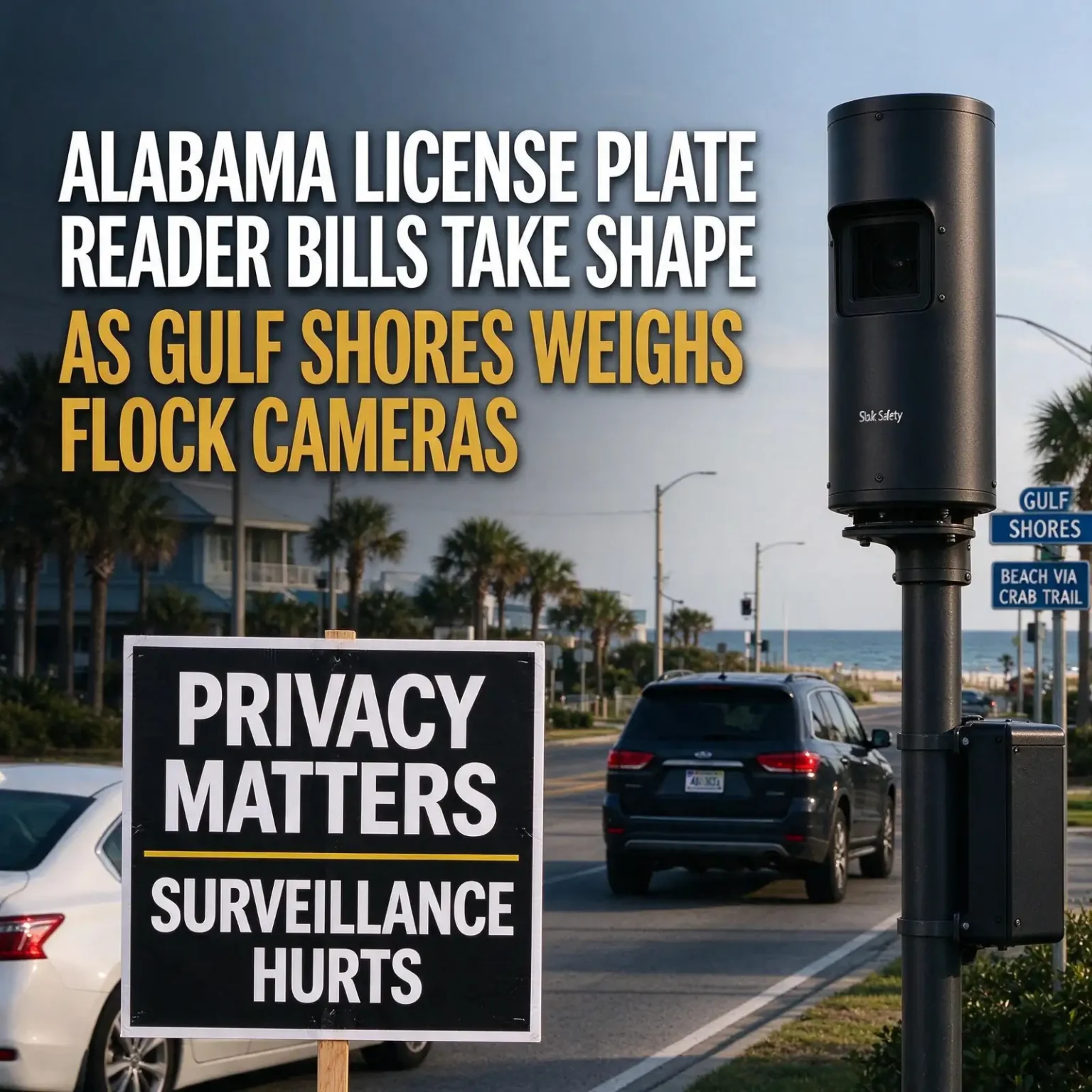
GULF SHORES, Ala. — Alabama license plate reader bills are being prepared for the coming legislative session, setting up a statewide debate over cameras that have already sparked pointed discussion in this beach city. Legislators plan to propose rules that would let police keep using automated license plate readers, including networked cameras made by Flock Safety, while placing new legal limits on how the data is stored, who can search it and how the systems are monitored.
Gulf Shores offers a close-up view of the questions lawmakers will face. After the city installed 87 Flock cameras, residents and local high school students went to City Council work sessions to raise concerns about privacy and surveillance, while the city’s police chief defended the program and pointed to department safeguards and recent cases in which the cameras helped officers.
What the Proposed Legislation Would Do
Alabama does not currently have a uniform set of statewide rules specifically governing automated license plate readers, often called ALPRs. The bills being prepared are intended to fill that gap by establishing consistent standards for agencies across the state.
According to the outline of the proposals, the legislation would address several areas:
- How long license plate data may be retained, with shorter retention windows than some agencies may now use.
- Authorized uses of the systems, defining when officers may run searches.
- Warrant requirements for certain types of searches.
- Oversight of the systems, including auditing procedures meant to prevent misuse.
The overall approach would allow law enforcement to keep the technology while setting boundaries in state law. Supporters of that model describe it as a middle path between banning the cameras and leaving their use unregulated. Details such as final bill language and specific retention limits will become clearer once the measures are formally filed.
How Automated License Plate Readers Work
An automated license plate reader is a camera system that photographs passing vehicles and uses software to read their plates. The system generally records the plate number along with the date, time and location of the image, and in many systems a photo of the vehicle itself.
Those reads can be compared against lists of plates that police are looking for, such as vehicles listed as stolen or tied to missing persons alerts. When a match occurs, the system can send an alert to officers. The stored reads can also be searched later, which is where most privacy concerns arise, because a collection of reads over time can show where and when a particular vehicle traveled.
What Makes Flock Different
Flock Safety, based in Atlanta, sells fixed cameras that are commonly mounted on poles along roadways and at city entrances. Its systems are cloud-based and can be networked, which allows participating agencies to share and search data under the terms they set. That networking capability is a major selling point for law enforcement and a frequent focus for privacy advocates, since it can widen the reach of any single camera.
The Gulf Shores Experience
Gulf Shores deployed 87 Flock cameras, a significant network for a city whose population swells with visitors during tourist season. The rollout drew public attention, and residents along with high school students used City Council work sessions to voice their worries.
Those concerns centered on the potential for mass surveillance, the continuous tracking of vehicles as they move around the city, and possible privacy violations. The participation of high school students was notable, reflecting interest in the issue among younger residents who are growing up with cameras as a routine part of public life.
The Police Department’s Response
The city’s police chief defended the camera program while acknowledging that strong safeguards are necessary. The department has put several policies in place that it says are designed to prevent misuse and build public trust.
Under those policies, officers must enter an active incident number before they can run a query in the system, meaning searches are tied to a specific case rather than conducted at random. The department has conducted regular audits of system use. License plate data is kept for no more than 30 days. Looking ahead, the department has said it intends to create a transparency portal open to the public, which would give residents a window into how the system is used.
Why Local Policies May Shape State Debate
Local policies like those adopted in Gulf Shores often serve as reference points when legislators consider statewide rules. Requirements such as tying each search to an active case, auditing who runs queries and limiting how long data is stored are among the kinds of measures the proposed state legislation is expected to address. How closely any final law tracks practices already used by individual departments remains to be seen.
For departments that have not adopted their own written policies, a state law could set minimum standards for the first time. For those that already have detailed rules, a state framework could either confirm their approach or require adjustments, depending on how the legislation is written.
The Case for the Cameras
Law enforcement officials across Alabama and the country generally regard license plate readers as a valuable crime-fighting tool. The technology can quickly flag a vehicle connected to a crime or an emergency, potentially saving hours of investigative work.
In Gulf Shores, the city has pointed to concrete examples. Flock alerts have helped officers find missing people with dementia, who were the subject of Silver Alerts, within minutes. The cameras have also helped police track down suspects fleeing in stolen vehicles.
Silver Alerts are issued to help locate missing older adults or people with cognitive impairments, and time is often critical in those cases. A camera network that can spot a vehicle associated with a missing person may shorten a search considerably, which is one reason police agencies emphasize those cases when explaining the technology to the public.
The Case for Stronger Limits
Privacy advocates and civil liberties groups take a different view of the same capabilities. They argue that logging millions of vehicle movements on public roads creates a broad surveillance footprint, one that could infringe on civil liberties if it is not kept in check.
Their concerns typically focus on several questions. How long is data kept, and who can see it? Can information be shared with other agencies or outside parties? What prevents an individual officer from searching for someone for personal reasons? And can a record of where a person drives reveal sensitive details about their life, such as visits to medical offices, places of worship or political gatherings?
Advocates generally argue that rules like warrant requirements, short retention periods and independent auditing are the minimum protections needed. Some go further and question whether such large networks should exist at all, while others focus on ensuring strict controls.
Questions Lawmakers Are Likely to Weigh
As the bills take shape, legislators will face a series of practical decisions. One is where to draw the line between searches that require a warrant and those that do not, such as responding to an active alert for a stolen car or a missing person. Another is how long data should be kept, since shorter windows reduce privacy risks but may limit investigators who need to look back at older records.
Lawmakers will also likely consider who conducts audits, what happens when misuse is found, whether data can be shared with agencies in other states or with federal authorities, and how much information agencies must disclose to the public. Each of those choices involves tradeoffs between investigative flexibility and individual privacy, and different groups are likely to press for different answers.
How Other States Have Approached the Issue
Alabama would join a number of states that have adopted laws addressing license plate readers. Approaches vary widely. Some states set firm limits on how long data can be stored, others restrict the purposes for which the systems may be used, and some require agencies to publish policies or report on their use.
Because laws differ from state to state, agencies that share data across state lines may operate under different sets of rules. A statewide standard in Alabama would generally give local departments a clear baseline and give residents a consistent set of expectations regardless of which city they drive through.
What Residents Can Do
For residents who want to follow or weigh in on the issue, there are several avenues. City Council meetings and work sessions in Gulf Shores and other communities are open to the public and typically include time for comment. Residents can also contact their state representatives and senators to share views on the proposed legislation once bills are filed.
When the Gulf Shores Police Department launches its planned transparency portal, residents may be able to review information about how the cameras are being used. Those who have questions about local policies can also contact their police department directly to ask about retention periods, audit practices and data-sharing agreements.
What Happens Next
The proposed bills are expected to be introduced during the upcoming session of the Alabama Legislature. Like any legislation, they would go through committee review and floor votes in both chambers, and their final form could change along the way as lawmakers hear from law enforcement, privacy advocates, local governments and the public.
By writing rules for license plate readers into state law, Alabama legislators aim to draw clear legal lines. Their stated goal is to preserve the capabilities police say they depend on while setting data privacy standards meant to protect the public. In Gulf Shores, where 87 cameras already watch the city’s roads, residents on both sides of the debate will be watching closely to see where those lines are drawn.