University of South Alabama Mobile
Three Mile Creek Dredging Plan Hinges on $6 Million Low-Interest State Loan
The City of Mobile is seeking up to $6 million in low-interest state funding to dredge about 10 acres of a sediment-filled basin on the University of South Alabama campus, part of a broader Three Mile Creek watershed effort.
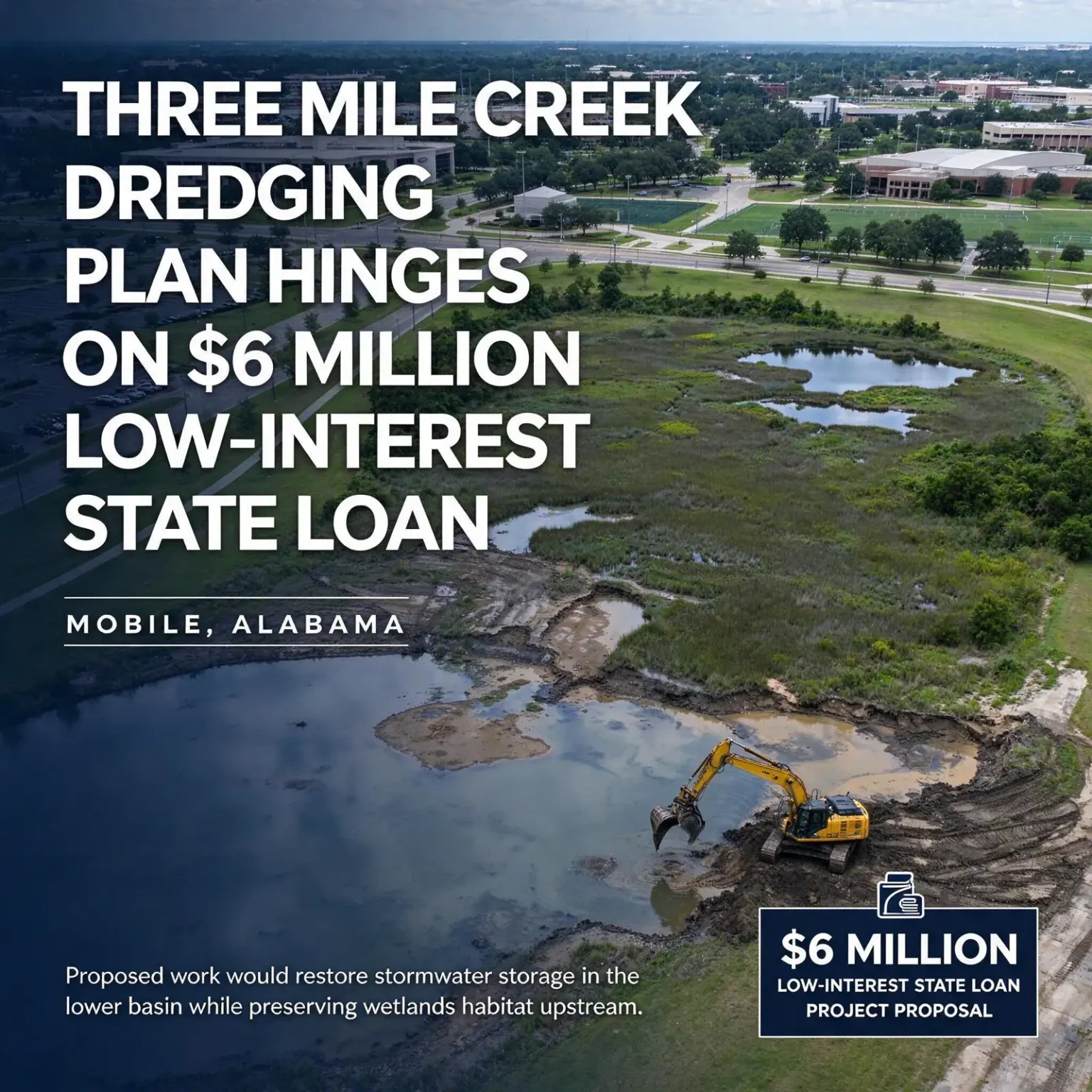
MOBILE, Ala. — Three Mile Creek dredging could soon move a step closer to reality as the City of Mobile pursues as much as $6 million in state financing at a low interest rate to pull decades of built-up sediment out of a stormwater basin on the University of South Alabama campus. City leaders say the work would help the basin hold more runoff during heavy rain, which could ease flood risk downstream and improve the quality of water moving through one of the city’s most important urban streams.
The proposed project targets roughly 10 acres in the lower portion of a campus water body that sits on university property just west of Langan Lake. The upper portion of the basin would not be dredged and would instead be kept as wetlands habitat. The effort is one piece of a larger, multi-project push to improve conditions across the Three Mile Creek watershed, including work at Langan Lake and along Twelve Mile Creek.
What the Project Would Do for Residents
For people who live and drive in the neighborhoods that drain toward Three Mile Creek, the practical question is simple: will the water go where it is supposed to go when a storm rolls through? City officials say years of sediment washing into the basin have steadily reduced how much stormwater it can hold. A basin that has partly filled with silt and soil simply has less room left for water, which can mean faster, higher flows moving downstream during intense rainfall.
By removing that accumulated material, the city aims to restore the basin’s original capacity to capture and slow stormwater. In general, a basin with more storage can temporarily hold runoff and release it more gradually, which can lessen the pressure on channels, culverts and pipes below it. Officials have described the project as one that may help reduce flood risk, while also benefiting water quality.
Residents should keep in mind that the city is still at the funding stage. The request for state financing is a step toward the work, not the start of construction, and timelines for dredging have not been announced.
Where the Basin Sits in the Watershed
The basin lies on the University of South Alabama campus in west Mobile, just west of Langan Lake, the familiar body of water inside Langan Municipal Park. That area forms part of the upper reaches of the Three Mile Creek watershed, a drainage area that collects rain falling across a large share of the city before the creek carries it east toward the Mobile River and, eventually, Mobile Bay.
Because the basin sits upstream of so many neighborhoods, what happens there has effects well beyond the campus. Water that is held back and filtered in the upper watershed generally arrives downstream in better condition and at a more manageable pace. Water that rushes through a filled-in basin carries more sediment and can contribute to flooding problems farther along the creek.
Two Halves, Two Purposes
The plan treats the basin as two distinct areas. The lower basin, covering about 10 acres, would be dredged to recover storage space. The upper basin would be preserved as wetlands habitat. That split reflects a common approach in watershed work, where engineers seek to restore function in one area while protecting natural features that already provide value in another.
Wetlands typically act as natural sponges and filters. Dense vegetation slows moving water, gives suspended particles a chance to settle out, and can take up some nutrients that would otherwise flow downstream. Wetland areas also tend to provide habitat for birds, amphibians, fish and insects, which is part of why many restoration plans seek to keep them intact.
Why Sediment Builds Up in Urban Basins
Sediment buildup is one of the most common problems facing stormwater basins and urban lakes. When rain falls on bare soil, construction sites, eroding stream banks, ditches and other exposed ground, it can loosen and carry particles of sand, silt and clay. As that muddy water reaches a basin or lake where the current slows, the particles drop to the bottom. Over years and decades, those layers can add up to a significant volume of material.
City officials say that is precisely what has happened at the campus basin, where sediment-laden runoff over several decades has eaten into the capacity the basin was meant to provide. The process is gradual, which is part of why it can go unnoticed until a basin’s performance during storms clearly declines.
Sediment also affects water quality in ways that go beyond storage space. Fine particles can cloud the water, block sunlight that aquatic plants need, and smother bottom habitat. Sediment can also carry attached pollutants, such as nutrients, metals or bacteria, which then settle where they can be stirred up again. Removing built-up material and slowing future runoff are both common strategies for addressing those concerns.
How Dredging Generally Works
Dredging is the process of excavating material from the bottom of a body of water. Depending on the site, contractors may use mechanical equipment, such as excavators or clamshell buckets, or hydraulic systems that pump a mixture of water and sediment through a pipeline to a disposal or drying area. The removed material typically must be dewatered and then handled according to environmental requirements.
Projects of this kind generally require planning for where the sediment will go, how the work will avoid harming nearby habitat, and how water quality will be protected during construction. Specific methods for the Mobile project have not been detailed publicly at this stage.
How Low-Interest State Funding Typically Works
To pay for the work, the city hopes to borrow as much as $6 million from the state at a low interest rate. In Alabama and across the country, water infrastructure projects are often financed through state revolving fund programs, which are supported in part by federal dollars and administered at the state level. In Alabama, those programs are administered by the Alabama Department of Environmental Management.
Revolving fund programs generally work like a community lending pool. A state makes loans at below-market interest rates to local governments and utilities for eligible water quality, stormwater or drinking water projects. As borrowers repay the loans, the money returns to the fund and can be loaned out again for future projects, which is what gives the programs their revolving name.
For a city, the main appeal is cost. A lower interest rate can save taxpayers a meaningful amount over the life of a loan compared with conventional borrowing. Applying for such financing usually involves submitting project plans, cost estimates and environmental information, and projects are often ranked against others competing for the same pool of money. Approval of the city’s request has not been announced.
A Piece of a Larger Watershed Effort
The campus basin project is not a standalone fix. City officials see it as one component of a wider campaign to make the entire Three Mile Creek watershed healthier. Other pieces of that campaign involve Langan Lake and Twelve Mile Creek, both of which feed into the same drainage system.
Watershed-scale planning has become a widely used approach for urban streams. Rather than treating each flooding or pollution problem in isolation, planners look at how water moves across an entire drainage area, from rooftops and parking lots to ditches, tributaries and the main channel. Improvements upstream can make downstream projects more effective, and coordinated work can help limit the chance that solving a problem in one place simply shifts it somewhere else.
Three Mile Creek has drawn sustained attention from local governments, environmental groups and community organizations over the years, with efforts focused on cleaning up the waterway, restoring habitat and reconnecting residents to the creek. The basin dredging proposal fits within that long-running push to treat the creek as a community asset rather than simply a drainage channel.
Why Upstream Work Matters Downstream
Communities farther east along the creek often feel the effects of what happens upstream. When the upper watershed holds water longer and sends cleaner flows downstream, it can lighten the load on low-lying areas that tend to see trouble during heavy storms. That is one reason projects near the creek’s headwaters, including the campus basin and Langan Lake, are viewed as important parts of the overall strategy.
The University Connection
Because the basin sits on the University of South Alabama campus, the project involves property that serves thousands of students, faculty and staff, along with visitors who use campus facilities. Stormwater management on a large campus can be challenging, since roads, rooftops, parking areas and athletic facilities all generate runoff that has to go somewhere.
Preserving the upper basin as wetlands also keeps a natural area intact on campus. Green spaces and wetlands near universities are often valued not only for their environmental role but also as places for study and observation, though specific academic uses of this site have not been described.
What Residents Can Do to Help the Watershed
While large projects like dredging require public funding and engineering, everyday actions by residents can also make a difference in how much sediment and pollution reach Three Mile Creek. Environmental agencies commonly recommend several simple steps for households and businesses in urban watersheds.
- Keep grass clippings, leaves and yard debris out of streets and storm drains, where they can wash into creeks and lakes.
- Cover bare soil in yards with grass, mulch or ground cover to reduce erosion during rain.
- Use fertilizers and lawn chemicals sparingly and avoid applying them before a forecast storm.
- Pick up pet waste, which can contribute bacteria to waterways.
- Dispose of litter properly, since trash in streets often ends up in drainage channels.
- Report clogged storm drains or illegal dumping to the city so crews can respond.
Homeowners who are planning landscaping or construction projects can also look into practices such as silt fences, rain gardens or rain barrels, which can help hold soil in place and slow runoff before it leaves the property. Small changes repeated across thousands of properties can add up across a watershed.
What Comes Next
The immediate next step is the city’s pursuit of the state funding. If the low-interest financing is secured, the project would then move toward final design, any required permitting and eventual construction, though a schedule has not been released. Residents who want to follow the project can watch for updates through Mobile City Council meetings and city announcements.
For now, the proposal represents a targeted effort to recover lost stormwater capacity on about 10 acres of the lower basin while keeping the upper basin as wetlands habitat. Paired with efforts at Langan Lake and on Twelve Mile Creek, city officials see it as part of a long-term strategy to make the Three Mile Creek watershed cleaner, healthier and better able to handle the heavy rains that are a regular part of life on the Gulf Coast.