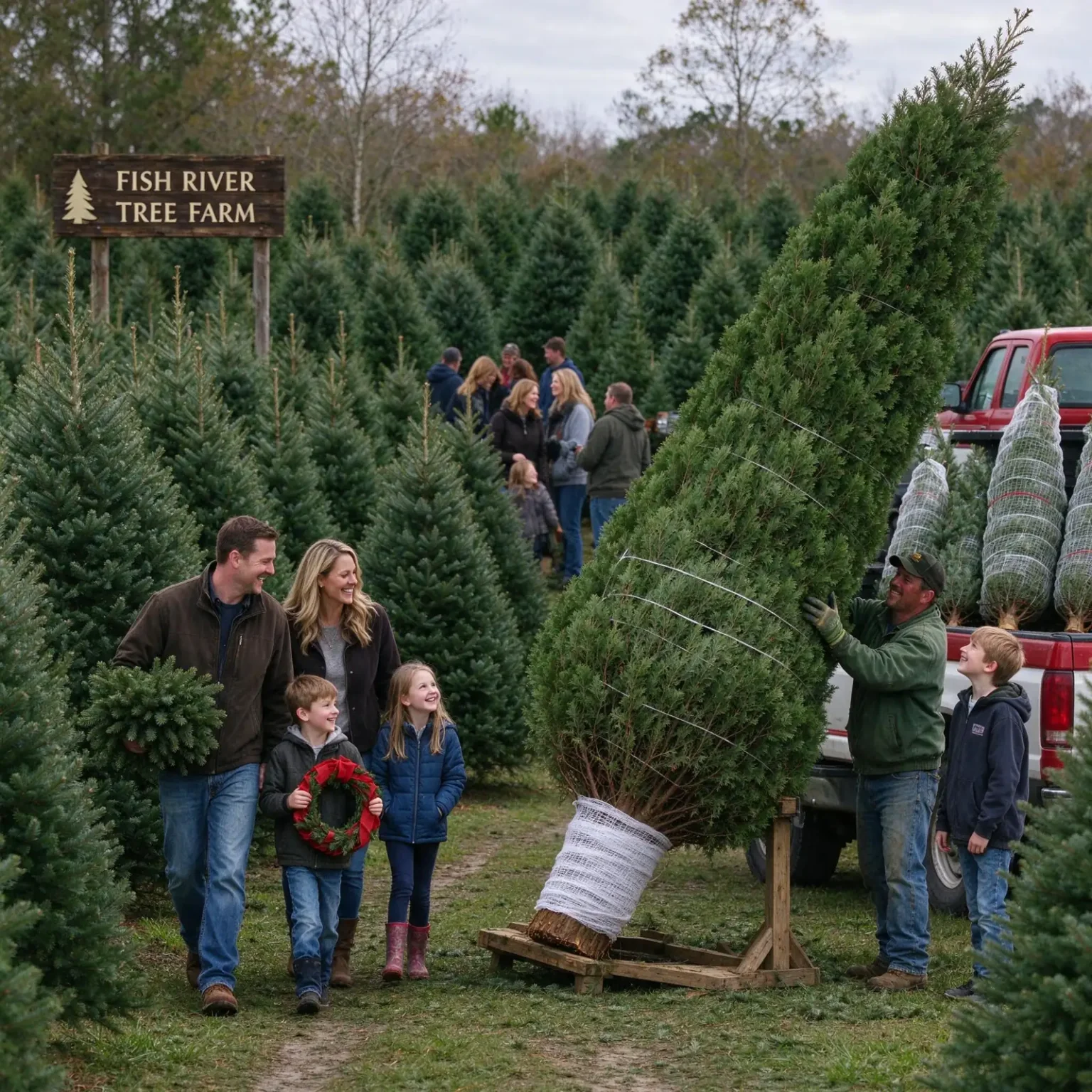
FAIRHOPE, Ala. — For many Baldwin County families, the most important purchase of the day after Thanksgiving was not found on a department store shelf. On Friday, Nov. 27, carloads of holiday visitors headed to Fish River Tree Farm near Fairhope to choose a Christmas tree, turning Black Friday into a family outing among the evergreens.
The farm was busy enough that, during its peak hours, workers were moving somewhere between 50 and 100 trees an hour, according to someone working at the farm. Each tree was cleaned and packed individually before being loaded up for the trip home.
A Farm Built on Four Decades of Tradition
Fish River Tree Farm covers 40 acres and holds roughly 20,000 trees. Its founder began selling Christmas trees on the property 41 years ago, and over the decades the farm has become a seasonal destination that many families return to year after year.
Watching the crowds on Friday, the farm’s founder said he hopes people will make family the center of their holidays. In his view, the season should be about tradition, joy and having fun together, and he said a look at the families gathered around the farm that day showed exactly that happening.
More Than a Tree Lot
Visitors to the farm found plenty to do beyond walking the rows in search of the perfect tree. Attractions this season include:
- Santa, on hand for visits with children
- A nativity scene built at life size
- A petting zoo
- Snacks, along with coffee and hot cocoa to warm up
- A family train ride that loops around the farm
Those extras help explain why many families treat the trip as a full afternoon rather than a quick errand. Children can visit the animals and meet Santa while parents decide between trees, and the train ride offers a view of the grounds for visitors of all ages.
Generations of Repeat Visitors
For some customers, the farm has been part of their holidays for decades. One woman, who was having a custom wreath made during Friday’s visit, said she first came to the farm when she was a young mother. Now she brings her grandchildren.
She said her family almost always makes the trip at least by the weekend after Thanksgiving. For years they came for a tree, she said, but these days their tradition is a wreath, and her grandchildren have grown up making the visit as well.
A young man whose family trips to the farm go back to his earliest memories said he still returns even though he now lives out of town. He said one of the fun parts of the annual trip is seeing how much he has changed over the years. He started out as the smallest in the family, he said, and is about to be taller than all of them.
Nearby, another visitor stood holding a saw next to what appeared to be one of the tallest trees cut that day. He said he had some help bringing it down and that he looks forward to the outing every year. He said this was one of the taller trees his group had ever gotten, which made it especially fun.
Why Families Choose a Farm-Grown Tree
Choose-and-cut and farm-fresh trees remain popular with families who want an outdoor experience and a tree that was growing in the ground only hours before it arrives in the living room. Because a freshly cut tree has not spent days or weeks in transit, it often holds its needles and moisture longer than a tree shipped from out of state, provided it is cared for properly once it gets home.
Christmas tree farms along the Gulf Coast generally grow species suited to the region’s warm, humid climate, since classic northern firs typically do not thrive in the Deep South. Common choices in the region include Leyland cypress, Virginia pine, Arizona cypress and Eastern red cedar. Shoppers who are unsure which variety fits their home can ask farm staff about needle softness, fragrance, branch strength for heavy ornaments and how well each type holds up indoors.
Buying from a local farm also keeps holiday dollars close to home and supports agricultural land in a fast-growing county. Real trees are a renewable crop, and growers typically replant after harvest to keep future seasons stocked.
Making the Most of a Farm Visit
The farm takes its name from the Fish River, which winds through central Baldwin County before emptying into Weeks Bay, an arm of Mobile Bay. The rural landscape east of Fairhope has long been home to farms and nurseries, and a trip to a tree farm offers many families a break from the traffic and crowds of the holiday shopping corridors.
Visitors heading out during a busy holiday weekend may want to arrive early in the day for the widest selection and shorter waits, bring cash or cards for extras such as snacks and wreaths, and allow extra time for children to enjoy the animals and activities. Families with young children may also want to bring a change of clothes and plan for a bit of walking across uneven ground between the rows of trees.
Tips for Picking the Right Tree
A little preparation can make the trip smoother, especially on a busy weekend. Tree growers and extension specialists commonly recommend the following:
- Measure first. Check the height of your ceiling and the width of the spot where the tree will stand. Leave room for the stand and a tree topper, and remember that trees look smaller outdoors than they do inside.
- Check freshness. On a tree that has already been cut, gently run a hand along a branch. Very few green needles should come off. Needles should be flexible rather than brittle.
- Look at the trunk. Make sure the base is straight enough to fit your stand and that the lower few inches are free of branches so it can sit securely.
- Dress for the outdoors. Wear closed-toe shoes and clothes that can handle sap, mud and pine needles, and bring gloves if you plan to help carry or cut.
- Plan the ride home. Bring rope or straps and a blanket or tarp to protect the vehicle roof. Trees are usually tied with the trunk facing the front of the vehicle to reduce wind damage to the branches.
Keeping a Real Tree Fresh at Home
How a tree is treated in its first few hours indoors can make a major difference in how long it lasts. The most important factor, according to tree industry guidance, is water.
- If the tree was not placed in water within several hours of being cut, make a fresh, straight cut about a half-inch to an inch off the base of the trunk before putting it in the stand. This removes the sealed-over layer of sap that can block water from being absorbed.
- Use a stand that holds plenty of water. A common rule of thumb is about one quart of water for each inch of trunk diameter.
- Check the water level every day, and more often during the first week, when a fresh tree can absorb a surprising amount. Never let the water drop below the base of the trunk.
- Plain tap water is generally all a tree needs. Additives are not usually necessary.
- Keep the tree away from heat vents, fireplaces and sunny windows, which dry it out faster.
Christmas Tree Fire Safety
A well-watered tree is not only better looking but also safer. Fire safety organizations, including the National Fire Protection Association, warn that a dried-out Christmas tree can catch fire and burn very quickly. Their advice for the season generally includes:
- Place the tree at least 3 feet from any heat source, including fireplaces, space heaters, radiators, candles, heat vents and lights.
- Make sure the tree does not block an exit or doorway.
- Use lights that are labeled for indoor use and listed by a recognized testing laboratory. Replace any strands with worn or broken cords or loose bulb connections.
- Follow the manufacturer’s instructions for how many light strands can be connected together.
- Turn off tree lights before leaving home or going to bed.
- Never use lit candles on or near a tree.
- Make sure smoke alarms are working, and test them before the holidays.
When the season is over, or once the tree starts dropping needles heavily, take it down promptly. Dry trees should not be left in a home or garage or stacked against the house. Burning a Christmas tree in a fireplace or wood stove is also discouraged, because the resin-rich branches can flare up quickly.
After the Holidays
One advantage of a real tree is that it does not have to end up in a landfill. Many communities offer curbside pickup or drop-off sites for tree recycling after Christmas, where trees are typically chipped into mulch. In some coastal areas, discarded trees have also been used in projects such as dune restoration or fish habitat. Residents should check with their city or county for local options and remove all lights, ornaments, tinsel, stands and nails before recycling.
For now, though, the season at Fish River Tree Farm is just getting underway. With the holiday season just beginning and families making their annual visits, the farm’s founder and his longtime customers seem to agree that the real value of the trip has less to do with the tree itself than with the tradition of picking it out together.