Mobile Youth Poetry Slam Gives Young Voices a Stage Against Gun Violence
Young poets gathered at the Ate Stax Art Gallery inside The Shoppes at Bel Air Mall for the Stop the Violence Write Now Youth Poetry Slam, a community-funded event urging peace over gun violence.
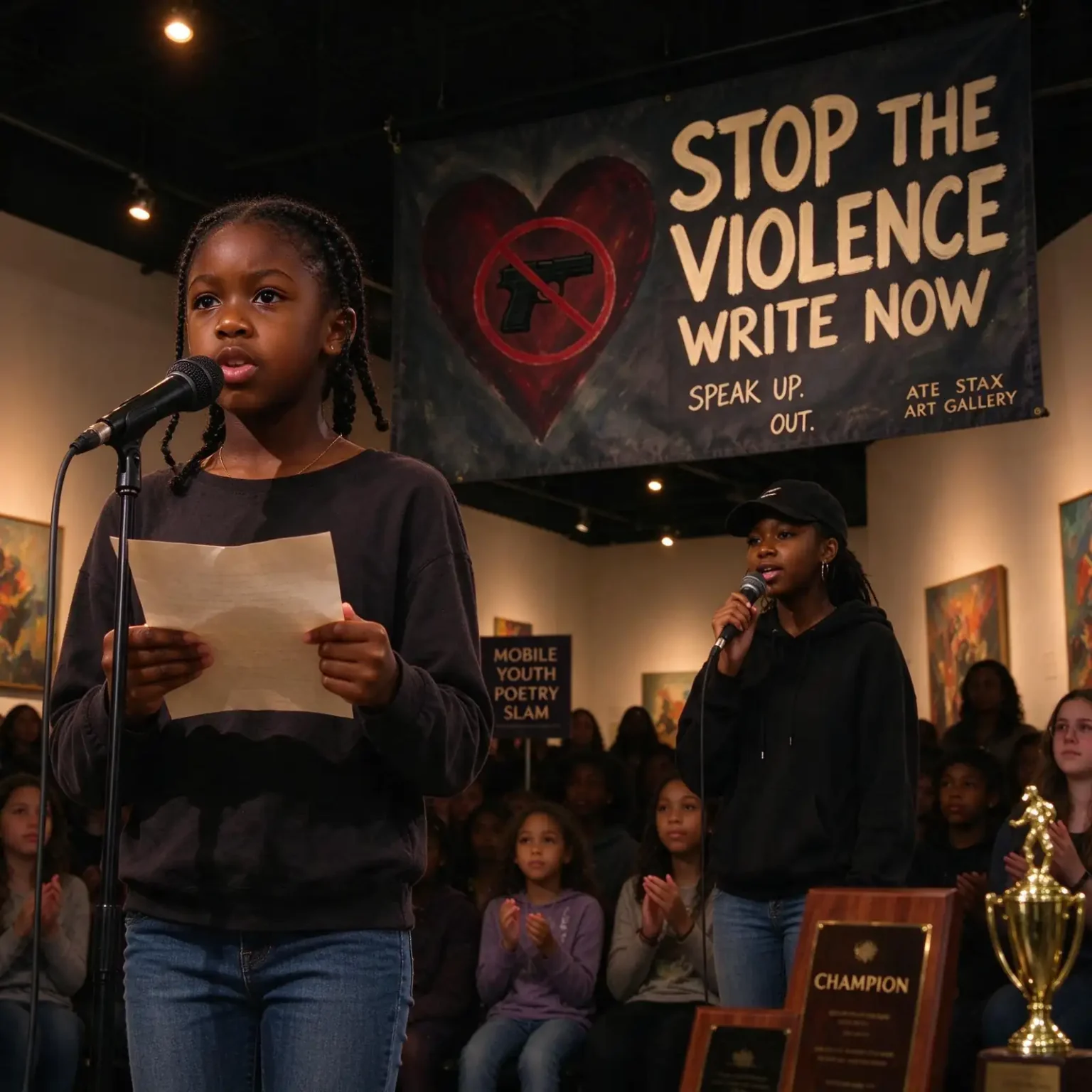
MOBILE, Ala. — A youth poetry slam focused on gun violence turned a gallery at The Shoppes at Bel Air Mall into a stage for Mobile’s young voices on Wednesday, Nov. 25, as kids and teenagers stepped to the microphone to describe how violence touches their lives and neighborhoods. Organizers named the event Stop the Violence Write Now, and it took place at the Ate Stax Art Gallery, where performers shared original work and competed for trophies and cash prizes.
The city’s poet laureate organized the event as a space where young people could speak openly through poetry. Getting there was not easy. The organizer applied for grant funding three times and was turned down each time, then decided to move ahead anyway, trusting that the community would recognize the event’s value and step in to help. Local residents, businesses and leaders did exactly that.
A Stage Built by the Community
Without grant money, the slam depended entirely on donations and volunteer support. The organizer credited the gallery’s founder for opening the space to the young poets, along with support from a Mobile city councilman, a local party-rental business, and a number of local donors and community members who gave both time and money so the youth could have their night.
That kind of grassroots backing is common for small arts events, which often operate on tight budgets and rely on neighbors, small businesses and civic leaders to cover costs such as venue space, prizes, sound equipment and refreshments. In this case, the organizer said after the showcase that the community had come through, seeing the event’s importance and helping carry it to the finish line.
The event took place the day before Thanksgiving, a time when many families are focused on gratitude and togetherness, which gave the slam’s message about protecting young lives an added layer of meaning.
The Youngest Voice in the Room
Among those who stepped up to the microphone, the youngest performer was just 9 years old. Her poem addressed grown-ups and fellow young people in the audience alike, urging them to resolve conflict by talking rather than reaching for a gun.
Her message encouraged listeners to stand up, walk away from confrontations and think about the permanence of pulling a trigger, reminding the room that some choices cannot be undone. Coming from a child that young, the plea underscored how early gun violence can enter a young person’s awareness and how clearly children can articulate a wish for safety and peace.
Teens Compete for the Title
Teenage poets also took the floor, competing for trophies and cash prizes. Their performances explored the same theme from the perspective of older youth, many of whom are navigating school, friendships and neighborhoods where violence can feel close at hand.
When the competition ended, one teen was crowned this year’s slam champion, earning the 2026 title. Second- and third-place finishers were also recognized for their work. The awards gave the young writers tangible recognition for the courage it takes to share deeply personal work in front of an audience.
How a Poetry Slam Works
A poetry slam is a competitive performance event in which poets present original work, usually without props or musical accompaniment, and are scored on both the writing and the delivery. Slams commonly use judges drawn from the audience or a panel, and performers are often held to a time limit for each piece. The format rewards honesty, rhythm and stage presence, which is part of why it has become popular with young writers.
Slam poetry grew out of the performance poetry scene of the 1980s and has since spread to schools, libraries, community centers and festivals across the country. Youth slams in particular are often used by educators and community groups as a way to build literacy, confidence and public speaking skills while giving teens a constructive outlet for their experiences.
Courage at the Microphone
Performing an original poem in public is a vulnerable act for anyone, and particularly for young people writing about painful subjects. Poets in a slam setting often draw on personal experience, which means sharing memories, fears and hopes with a room full of listeners. Audiences at youth slams commonly respond with snaps, applause and encouragement, creating an atmosphere meant to reward honesty rather than perfection.
For many young performers, the experience of being heard can matter as much as any trophy. Simply finishing a piece in front of a crowd can build confidence that carries over into the classroom and beyond.
Why Poetry and Violence Prevention Go Together
Arts programs are frequently part of broader efforts to support young people in communities affected by violence. Writing and performing can help youth process difficult emotions, name what they are seeing around them and connect with peers who share similar experiences. Speaking before an audience can also build a sense of agency, the feeling that one’s voice matters and can influence others.
Community organizers and youth advocates generally point to safe, structured spaces as an important element of prevention. Events that bring young people together under adult supervision, with clear expectations and positive recognition, can offer an alternative to the street and a reason to stay engaged with school and community life.
The slam’s theme also gave adults in the audience a chance to listen. Hearing young people describe their fears and hopes in their own creative language can be a powerful reminder of how violence affects not only those directly involved but also the children and teens who live nearby.
Part of a Wider Grassroots Effort in Mobile
The slam is one of several community-driven projects in Mobile designed to offer youth secure places to gather and healthy ways to channel their energy. Among them is Tricentennial Park’s Stop The Violence Halloween Funday, a neighborhood gathering designed to give families a safe, festive place to celebrate.
Another piece of that landscape is HALO, which leads violence prevention training in the community. Training programs of this kind typically focus on teaching participants how to recognize warning signs, de-escalate conflicts and connect people with resources before disagreements turn dangerous.
Together, these efforts reflect a community-level approach in which residents, artists, nonprofits and local leaders work alongside one another rather than waiting for large outside programs. The slam’s path from three grant rejections to a full event shows how that approach can work in practice.
The Role of a Poet Laureate
Many cities and states appoint a poet laureate to serve as an ambassador for poetry and the literary arts. The role generally involves promoting reading and writing, appearing at civic events and developing programs that bring poetry to people who might not otherwise encounter it. Duties vary from place to place, and many laureates use the position to focus on causes that matter to their communities.
In Mobile, the city’s poet laureate has used the platform to center young people and the issue of gun violence. Organizing a competitive slam with prizes, a venue and an audience gave youth a public stage that recognized their work as worthy of attention.
The Venue at Bel Air
The Ate Stax Art Gallery is located inside The Shoppes at Bel Air, the long-established shopping center along Airport Boulevard in midtown Mobile. Hosting the slam inside a mall gallery placed the event in a familiar, accessible public setting, the kind of everyday space where families and young people already gather.
Community art galleries often serve as more than exhibition spaces. Many host workshops, open mic nights and community meetings, functioning as gathering places that connect local artists with the public. Opening the gallery to young poets extended that role to the city’s youngest creative voices.
How Families and Residents Can Get Involved
For parents, educators and residents who want to support efforts like this one, there are several common ways to help:
- Encourage young people to write and share their experiences through journals, school writing clubs or library programs.
- Attend local youth performances, art shows and open mic events to show young artists that their work is valued.
- Support grassroots organizers through donations, volunteer time or in-kind help such as supplies and venue space.
- Participate in violence prevention trainings and community gatherings that promote conflict resolution.
- Talk openly with children and teens about safety, conflict and the choices available to them when tensions rise.
Families who want to learn about upcoming youth arts or violence prevention events in Mobile can watch for announcements from local galleries, community organizations and city leaders.
A Message That Outlasts the Night
This year’s slam lasted a single evening, but the message its performers delivered was meant to travel further. From the 9-year-old who was the youngest on the program to the teens who competed for the championship, the young poets made a shared case for choosing words over weapons and for treating every life as worth protecting.
For an event that began with three rejected grant applications, the result was a room filled with young writers, supportive adults and a community that decided their voices deserved to be heard. Organizers and supporters hope that the conversation started at the gallery continues in homes, schools and neighborhoods across Mobile.