Hillcrest Road Pedestrian Killed on Thanksgiving Night as Mobile Police Investigate Crash
A man was struck and killed by a southbound vehicle while crossing Hillcrest Road near Willow Brook Run East in Mobile on Thanksgiving night. Police have not released names, and no charges have been announced.
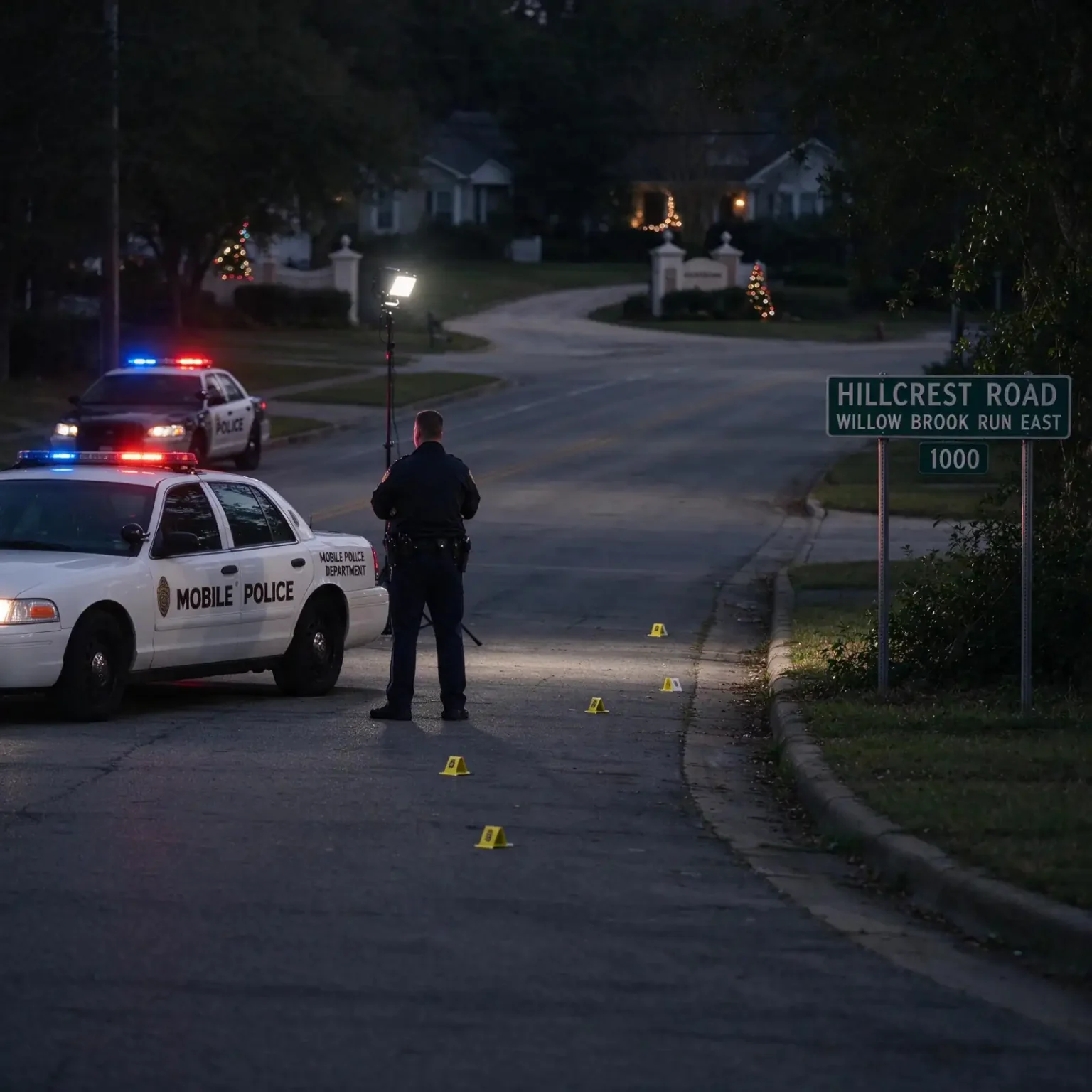
MOBILE, Ala. — A Hillcrest Road pedestrian died Thursday night after being struck by a vehicle near Willow Brook Run East, turning Thanksgiving into a night of tragedy in west Mobile. Witnesses said relatives were with the man, but he alone was walking across the street at the moment the vehicle hit him.
Mobile Police officers responded to the scene, and authorities have not released the names of the man who died or the driver of the vehicle. No charges have been announced.
What Is Known So Far
The deadly collision took place on Thursday, Nov. 26, along a stretch of Hillcrest Road close to Willow Brook Run East. According to witnesses, the vehicle involved was traveling south on Hillcrest Road at the time.
The man was with family members, witnesses said, but he was the only person in the group crossing the roadway when the vehicle struck him. He did not survive his injuries.
While still at the scene, the driver was observed taking sobriety tests given by Mobile Police officers. Officials have not said what those tests showed, and police have not announced any arrest or charges in connection with the crash. Investigators have also not released details about the speed of the vehicle, lighting conditions or the exact location where the man was crossing.
Why Sobriety Testing Does Not Mean Charges
Readers should be careful not to draw conclusions from the testing seen at the scene. In serious and fatal crashes, officers commonly evaluate drivers for possible impairment as part of a standard, thorough investigation. Field sobriety tests are one of several tools police may use to rule impairment in or out, and they are often given regardless of whether officers suspect a problem.
A sobriety test is not an accusation, and it is not evidence of wrongdoing on its own. Whether any charge is filed in a case like this depends on the full findings of the investigation, which typically take time to complete. As of Friday, Mobile Police had not announced any charges or released any conclusions about how the crash happened.
How Fatal Crash Investigations Generally Work
When a crash results in a death, police departments typically treat the scene with particular care. Specially trained traffic investigators are often called in to document the area before vehicles and debris are moved. That process can close part of a roadway for hours.
Investigators generally take measurements and photographs, mark where the vehicle and the victim came to rest, and look for evidence such as skid marks, debris fields and damage to the vehicle. Those details can help reconstruct the speed and path of the vehicle and the point of impact.
Officers also interview the driver, passengers and witnesses. They may look for video from nearby homes, businesses or traffic cameras, and they may inspect the vehicle for mechanical problems such as faulty brakes or lights. If blood or other tests are taken, laboratory results can take weeks to come back.
A medical examiner or coroner typically determines the official cause of death. Once the investigation is complete, police commonly review the findings with prosecutors, who decide whether any criminal charges are warranted. In many cases, the final findings on a fatal crash are not completed for weeks or even months.
That timeline can be frustrating for families and the public, but investigators generally prefer to wait for complete information rather than release early conclusions that may later change. Updates in cases like this one usually come when a name is released, when charges are filed or when an investigation is formally closed.
When Names Are Released
Police generally do not release the name of someone killed in a crash until relatives have been notified. Even when relatives are present at a scene, formal identification and notification procedures typically take place before any public announcement. Authorities have not said when they expect to release the man’s name.
The identity of a driver is also commonly withheld unless and until charges are filed. Mobile Police have not identified the driver involved in Thursday night’s crash.
A Busy Corridor in West Mobile
Hillcrest Road is one of the main north-south routes on Mobile’s west side, carrying traffic between residential neighborhoods, schools, shopping areas and major east-west roads. Like many suburban arterial roads, it serves both through traffic and local trips, and drivers often travel at steady speeds over long stretches.
Roads built primarily for moving cars can be challenging for people on foot. Crosswalks and signals may be spaced far apart, and pedestrians sometimes cross between intersections to reach homes, bus stops or businesses on the other side. Lighting can also vary from block to block, especially along stretches lined with subdivision entrances.
Officials have not said whether lighting or road design played any role in Thursday’s crash, and those questions are part of what investigators typically examine.
A National Problem After Dark
Thursday’s death comes amid a long-running national concern about pedestrian safety. In recent years, more than 7,000 people a year have been killed while walking on U.S. roads, according to federal traffic safety data, a level far higher than a decade earlier.
Federal figures have consistently shown that the large majority of pedestrian deaths happen in the dark. Most also occur away from intersections, on the kinds of multi-lane roads that are common in growing suburban areas across the South.
The holiday season can add to the risk. Daylight saving time ended on Nov. 1, so darkness now falls in the late afternoon, right as many people are traveling, shopping and visiting relatives. Holiday gatherings also bring more people walking between cars, homes and parking areas after dark, often in unfamiliar neighborhoods.
Tips for Walking Safely at Night
Safety advocates and transportation agencies generally offer the same core advice for people on foot, especially during the darker months:
- Cross at marked crosswalks or intersections whenever possible, and use pedestrian signals where they exist.
- Before stepping into the street, look left, right and left again, and keep watching as you cross.
- Make eye contact with drivers when you can. Do not assume a driver sees you just because you can see the vehicle’s headlights.
- Wear bright or light-colored clothing, and add reflective gear or a small light when walking at night.
- Carry a flashlight or use a phone light to make yourself more visible.
- Put the phone away and remove earbuds while crossing so you can hear approaching traffic.
- Walk on sidewalks when available. If there is no sidewalk, walk facing oncoming traffic as far from the travel lanes as possible.
- Keep a close hand on children and help older relatives cross, particularly when leaving holiday gatherings.
What Drivers Can Do During the Holidays
Drivers share responsibility for keeping people on foot safe. Traffic safety experts commonly encourage motorists to slow down in neighborhoods and near shopping areas, where people may step into the road unexpectedly.
- Stay alert for pedestrians, especially at night and near driveways, bus stops and subdivision entrances.
- Keep headlights on and clean, and use high beams on dark roads when no other vehicles are approaching.
- Avoid distractions such as texting, navigation adjustments or reaching for items while the vehicle is moving.
- Obey speed limits. Lower speeds give drivers more time to react and greatly reduce the severity of injuries when a crash does occur.
- Never drive impaired. Plan for a sober ride, rideshare or taxi when celebrating.
- Be patient around holiday crowds, as people may be carrying packages, wrangling children or walking to cars parked along the street.
Alabama law, like that of most states, generally requires drivers to exercise due care to avoid striking pedestrians, and it sets rules for when people on foot must yield to traffic outside of crosswalks. How those rules apply to any specific crash is determined by investigators and, if needed, prosecutors. Nothing about the general rules should be read as a finding about what happened on Hillcrest Road.
What Happens Next
Mobile Police are expected to continue investigating the crash in the coming days. Officials have not said whether they are seeking additional witnesses, but anyone with information about a fatal crash is generally encouraged to contact the investigating agency directly.
If You Witness a Crash Involving a Pedestrian
Emergency responders generally advise anyone who sees a pedestrian struck to call 911 immediately and give the most precise location possible, such as the nearest cross street or a landmark. If it is safe to do so, turn on hazard lights and use your vehicle or a flashlight to help warn approaching drivers.
Do not move an injured person unless they face an immediate danger, such as fire or oncoming traffic, because movement can worsen certain injuries. Stay at the scene until officers arrive, and be ready to share what you saw. Details that seem minor, such as the direction a vehicle was traveling or the color of a traffic signal, can be important to investigators later.
Once relatives have been notified, police may release the man’s name. Any decision on charges would typically follow the completion of the investigation and a review of the evidence.
For the family who was with the man when he died, the holiday will now carry a painful memory. For everyone else traveling around Mobile during the busy weeks ahead, the crash is a sobering reminder to slow down, stay alert and look out for one another after dark.