Injured Bald Eagle From Dauphin Island Fights to Recover at Orange Beach Wildlife Center
An adult male bald eagle found injured on Dauphin Island is being treated at the Orange Beach Wildlife Center for a badly damaged and maggot-infested right wing, dehydration and other injuries. Staff say it is too early to know if he will fully recover.
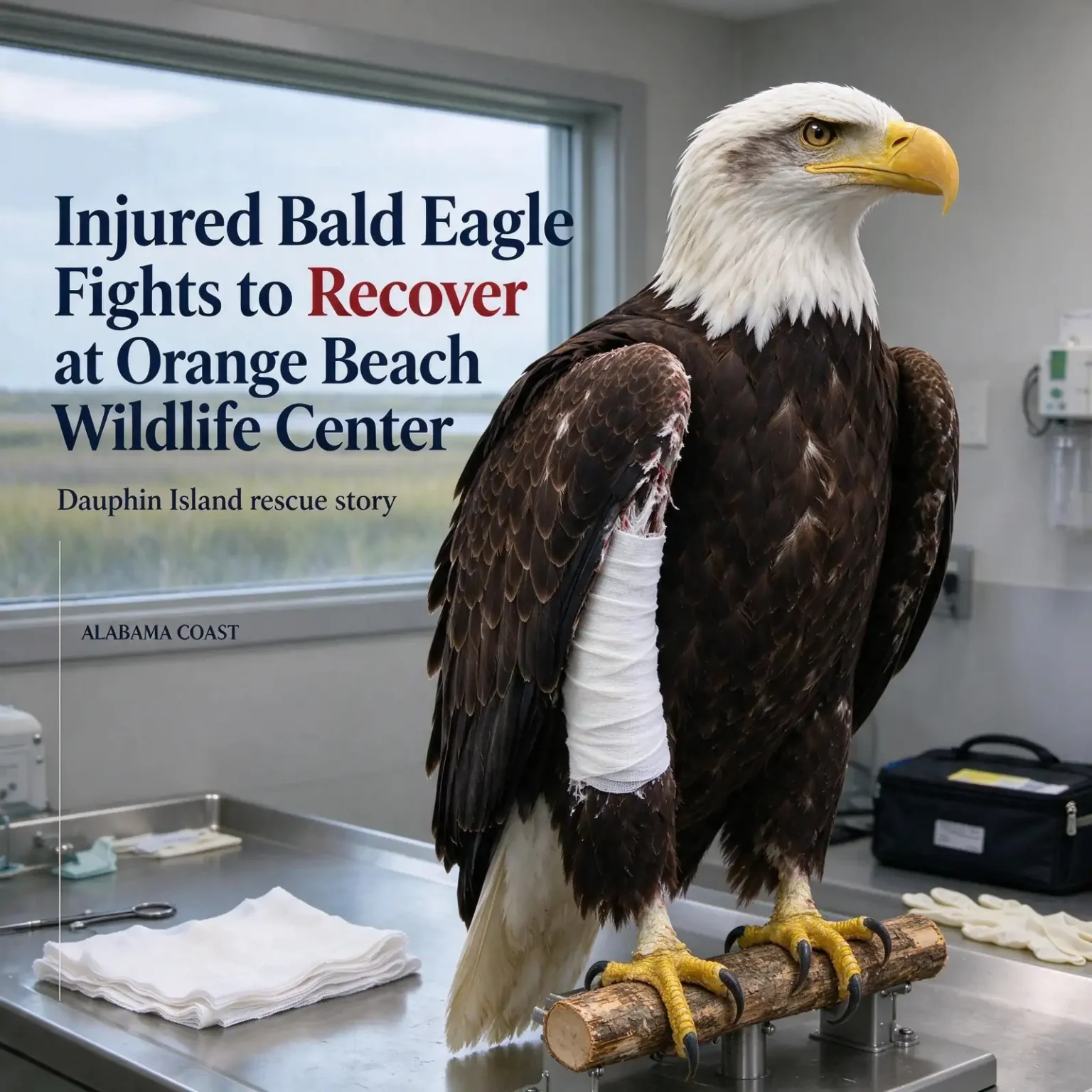
ORANGE BEACH, Ala. — An injured bald eagle found on Dauphin Island is now under round-the-clock care at the Orange Beach Wildlife Center, where staff are treating a badly damaged wing and several other serious problems. The center said it is still too early to know whether the bird will make a full recovery.
For now, the news is cautiously encouraging. The center said the eagle is resting on proper medication, eating and receiving the fluid therapy he needs.
Meet Patient BAEA 26-1635
The patient is a small adult male bald eagle, identified by the center as BAEA 26-1635. He arrived at the Orange Beach facility on Wednesday, Nov. 25, after being transferred from the Environmental Studies Center.
The first part of that identifier reflects a common practice in the bird world. BAEA is the standard four-letter code that ornithologists and bird banders use for the bald eagle, and wildlife hospitals often pair species codes like it with a year and an intake number to track each animal through treatment.
His size is not unusual for his sex. Among bald eagles, females are typically noticeably larger and heavier than males, a pattern common to many birds of prey. A small adult male, then, may simply be a normal member of his species.
His adult status also says something about his age. Young bald eagles are mostly mottled brown, and they generally do not develop the familiar white head and tail until they are about 4 or 5 years old. An adult eagle has already survived the most dangerous early years of life, when many young birds fail to learn to hunt well enough to make it.
A Long List of Injuries
The center said the bird’s right wing was seriously damaged. Staff also found injuries to his soft tissue, signs that he was dehydrated and blood in his trachea. The injured wing was also infested with maggots, which added another layer of concern for his caregivers.
Maggot infestation, known to veterinarians as myiasis, is a known risk for wild animals with open wounds. Flies are drawn to injured tissue and lay eggs there, and the larvae that hatch can cause further damage and infection if they are not removed. Treatment generally involves carefully cleaning the wound, removing the larvae and managing infection with medication.
Dehydration is also common in injured wildlife. A bird that cannot fly or hunt may go without food or water for some time before it is found, and fluid therapy is often among the first steps in stabilizing a patient.
Blood in the trachea, the airway that carries air to the lungs, can be a sign of internal trauma or injury to the respiratory system. In birds, the respiratory system is complex and includes a series of air sacs that extend through the body, so caregivers typically monitor breathing closely in a patient with that kind of finding. The center has not shared further details about the cause of the bleeding.
How the Eagle Got Hurt Remains a Mystery
Staff at the center said the cause of the eagle’s injuries is unknown. They did, however, raise the possibility that he was hurt in a fight with another eagle over territory.
Bald eagles can be fiercely protective of their nesting areas and feeding spots, and fights between eagles are a well-documented source of injury. In the Southeast, eagles generally nest during the cooler months, roughly from fall into spring, and adults often become more defensive of their territories as that season gets underway.
Other common causes of eagle injuries across the country include collisions with vehicles, power lines and other structures, as well as lead poisoning from eating contaminated prey or carcasses. The center has not linked any of those causes to this case.
Why Dauphin Island Draws Eagles and Other Birds
Dauphin Island, a barrier island at the mouth of Mobile Bay, is one of the best-known birding destinations on the Gulf Coast. Its marshes, beaches, maritime forest and surrounding waters provide food and shelter for a wide range of species, and the island is a major stopover for migratory birds each spring and fall.
Bald eagles are drawn to coastal areas like this because fish make up a large part of their diet. They also feed on waterfowl and carrion, and they are known to steal fish from ospreys and other birds. The open waters around Mobile Bay and the Mississippi Sound offer plenty of hunting opportunities.
A Comeback Story in Alabama
The sight of a bald eagle along the Alabama coast is far more common today than it was a few decades ago. Across much of the lower 48 states, eagle populations declined sharply during the 20th century because of habitat loss, illegal shooting and the widespread use of the pesticide DDT, which caused eggshells to thin and break.
The United States banned DDT in 1972, and federal protections helped the species recover. In Alabama, nesting eagles had become extremely rare, and state wildlife officials worked to restore them in the 1980s and early 1990s by releasing young eagles through a process known as hacking. Nesting pairs gradually returned to lakes, rivers and coastal areas around the state.
The national recovery was strong enough that the bald eagle was removed from the federal list of endangered and threatened species in 2007. Today, eagles nest in many parts of Alabama, and sightings in Baldwin and Mobile counties are increasingly common.
Still Protected Under Federal Law
Coming off the endangered species list did not leave bald eagles without protection. The birds remain covered by the Bald and Golden Eagle Protection Act and the Migratory Bird Treaty Act, which generally make it illegal to kill, harm, harass or possess an eagle, including its feathers, nests or eggs, without a federal permit.
Those rules also shape how injured eagles are cared for. Only properly permitted wildlife rehabilitators are allowed to treat and house eagles, and they typically work in coordination with state and federal wildlife agencies. If an eagle cannot be returned to the wild after treatment, it may be placed with a licensed facility for education or other approved purposes.
What Recovery Usually Looks Like
Wildlife rehabilitation generally moves in stages. The first priority is stabilization, which includes pain control, fluids, wound care and medication to fight infection. Once a patient is eating on its own and its condition improves, caregivers can better assess the full extent of its injuries.
For birds of prey, wing injuries are among the most serious, because a raptor needs nearly perfect flight to hunt and survive. Depending on the damage, healing can take weeks or months, and many birds need time in a large flight enclosure to rebuild strength and stamina before they can be considered for release.
Rehabilitators typically release a bird only when they are confident it can fly, hunt and avoid danger on its own. When possible, birds are returned to the general area where they were found, especially adults that may already hold a territory. Whether that will be possible for BAEA 26-1635 is not yet known.
Caregivers also try to keep human contact to a minimum during treatment. Wild animals that become too comfortable around people can struggle after release, so staff at rehabilitation centers commonly limit handling, keep patients in quiet areas and avoid unnecessary noise or visitors.
What to Do If You Find Injured Wildlife
Coastal Alabama residents and visitors regularly encounter wildlife in trouble, from songbirds to sea turtles to large raptors. Wildlife professionals generally recommend the following steps:
- Keep your distance. Injured animals are frightened and can bite, scratch or strike, and an eagle’s talons and beak can cause serious injuries.
- Keep pets and children away from the animal.
- Do not try to feed the animal or give it water, which can do more harm than good.
- Note the exact location, take a photo from a safe distance if you can and watch the animal until help arrives if it is safe to do so.
- Contact a licensed wildlife rehabilitator, such as the Orange Beach Wildlife Center, or the Alabama Department of Conservation and Natural Resources for guidance.
- For eagles and other protected birds, let trained professionals handle the capture and transport.
- Do not keep any feathers or parts from an eagle you find, since possession is generally prohibited without a permit.
Acting quickly can make a real difference. Many animals that reach rehabilitation centers do better when they are found and treated early, before dehydration, infection or other complications set in.
How the Community Can Help
Nonprofit wildlife centers rely heavily on volunteers and donations to care for the animals that come through their doors. Medications, specialized diets, enclosures and veterinary care can be costly, and a single large bird like an eagle may require weeks of intensive treatment.
Residents who want to support that work can typically help by donating, volunteering or spreading the word about what to do when they find injured wildlife. They can also reduce risks to animals by disposing of fishing line and hooks properly, keeping trash secured and slowing down on roads near water and wooded areas.
For now, staff at the Orange Beach Wildlife Center are focused on helping one battered eagle heal. The coming weeks should offer a clearer picture of whether he will be able to fly free over the Alabama coast again.