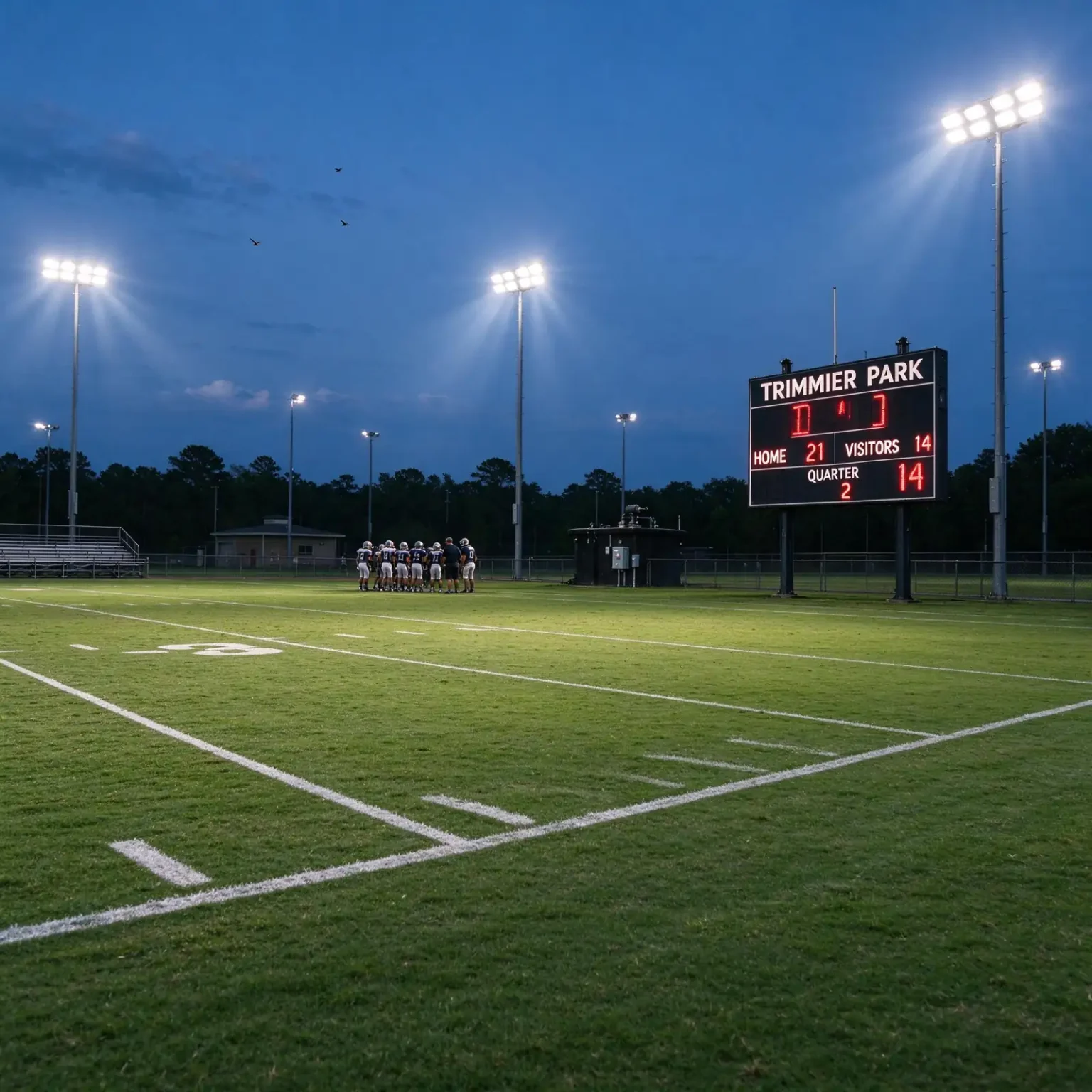
MOBILE, Ala. — Football teams and families who spend their evenings at Trimmier Park now have a brighter, safer place to play. The city of Mobile has finished a Trimmier Park upgrade that brought new lighting, a new scoreboard and electrical power to a pumphouse, an investment of nearly $600,000 aimed at improving the field for the teams that depend on it.
City officials said the work has made the field safer, improved the quality of the turf and opened the park to evening use. For players, coaches and spectators, that means more practice and game time after the sun goes down, particularly during the busy football season.
What Changed at the Field
The project focused on three main improvements, each addressing a different need at the park:
- Lighting: New lights were installed, allowing teams to use the field in the evening and improving visibility for players and spectators.
- Scoreboard: A new scoreboard replaced the previous equipment, giving teams and fans a clearer way to follow the action.
- Pumphouse power: Electrical service was brought to a pumphouse on the property, part of the work that city officials linked to better turf conditions.
Taken together, the changes are designed to make the park more functional throughout the year. A field that can be used safely after dark gives local teams more flexibility to schedule practices and games around school, work and family commitments.
Why Lighting Matters for Youth and Community Sports
Field lighting is often one of the most important features at a recreational sports facility. In the fall, daylight fades early, and many practices and games for youth and amateur teams take place in the late afternoon or evening. Without adequate lights, those activities can be cut short or moved elsewhere.
Good lighting also plays a role in safety. Players can better track the ball and see other athletes, and spectators can move more safely around the field, bleachers and parking areas. Coaches and officials generally find it easier to supervise activities when the entire playing surface is evenly lit.
City officials said safety was one of the key outcomes of the Trimmier Park project. A safer field benefits not only players but also parents, volunteers and others who spend time at the park.
The Role of a Scoreboard
A scoreboard may seem like a simple addition, but it can significantly improve the experience of a game. It keeps players, coaches and spectators informed about the score, the time remaining and other key details, helping games run more smoothly.
For young athletes, a working scoreboard can also add a sense of occasion to their games. Seeing their team’s score light up can make a regular-season matchup feel more special, and it helps families in the stands follow along without needing to ask what the score is.
The mayor said that while the project is not the largest the city will take on this year, swapping out the old lights and putting up a new scoreboard will make things better for the teams that count on this field each fall when football is in full swing.
Turf Quality and the Pumphouse
One of the less visible parts of the project involved bringing power to a pumphouse. At many athletic complexes, pumphouses are generally connected to water systems that help keep grass fields healthy, although the specific setup varies from site to site.
City officials said the overall project has improved the quality of the turf at Trimmier Park. Healthy turf matters for both performance and safety. A well-maintained playing surface is typically more even and more forgiving, which can reduce the chance of slips and falls and make the field more enjoyable to play on.
Maintaining natural grass fields in Mobile’s climate can be challenging. The area’s hot, humid summers and periods of heavy rain, followed at times by dry stretches, put stress on turf that sees frequent use. Reliable infrastructure supporting field maintenance can help crews keep a heavily used surface in good shape.
The Teams Behind the Work
The project brought together several city departments and private partners. The mayor thanked the city’s Real Estate and Asset Management team for its role in the effort.
Design work was handled by Jaguar Consulting and Barter and Associates, while Bill Smith Electric carried out the construction. Electrical contractors on projects like this one are typically responsible for installing light fixtures, running power to equipment and making sure systems meet safety codes.
The mayor also praised the work of the city’s Mobile Parks and Recreation Department, whose crews keep up Mobile’s greenspaces year-round. Parks departments generally handle the day-to-day upkeep of fields, playgrounds, trails and other public spaces, a job that often goes unnoticed until something needs repair.
A Look at the Investment
The total cost of the project was nearly $600,000. The mayor described the investment as further evidence that Mobile intends to offer residents across the city good places to play, and to keep making those places better.
Spending on parks and recreation facilities is often viewed by local governments as an investment in public health and quality of life. Well-maintained parks can encourage physical activity, give young people safe places to spend their time and bring neighbors together for games, events and other gatherings.
Projects like the Trimmier Park upgrade also tend to have a long useful life. New lighting and scoreboard equipment, once installed, can serve teams and families for years, spreading the benefit of the investment across many seasons.
Parks as Part of the City’s Infrastructure
Recreation facilities are sometimes thought of as amenities, but they share many characteristics with other public infrastructure. Light poles, wiring, scoreboards and pump equipment all age over time and eventually need to be repaired or replaced, much like streetlights or drainage systems.
Cities that own many parks and fields generally have to decide which facilities need attention first, based on factors such as how heavily a site is used, the condition of its equipment and any safety concerns. Replacing older systems before they fail can help avoid disruptions to the teams and residents who depend on them.
Electrical upgrades in particular require careful planning. Bringing new power to a structure such as a pumphouse, or supporting a set of field lights, often involves evaluating existing service, running new lines and making sure the work meets applicable codes. That is one reason projects of this kind usually involve both design professionals and licensed electrical contractors.
For residents, the result of that behind-the-scenes work is simple: a field that works when they need it. Lights that come on reliably, a scoreboard that functions on game night and a playing surface that holds up through the season are the kinds of improvements people notice most.
How Parks Projects Typically Come Together
Municipal recreation improvements generally follow a series of steps. A city first identifies a need, such as aging lights or equipment that no longer works well. Planners and asset managers then evaluate the site, set priorities and secure funding through the city’s budget process.
Once a project is approved, design professionals develop plans that address technical requirements such as light levels, electrical capacity and placement of equipment. Contractors then carry out the construction, often working around existing schedules to minimize disruption to teams that use the facility.
Throughout the process, coordination among city departments is important. Asset management teams typically oversee city-owned property, while parks staff provide insight into how a facility is used and what maintenance it will need after the work is complete. The Trimmier Park project reflects that kind of collaboration, with city teams, designers and a construction firm each contributing.
What It Means for the Community
For the teams that use Trimmier Park, the most immediate change is the ability to play and practice in the evening. That added flexibility can be especially helpful for youth leagues and recreational programs that depend on volunteer coaches who may only be available after work.
Parents may also appreciate a field that is safer and better lit, particularly when picking up or dropping off children after dark. Spectators can enjoy games in more comfortable conditions, and the new scoreboard makes it easier for everyone to follow along.
Beyond football, improved recreational spaces can strengthen neighborhood ties. Community fields often serve as gathering places where families meet, children make friends and residents take pride in the shared spaces around them.
Tips for Visiting City Fields After Dark
With evening use now possible at Trimmier Park, families heading out for night practices or games may want to keep a few general tips in mind:
- Arrive a little early to find parking and get settled before activities begin.
- Bring water, especially on warm evenings, and consider insect repellent, since mosquitoes are common along the Gulf Coast.
- Keep a close eye on young children, particularly around parking areas and walkways.
- Check with your team or league for schedule updates, as weather can affect outdoor activities.
- Follow any posted park rules and help keep the field clean by using trash cans.
Residents who have questions about field schedules, reservations or park rules can generally get details by contacting the Mobile Parks and Recreation Department. Leagues and teams that use the field typically coordinate directly with the department.
The completion of the work at Trimmier Park adds to the city’s broader efforts to keep its recreation spaces in good condition. City officials have signaled that more projects are planned this year, and residents can expect continued attention to parks and greenspaces across Mobile.