Prichard Apartment Fire Sends Mobile Firefighter to Trauma Center After Window Escape
A Mobile Fire-Rescue firefighter was taken to an area trauma center after being hurt escaping through a second-floor window during a large fire at Arbor Pointe Apartments in Prichard on Friday night. Crews were forced into a defensive attack as flames burned through the roof.
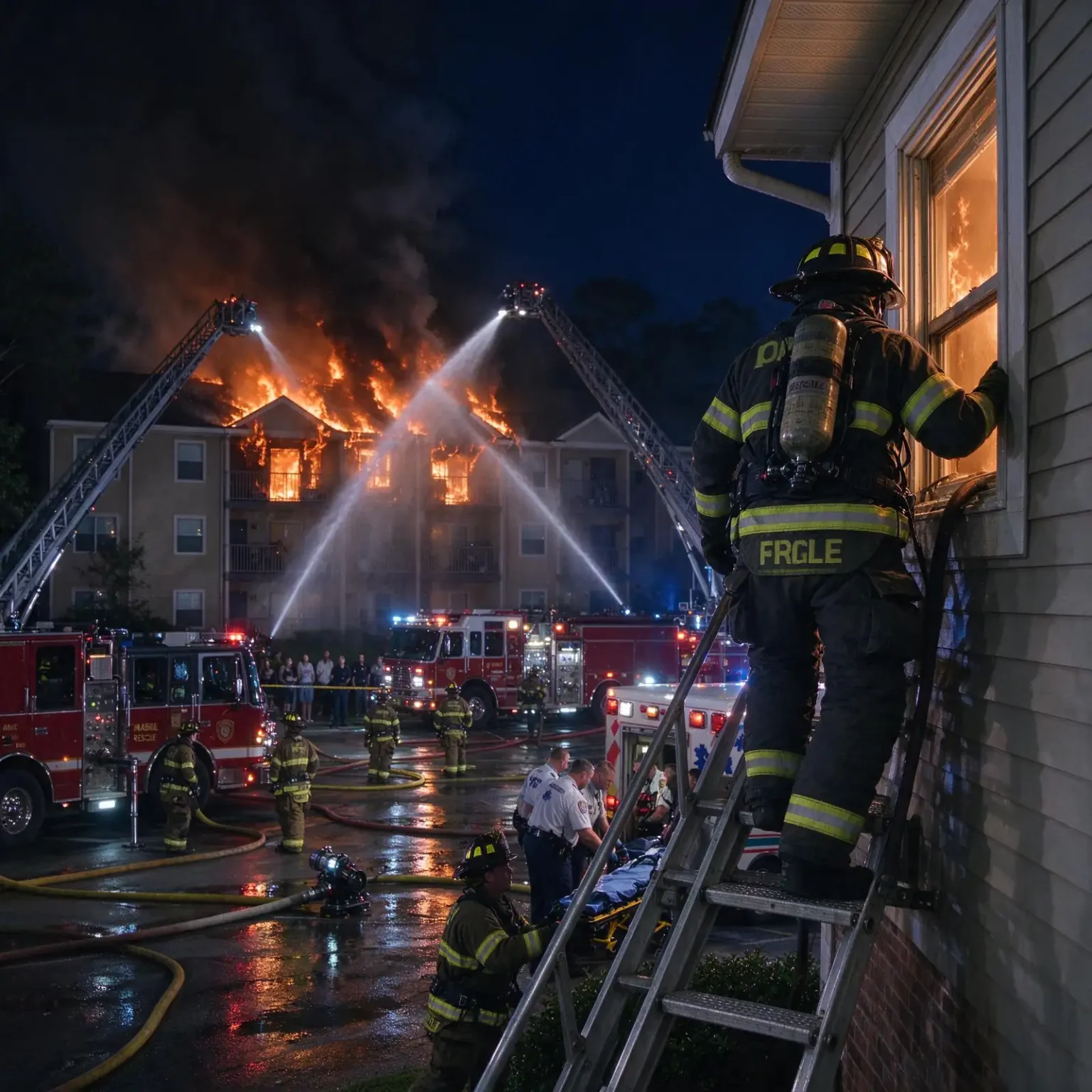
PRICHARD, Ala. — A Mobile Fire-Rescue firefighter was rushed to a trauma center Friday night after being hurt while trying to climb out of a second-floor window during a Prichard apartment fire at Arbor Pointe Apartments, 100 Dairy Road. Officials said the extent of the firefighter’s injuries was not known, and crews from more than one department remained on scene, still fighting heavy flames, after the firefighter was hurt.
The blaze broke out on the night after Thanksgiving and quickly grew into a multi-agency operation. Prichard firefighters were first to arrive, and they called for the full weight of Mobile Fire-Rescue after finding the fire already burning through the roof of the complex.
What Is Known About the Injured Firefighter
Mobile Fire-Rescue said one of its firefighters got hurt while trying to climb out of a window on the second floor as crews worked the fire. Paramedics cared for the firefighter on site before the firefighter was transported to a trauma center in the region so doctors could provide emergency treatment.
As of Friday night, the department said the extent of the injuries remained unknown. The firefighter has not been publicly identified, and officials had not provided an update on the firefighter’s condition.
Officials have not described the circumstances that led to the escape attempt. Firefighters are generally trained in emergency self-rescue techniques, including how to exit through a window, for moments when an interior route becomes unsafe. Mobile Fire-Rescue has not said what conditions inside the building prompted the firefighter to use that option.
How the Night Unfolded
According to Mobile Fire-Rescue, the Prichard Fire Department pulled up to Arbor Pointe at about 8:47 p.m. on Friday, Nov. 27. Crews found flames coming through the roof and requested a full response from Mobile Fire-Rescue to help bring the fire under control.
A department spokesman said heavy flames were already showing when firefighters got there, extending through the roof. Crews pushed an aggressive attack against heated gases, heavy smoke and fire before conditions forced commanders to move to defensive strategies.
Multiple fire and rescue agencies responded to the complex. Later Friday night, firefighters remained on the property and were still actively battling heavy flames, with the Mobile department working alongside Prichard crews in support.
Why Firefighters Switch to a Defensive Attack
Fire departments typically describe their tactics in two broad categories. In an offensive attack, firefighters carry hose lines inside a building to reach the seat of the fire, search for anyone who may be trapped and stop the flames from spreading room to room. It is the fastest way to put out a fire, but it also places crews directly inside the hazard.
A defensive attack keeps firefighters outside. Crews pour large volumes of water onto the structure from hand lines, ground monitors and aerial ladders, and they focus on keeping the fire from reaching neighboring buildings or units. The goal shifts from saving the burning section to containing the damage and protecting lives, including the lives of the firefighters themselves.
Incident commanders generally weigh several factors when deciding to pull crews out. Fire showing through a roof often means the blaze has reached the attic or the structural members that hold the building together, which raises the risk of a ceiling or roof collapse. Superheated gases collecting near the ceiling can also ignite suddenly, sending conditions from dangerous to unsurvivable in a matter of seconds. When the risk to crews outweighs what can still be saved, departments commonly order everyone out and fight the fire from the exterior.
Moving to defensive operations does not mean a fire is out of control in the sense of being abandoned. It reflects a judgment that the safest way to finish the job is from a distance, and that approach can mean a fire takes many hours to fully extinguish.
Neighboring Departments Working Side by Side
Prichard sits just north of Mobile in Mobile County, and the two cities share borders, roads and, often, emergency resources. When a fire grows beyond what a single department can handle with the people and equipment on duty, it is common for nearby agencies to send help under mutual aid arrangements.
Those arrangements generally allow a department to request engines, ladder trucks, rescue units and command staff from a neighboring city without delay. Large apartment fires are a typical example, because they can require far more firefighters than a single-family house fire, both to attack the flames and to rotate fresh crews in as others tire in the heat.
Friday night’s response showed that system at work. Prichard firefighters were first on the scene and quickly asked for Mobile Fire-Rescue’s full response once they saw how far the fire had spread. Mobile crews then joined the effort, and it was a member of that assisting department who was hurt.
Questions Officials Have Not Yet Answered
Several key details had not been released as of Friday night. Officials had not said what caused the fire, how many apartment units were affected, whether any residents were hurt or how many people might be displaced.
In most significant fires, investigators wait until the flames are fully out and the structure is safe to enter before they begin examining where and how the fire started. Fire investigators typically study burn patterns, interview residents and witnesses, review any available video and check electrical, heating and cooking equipment. That process can take days or longer, and a cause is sometimes listed as undetermined if the evidence is too badly damaged.
Officials also typically assess the condition of the building before allowing anyone back inside. Units that were not burned can still suffer heavy smoke and water damage, and utilities are often shut off until the property can be inspected.
What Residents and Neighbors Can Do Now
For people who live at or near the complex, the days after a fire can be confusing. Fire safety and disaster relief groups generally recommend several steps for anyone affected:
- Do not go back into a damaged building until fire officials say it is safe, even to retrieve belongings.
- Contact the property management office to learn about the status of your unit and any temporary arrangements.
- If you have renters insurance, call your insurer as soon as possible and ask what your policy covers for temporary housing and lost property.
- Take photos of any damage you are allowed to see, and keep receipts for emergency purchases such as clothing, food and lodging.
- Replace important documents such as identification cards, birth certificates and Social Security cards if they were lost.
- Reach out to disaster relief organizations, such as the American Red Cross, which commonly assists families displaced by home fires with immediate needs.
Neighbors who want to help are usually encouraged to wait for organized donation drives rather than dropping off items at the scene. Drivers in the area should also give emergency vehicles plenty of room, as hose lines and equipment can remain in roadways for hours after a large fire.
Apartment Fire Safety as the Holidays Begin
Fire officials across the country consistently point to the holiday season and colder months as a time of increased risk at home. Thanksgiving is widely recognized as the peak day of the year for home cooking fires, and the weeks that follow bring more use of space heaters, candles, decorations and extension cords.
Apartment living adds its own considerations because a fire in one unit can affect many families. Safety experts generally recommend the following:
- Test smoke alarms monthly and replace batteries as needed. Tell your landlord right away if an alarm is missing or not working.
- Know at least two ways out of your apartment and your building, and practice the route with everyone in your household.
- Close doors behind you as you leave during a fire. A closed door can slow the spread of smoke and flames.
- Never use elevators during a fire. Use the stairs and follow the building’s posted evacuation map.
- Stay in the kitchen while frying, grilling or broiling food, and keep flammable items away from the stovetop.
- Keep space heaters at least three feet from anything that can burn, and turn them off before going to sleep or leaving the room.
- Never use an oven or stove to heat your home.
- Once you are outside, stay outside and call 911. Do not go back in for pets or belongings.
If smoke fills a room, experts advise getting low and crawling toward an exit, since cleaner air tends to stay near the floor. Before opening a door, feel it with the back of your hand. If it is hot, use another way out.
A Reminder of the Risks Firefighters Accept
Firefighting remains one of the most physically demanding and dangerous jobs in public service. Crews work in protective gear that can weigh dozens of pounds, often in extreme heat and near-zero visibility, while carrying air tanks, tools and charged hose lines through unfamiliar buildings.
Fire departments train constantly for situations like the one Mobile Fire-Rescue faced Friday night, including rapid changes in fire behavior, structural collapse and emergency escapes. Even so, injuries on the fireground are an ongoing reality of the profession, and incidents involving large multi-unit buildings present some of the most complex challenges crews can encounter.
For now, the focus in Prichard and Mobile is on the injured firefighter and on finishing the work at Arbor Pointe. Officials are expected to share more information about the firefighter’s condition, the cause of the fire and the impact on residents as it becomes available.