Providence Park Rehabilitation Center Opens With 98 Beds on Mobile’s Providence Hospital Campus
Ball HealthCare Services has opened Providence Park Rehabilitation & HealthCare Center, a new 98-bed skilled nursing and rehabilitation facility on the Providence Hospital campus in Mobile.
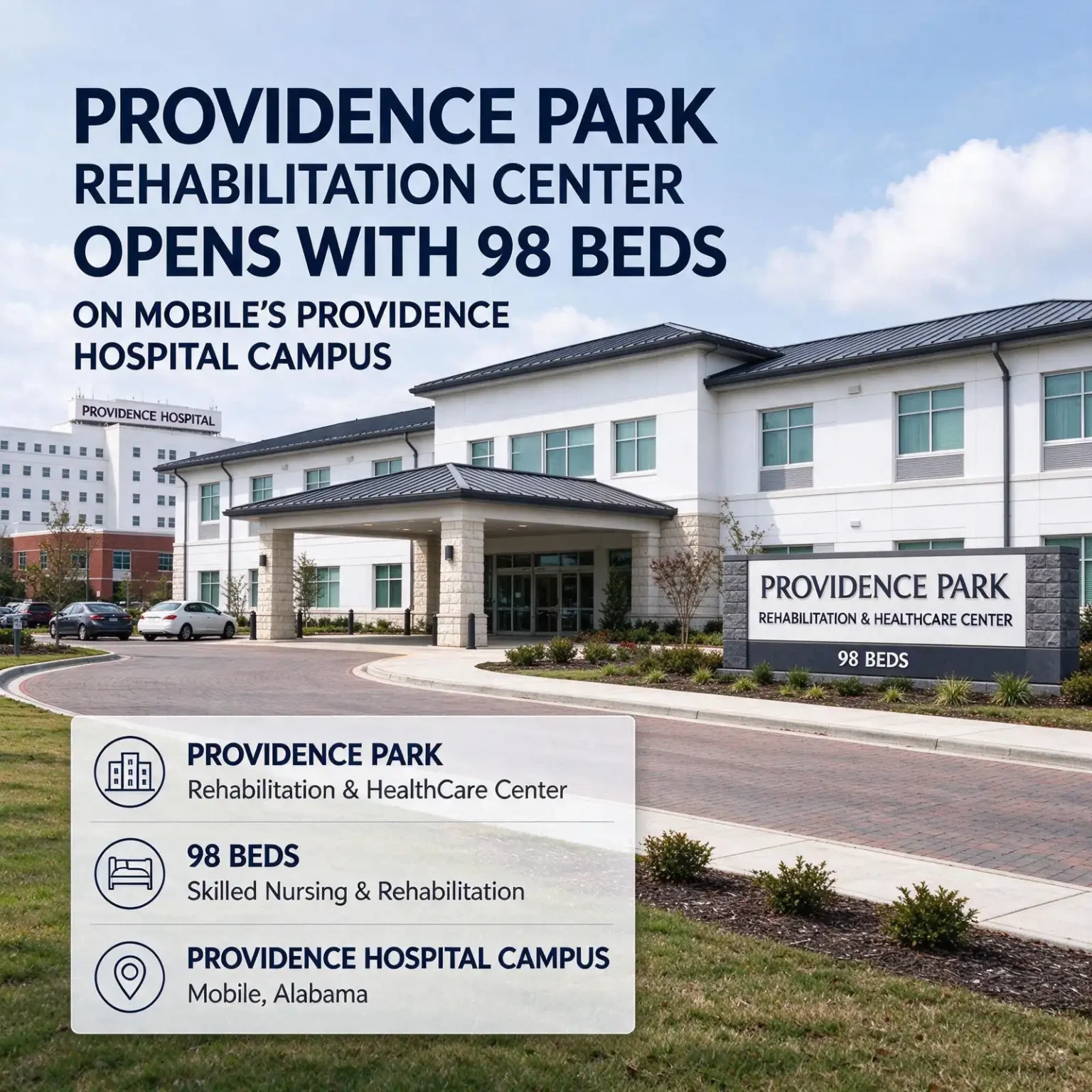
MOBILE, Ala. — Patients recovering from surgery, illness or injury in the Mobile area have a new option for care now that Providence Park Rehabilitation & HealthCare Center has opened its doors. The skilled nursing and rehabilitation facility, which has 98 beds and is operated by Ball HealthCare Services, sits on the Providence Hospital campus.
The newly built center is described as an advanced facility focused on post-acute care, the type of treatment many patients need after leaving a hospital but before they are ready to return home.
What the New Center Offers
Providence Park combines two closely related types of care under one roof: skilled nursing and rehabilitation. With 98 beds, the facility adds capacity for short-term recovery and nursing services for patients in Mobile and the surrounding area who need care after a hospital stay.
The Alabama Nursing Home Association, which represents nursing homes across the state, said the center was designed to deliver post-acute care of high quality within a setting that feels welcoming and home-like. The association described the project as an exciting investment that looks ahead to the future of rehab and skilled nursing services for the Mobile area.
At a recent grand-opening event, the company’s chief executive described the new facility as representing the very best of what Ball HealthCare has to offer. The executive said it was built to meet the post-acute health care needs of patients today and for many years to come.
Why the Hospital Campus Location Matters
Placing a skilled nursing and rehabilitation center on a hospital campus can make transitions easier for patients and families. When a patient is discharged from an inpatient stay and needs continued care, a nearby facility can reduce travel time and make it simpler for relatives who are already familiar with the area to visit.
Providence Hospital is located in west Mobile, near some of the city’s main commercial corridors. For families across Mobile County, a location tied to an established hospital campus may also offer a sense of familiarity at a stressful time.
Skilled Nursing and Rehabilitation, Explained
The terms skilled nursing, rehabilitation and nursing home are often used interchangeably, but they generally describe different levels and types of care.
Skilled nursing care
Skilled nursing refers to medical care that must be provided or supervised by licensed professionals, such as registered nurses or licensed practical nurses. Examples typically include wound care, intravenous medications or injections, monitoring of a serious condition and management of complex medication schedules. Skilled nursing facilities provide this care around the clock.
Rehabilitation therapy
Rehabilitation focuses on helping patients regain strength, mobility and independence. Therapy commonly includes physical therapy to improve walking, balance and strength; occupational therapy to help with daily tasks such as dressing, bathing and cooking; and speech-language therapy for patients who have difficulty communicating or swallowing, often after a stroke.
Long-term or custodial care
Long-term care, often called custodial care, involves help with activities of daily living, such as eating, bathing, dressing and using the bathroom, for people who are not expected to recover enough to live independently. Many nursing homes offer both short-term rehabilitation and long-term residential care, sometimes in separate wings or units.
Understanding Post-Acute Care
Post-acute care is the broad term for medical and rehabilitation services provided after a hospital stay. It can be delivered in several settings, and the right one depends on a patient’s condition, goals and ability to participate in therapy.
- Skilled nursing facilities provide daily skilled nursing and therapy for patients who need continued care but may not be able to handle the most intensive rehab schedules.
- Inpatient rehabilitation facilities offer more intensive therapy, generally for patients who can tolerate several hours of therapy a day, several days a week, such as some stroke, spinal cord injury or brain injury patients.
- Home health care brings nurses and therapists into a patient’s home for those who are well enough to live at home but still need skilled services.
- Outpatient therapy allows patients to travel to a clinic for scheduled therapy sessions.
Common reasons patients need a skilled nursing and rehab stay include recovery from joint replacement surgery, hip fractures, strokes, heart surgery, serious infections or complications from chronic conditions such as heart failure or diabetes. Hospital case managers and discharge planners typically help patients and families sort through these options before discharge.
What to Expect During a Short-Term Stay
A short-term rehabilitation stay typically begins with an admission assessment, during which nurses, therapists and other staff review the patient’s medical history, medications, mobility and goals. Federal rules for nursing homes that participate in Medicare and Medicaid require facilities to complete standardized resident assessments and develop a written care plan for each person they serve.
From there, the care team generally sets therapy goals, such as walking a certain distance, climbing stairs safely or managing personal care independently, and tracks progress over the course of the stay. Families are usually invited to care planning meetings where they can ask questions and help shape the plan.
Length of stay varies widely. Some patients recovering from a planned joint replacement may need only a short stay, while others recovering from a stroke or a long hospitalization may need several weeks. As a patient improves, staff typically begin preparing for discharge, which may include arranging home health services, outpatient therapy, medical equipment such as a walker or shower chair, and training for family caregivers.
Families can help by bringing comfortable clothing and supportive shoes, a current list of medications and doctors, and any personal items that make the room feel familiar. Staying involved and asking questions throughout the stay often helps the transition home go more smoothly.
How Medicare Generally Covers Skilled Nursing
For many older adults, Medicare is the primary payer for short-term skilled nursing and rehabilitation. Coverage rules can be complex, and patients should always confirm details with their plan or a benefits counselor, but some general points apply under Original Medicare:
- Medicare Part A can cover care in a skilled nursing facility for a limited time when certain conditions are met, typically including a qualifying inpatient hospital stay of at least three consecutive days.
- Time spent in a hospital under observation status generally does not count toward that qualifying stay, even if the patient stayed overnight. Patients and families may want to ask hospital staff whether a patient has been formally admitted as an inpatient.
- The patient must need daily skilled nursing or therapy services that can practically be provided only in a skilled nursing facility.
- Coverage is limited to up to 100 days per benefit period. The first 20 days generally carry no daily coinsurance, while days 21 through 100 require a daily coinsurance payment that is set each year.
- Medicare generally does not pay for long-term custodial care when that is the only care a person needs.
People enrolled in Medicare Advantage plans may face different rules, including prior authorization requirements and network restrictions, so it is wise to check with the plan before choosing a facility. Medicaid, which is administered in Alabama by the Alabama Medicaid Agency, can help pay for long-term nursing home care for people who meet financial and medical eligibility requirements. Some people also carry private long-term care insurance.
Free, unbiased help understanding Medicare benefits is available through the State Health Insurance Assistance Program. In Alabama, that program is offered through the Alabama Department of Senior Services and local area agencies on aging.
Choosing a Skilled Nursing or Rehab Facility
Families often have to choose a facility quickly, sometimes with just a day or two of notice before discharge. Planning ahead and knowing what to look for can help. Advocates for older adults commonly recommend these steps:
- Use Medicare’s Care Compare tool. The online tool at Medicare.gov lets users look up nursing homes and see star ratings based on health inspections, staffing and quality measures. Newly opened facilities may not yet have a full rating history.
- Visit in person when possible. Look at cleanliness, how staff interact with residents and whether residents appear engaged and comfortable.
- Ask about therapy. Find out how often therapy is provided, whether therapists are on site and what equipment is available.
- Ask about staffing. Questions about nurse-to-patient ratios, staff turnover and how care is handled at night and on weekends can be revealing.
- Understand communication. Ask how the care team will keep families informed and how care planning meetings are scheduled.
- Plan for discharge. A good facility will discuss the goals of a stay from the start, including when and how a patient may be able to return home and what support they may need.
- Confirm insurance. Check that the facility accepts your Medicare, Medicare Advantage, Medicaid or private insurance coverage.
Patients generally have the right to choose among available facilities, and families should feel comfortable asking hospital discharge planners for a list of options and time to review them.
About Ball HealthCare Services
Ball HealthCare Services operates skilled nursing and rehabilitation facilities in Alabama, and Providence Park is a new addition to its operations. The company’s chief executive has framed the Mobile facility as a long-term investment designed to serve patients well into the future.
The opening comes as health care providers across the country work to meet rising demand for post-acute services. As the large baby boom generation ages, the number of Americans needing care after a hospital stay is expected to continue growing in the years ahead, making new capacity in communities like Mobile increasingly important.
Patients and families interested in learning more about admissions, services or tours can contact Providence Park Rehabilitation & HealthCare Center directly.