Four Baldwin County Commission Races Set as 10 Candidates File for 2018
Three incumbents are running for re-election and Chris Elliott is departing for a State Senate bid as 10 candidates compete for Baldwin County's four commission seats.
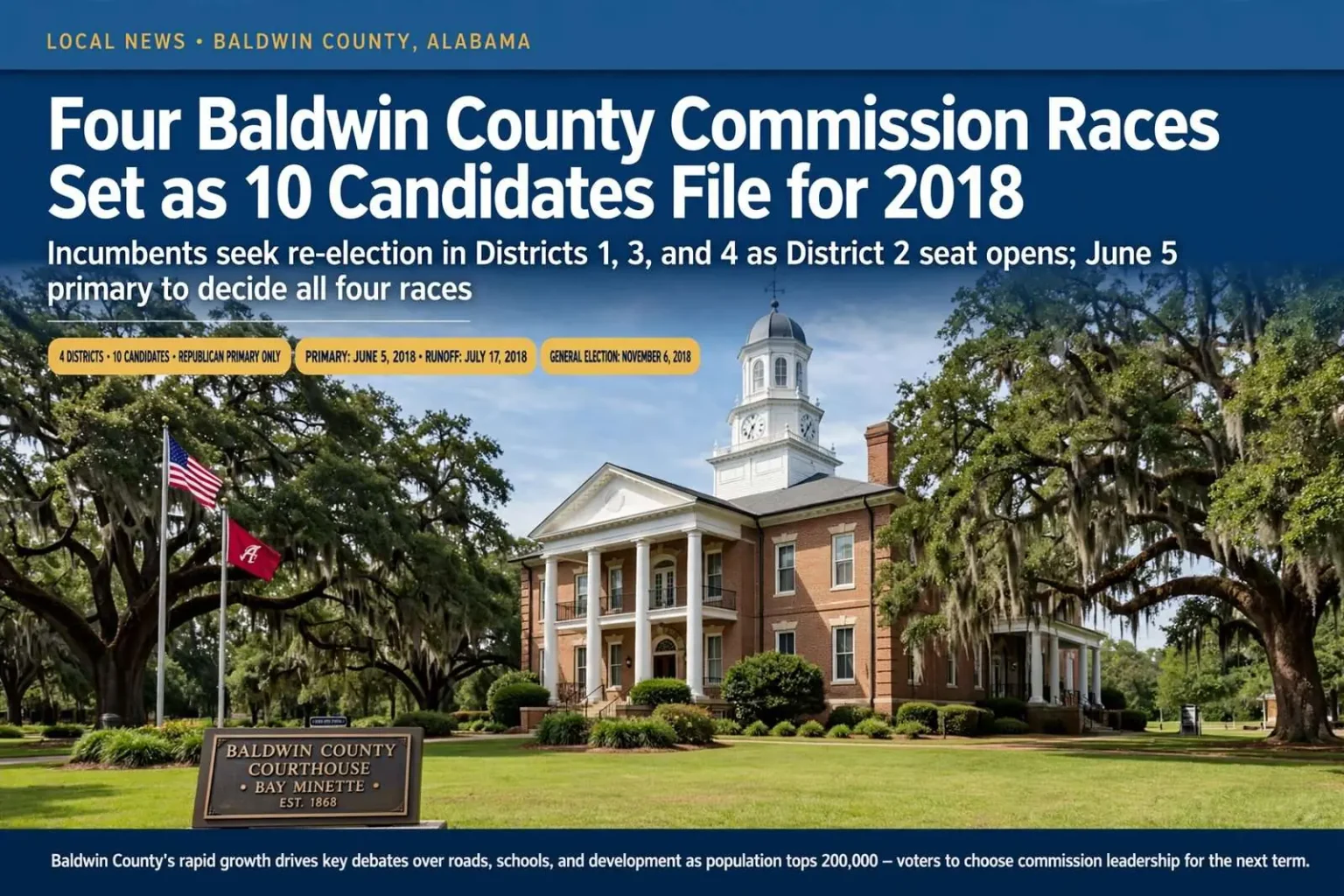
Baldwin County voters will see at least one new face on the County Commission after next year’s elections, with three incumbents seeking to hold onto their seats and ten total candidates now in the running across the commission’s four districts. The county, Alabama’s fastest-growing and one of its most politically conservative, has seen commission races grow increasingly competitive as population surges along the Interstate 10 corridor put pressure on roads, schools and services.
District 1 Commissioner Frank Burt and District 4 Commissioner Skip Gruber are both seeking re-election, as is District 3’s Tucker Dorsey. District 2 Commissioner Chris Elliott, meanwhile, is not seeking another term on the commission — he has announced a run for the Alabama Senate seat that Trip Pittman is voluntarily vacating next year. Elliott’s departure opens the county’s most populous commission district, which stretches through Daphne and the Eastern Shore communities where growth has been heaviest.
Baldwin County’s primary election is set for June 5, 2018, with runoffs scheduled for July 17 and the general election on Nov. 6. Every declared candidate in the race is a Republican; no Democratic candidates have entered any of the four commission contests. That means in practical terms the June primary will decide three of the four seats outright, and any runoff battles will be the last meaningful contests before November, when the general election becomes a formality in districts that Republicans have dominated for decades.
Each of the four seats drew at least two candidates, and the crowded southernmost District 4 has three contenders. There, Christopher Callaghan and Orange Beach City Councilman Jerry Johnson are both looking to unseat three-term incumbent Gruber.
The District 4 Contest
Gruber said the county is facing significant infrastructure challenges, both on its roads and within the school system, and that he wants to remain on the commission to help find solutions. “The citizens voted down the toll authority for the county, which would have helped us a lot finishing up the beach express from I-10 to I-65,” Gruber said. “We could’ve been moving along with that project a lot better. Tax dollars are just not there to do a $200 million project. We need to look at alternatives.”
His reference is to the Beach Express, the tolled corridor that carries traffic from Interstate 10 south toward Gulf Shores and Orange Beach, and to the long-sought connection between the toll road and Interstate 65. Baldwin County voters rejected a toll authority referendum in 2016 after a contentious campaign, leaving the county without a dedicated funding stream for major road work even as traffic along Alabama 181, County Road 64 and the Foley beach corridor has multiplied. Commissioners have since leaned on state and federal sources, impact fees and the county’s share of gas tax money to keep projects moving.
Callaghan, an attorney who serves on the Orange Beach Planning Commission, described his decision to run as an exciting and serious step. “I believe that my skill set makes me uniquely qualified for this opportunity,” he said. Johnson, now in his second term on the Orange Beach City Council, said leadership will be central to his campaign. “Leadership is not about the leader; it is about the people they serve,” Johnson said. “I espouse servant leadership, which means I will work to help the county employees and the residents.”
A Long-Serving Incumbent Challenged in District 1
In District 1, Burt is seeking a ninth term on the commission, having held the seat in every election since 1988 — nearly three decades of service across numerous boards and panels. His tenure spans the transformation of northern Baldwin County from a largely rural, farming-dependent economy to one of the state’s boom areas, with the growth of Spanish Fort, Daphne and Loxley and the arrival of major industrial employers reshaping the county’s tax base and its road network.
Challenging him is Jeb Ball, program director for Baldwin Substance Abuse Services Inc. in Bay Minette. Ball previously worked in the Baldwin County District Attorney’s office from 1998 to 2007 and went on to found Baldwin Substance Abuse Services, a company certified by the Alabama Administrative Office of Courts to provide court-ordered drug and alcohol education classes. His background in the court system and in substance abuse treatment puts public safety and drug enforcement issues at the center of his challenge in a district anchored by Bay Minette and the county’s northern communities.
An Open Seat in District 2
In District 2, the race to succeed Elliott features a sitting Daphne councilman and a former one. Joe Davis, appointed to the Daphne City Council in 2013, said continued economic development and job growth in the county are priorities he wants to keep pushing. John Lake, who served on the Daphne City Council for 24 years before an unsuccessful 2016 mayoral bid against incumbent Dane Haygood, is also in the race. Both men bring municipal experience on the Eastern Shore, where decisions about sewers, subdivisions and school growth routinely intersect with county commission policy.
The seat has extra significance because of the county’s commission structure. With four districts covering the entire county — from the Gulf beaches in the south to the timberlands and new subdivisions along I-65 in the north — each commissioner represents a quarter of Baldwin’s population, and the rapid growth of the Eastern Shore has made District 2’s seat one of the most consequential local offices on the ballot.
A Three-Way Race in District 3
In District 3, incumbent Tucker Dorsey, a real estate developer who has served on numerous boards and commissions throughout Baldwin County, faces challenges from Billie Jo Underwood and Will McDaniel. Underwood is a certified public accountant from Summerdale who has served on that city’s planning commission. Dorsey has been a prominent voice on infrastructure funding during his time on the commission, and the district’s territory along the central corridor of the county — taking in communities such as Summerdale, Robertsdale and Foley’s western outskirts — has seen some of the sharpest growth pressures on rural roads and school capacity.
Higher Pay, Higher Stakes
The stakes for whoever wins are set to rise along with the pay. In June, the Alabama Legislature passed a bill raising Baldwin County commissioners’ salaries from $33,600 a year to $50,240 — matching the county’s median family income. The new pay takes effect in November 2018 and will be reviewed every four years afterward. Supporters of the raise argued that the county’s commissioners oversee a budget and a workforce larger than those of many municipalities, and that the old salary made full-time service difficult for anyone not retired or independently secure. Critics, meanwhile, questioned the timing as commissioners seek re-election.
Growth Shapes Every Race
Baldwin County has seen rapid population growth in recent years, driving increased demand on roads, schools and other infrastructure — issues that are shaping up to be central themes across all four commission races heading into next year’s elections. The county’s population has climbed past the 200,000 mark, making it the fourth-largest in Alabama, and projections have suggested continued expansion as retirees, remote workers and families priced out of Florida’s panhandle move across the state line. That growth has translated into some of the busiest school construction schedules in the state and persistent congestion along Highway 98, Alabama 181 and the Beach Express.
The commission itself sits atop a budget that funds the county’s sheriff’s department, highway department, parks and sanitation services, and it plays a key role in economic development recruiting alongside industrial boards in Bay Minette, Loxley and the county’s other municipalities. The arrival of major manufacturers along the I-65 corridor has raised the profile of the commission’s economic development votes, while the hangover from the toll authority referendum has made any discussion of new taxes or tolls politically treacherous.
For the ten candidates in the field, the June 5 primary is the decisive date. With no Democrats in any of the four races, the winners — or runoff survivors — in June will effectively hold the seats when the new pay scale takes effect in November. Voters in Districts 1 through 4 will find commission races at or near the top of a ballot that also features statewide races, and in Elliott’s former district, the added intrigue of a new senator’s race that drew the sitting commissioner away in the first place.
What happens in these contests will help determine how Baldwin County manages the decade ahead: whether the Beach Express connection is financed without a toll, how quickly school capacity catches up with subdivision approvals, and how the commission balances the influence of developers against the traffic and drainage concerns of longtime residents. Each of the four districts will send a message about which direction its voters want the county to grow.