Pier and Shore Fishing Outlook: Clearing Water, Cooling Gulf and a Blue Crab Spectacle in the Surf
After a brutal fortnight of heat and dingy water, September conditions are improving. Baitfish are returning, jacks are terrorizing the surf, and Alabama fishing licenses expired Aug. 31.
This has been one long, hot summer, and fishing suffered through the previous fortnight as heat, humidity and dingy water conspired against shorebound anglers, making it difficult to catch keeper fish in any numbers.
Signs Beneath the Slow Bite
As usual for this time of year, there were good numbers of undersized regulated fish along with some oversized fish — both good signs for the future of these stocks.
There have also been plenty of pinfish, blue runner, small bluefish and ladyfish around the Gulf State Park Pier, which give newcomers to the sport something to try their luck with.
The Outlook Is Improving
Early weather predictions for September indicate better fishing conditions, as long as we continue to be spared additional interference of a tropical nature.
Gulf waters are finally clearing, and seasonal abundances of baitfish and other small prey should lure more predatory species back within range of pier and shore fishers. The days are getting noticeably shorter, and the Gulf water temperature — now around 88 degrees — should begin edging down within the next few weeks.
The specter of devastating hurricanes hangs over this fortnight historically, though a strengthening El Niño effect may spare this year from such trouble.
A Marvel in the Surf Zone
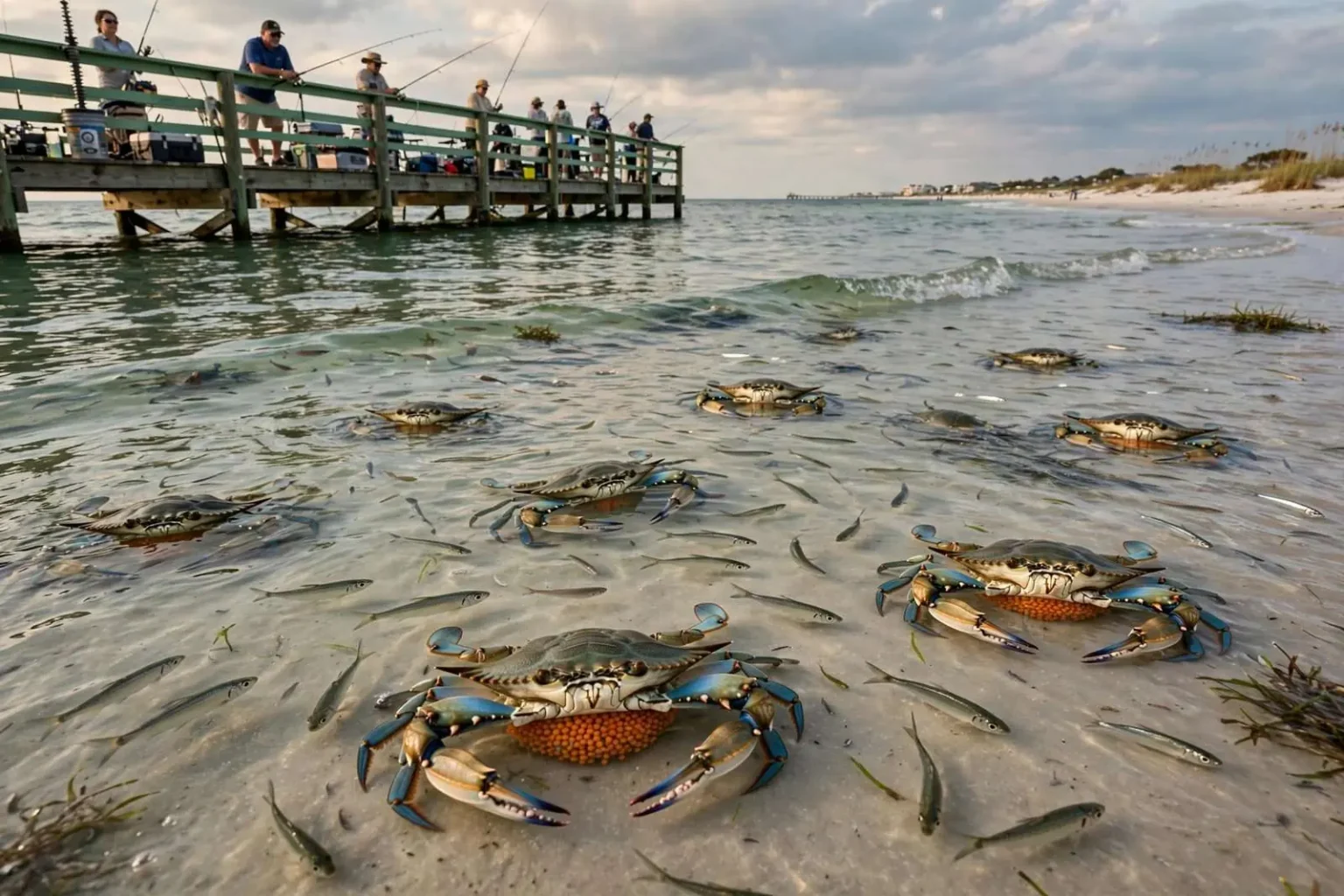
The recent spell of hot, still air has calmed the Gulf enough for the inshore water to clear, revealing one of the season’s natural spectacles.
Thousands of female blue crabs invade the surf zone all along the northern Gulf Coast this time of year to hatch their eggs in the warm, fertile, salty shallows just off the beaches.
The hatchlings quickly morph into swimming forms and soon vacate the Gulf for the back bay estuaries, where they spend their first year.
The Blue Crab Life Cycle
Crabs molt and grow during warmer months when food is more available, and mate during the last molt each female undergoes. She carries the seed of future generations inside her as she spends the rest of her life in the Gulf.
Males remain in the estuary for their entire lives, breeding with new females each year.
The underside of a female crab expands to expose an orange egg cluster. Crabs in that condition are protected from harvest until their eggs hatch and swim away — then the next generation begins the cycle again.
Blue crabs are abundant but subject to regulations protecting against overharvest of this valuable resource. They help clean the sea bottom and provide nourishment for a wide variety of fish species, along with humans.
The Baitfish Are In
Vast schools of young-of-the-year scaled herring — called LYs — and Gulf menhaden, or pogies, are also in the mix, providing a rich food source for fish inshore, offshore and along the shore.
Many predatory fish invade the surf zone or shallow bays this time of year in search of those snack-sized baitfish. Lures that imitate these 2- to 3-inch silver-sided fish, such as spoons, jigs and plugs, work reasonably well.
But predators find the real thing harder to resist, and anglers can gather bait themselves with cast nets where permitted or practical, with small sabiki rigs, and with ribbon rigs.
The Ribbon Rig
Nobody knows for certain how ribbon rigs were invented or by whom, but they have been used for more than 50 years at the Gulf State Park Pier to catch herring of all sizes.
The likeliest explanation is that herring dart at the red ribbon to dislodge parasites from their gills and get hung in the net in the process. The baitfish are then removed and put in a five-gallon bucket with an aerator for later use — or used immediately, hooked and cast out in view of the predators.
The flash and struggle of a small fish is often too much for hungry predators such as king or Spanish mackerel, redfish, speckled trout, bluefish, ladyfish and jacks. Schooling species in particular, which compete with one another for a meal, will gobble up these hapless baitfish.
The method works equally well from the seawall and jetties at Perdido Pass, especially when the bite on lures has slowed.
Matching Bait to Target
Just about any small fish available to anglers can be used to target specific gamefish.
Plentiful pinfish work as live bait for redfish or bluefish on the bottom, and can be cut into strips as cut bait for smaller species such as white trout, grunts or mangrove snapper. The same applies to mullet — smaller ones make excellent live bait for a wide variety of small and intermediate gamefish, while larger mullet make good cut bait for bigger predators like redfish.
The Big Ones at the Point
The mostly catch-and-release fishery for adult jack crevalle and bull redfish continues from the beach at the point near Fort Morgan.
Because this is a full-pressure battle on heavy tackle with an emphasis on release, anglers are encouraged to mash down the barbs on their lure hooks. That speeds unhooking so a tired fish can be returned to the water sooner to make more of its kind.
Junior Jacks Take Over the Surf
Meanwhile, the junior versions of those jacks — in the 8- to 12-inch fork length range — typically terrorize the surf zone this time of year.
They quickly become the most commonly hooked fish for surf anglers actually targeting pompano or whiting through September into October. But they also offer excellent sport on light or ultralight tackle using small jigs or spoons, and again the barbs can be mashed down to make catch and release faster.
It is the same on the pier, where a sabiki brigade often sets up a gauntlet along the rail, pulling in multiple jacks on each cast until the fish quit biting or the cooler is full.
So far the fecundity of jack crevalle has kept the species fairly abundant, but growing popularity and increasing mortality from anglers may be affecting it. Some measure of protection may be needed in the future to ensure they can keep terrorizing the surf zone each summer.
One Housekeeping Note
All Alabama fishing licenses expired Aug. 31. If you have not renewed yet, do it before the next trip — a lapsed license is the easiest and most avoidable way to turn a good morning on the pier into an expensive one.