Baldwin County Reverses Course on Controversial Case Assignment System
Baldwin County quietly dropped a system letting the DA's office help assign cases to judges, after defense attorneys raised favoritism concerns.
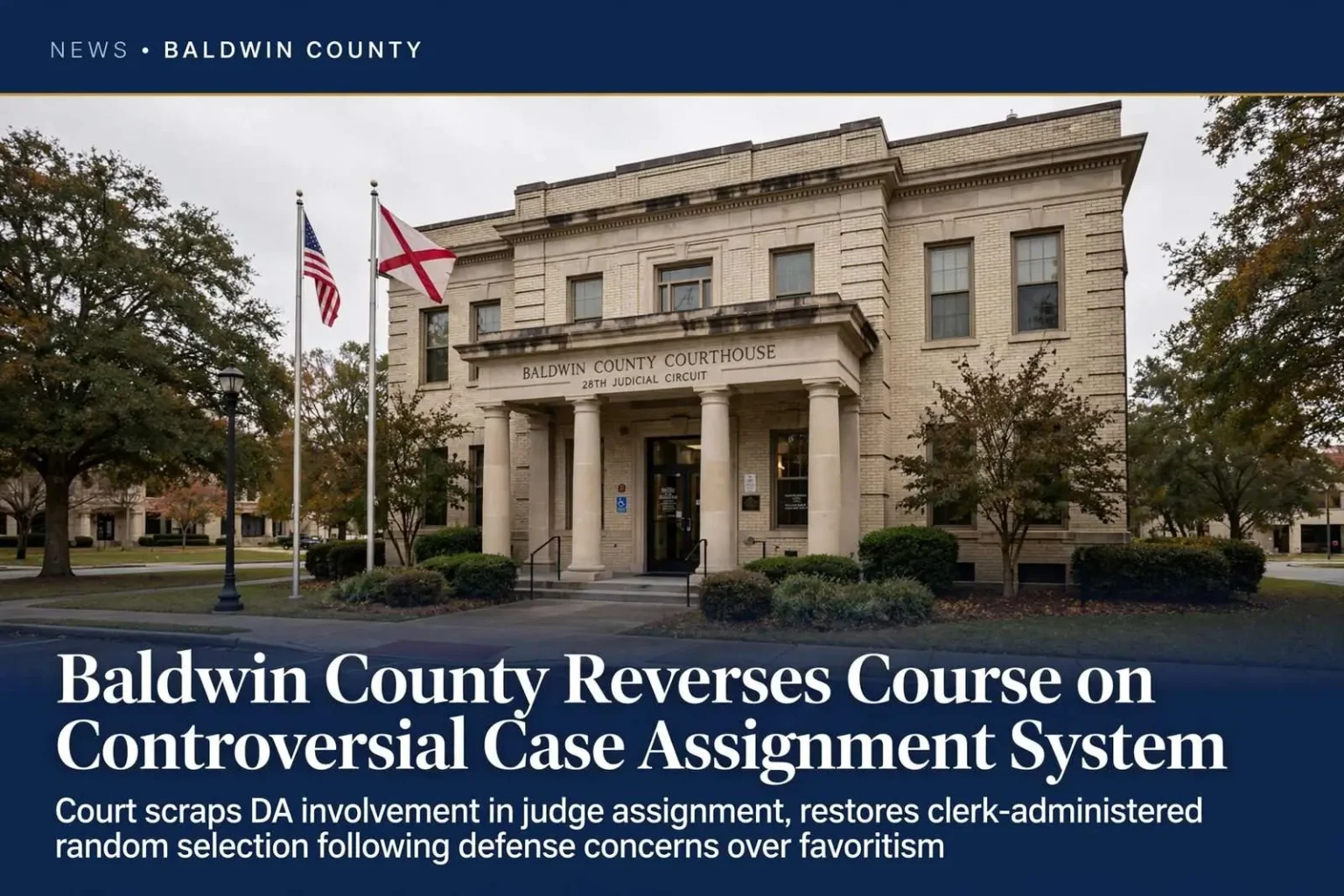
Baldwin County’s court system has scrapped an unusual case assignment arrangement that had allowed the District Attorney’s office to play a role in deciding which judge would hear which case, following months of quiet concern from defense attorneys about the potential for favoritism. The reversal quietly undid an experiment that had set the county apart from the way nearly every other Alabama circuit assigns its cases.
For more than a year, Baldwin County’s 28th Judicial Circuit allowed District Attorney Hallie Dixon’s office to help direct cases to specific judges as part of a “vertical prosecution” model, in which a single prosecutor is assigned to a case from start to finish. Dixon has said the change was intended to move cases through the system more efficiently and ease the workload on her staff, an argument rooted in the practical difficulties of running a prosecutor’s office in one of the fastest-growing counties in the United States.
The arrangement was reversed last month and handed back to the Circuit Clerk’s office, which now handles the random assignment of cases the way most other Alabama counties operate. Circuit Clerk Jody Campbell said the change had nothing to do with reluctance to take the responsibility back, but noted that when someone offers to help with a job that had been shorthanded, it was hard to turn down at the time.
Campbell’s explanation sketches the origin of the arrangement: a clerk’s office stretched thin by Baldwin County’s explosive growth, a district attorney’s office offering administrative help, and an informal accommodation that hardened into practice. What began as a staffing solution ultimately became a structural question about who controls the flow of criminal cases, and the answer, after more than a year, was that the clerk’s office would.
How the Practice Came to Light
The shift became public through a court order in a case involving reckless manslaughter and negligent homicide charges, after a defense attorney filed a motion seeking to stop the DA’s office from what he described as “judge shopping,” the widely condemned practice of steering cases toward judges seen as more favorable to one side. The motion forced into the open a practice that had operated for months without public scrutiny.
Judge shopping carries particular weight in criminal justice because the prosecutor’s office is the most powerful recurring actor in the courthouse. Defense attorneys come and go from case to case, but the District Attorney’s office appears before every judge every day, and if that office can influence which judge receives a new case, it accumulates institutional knowledge no individual defendant can match. Random assignment exists precisely to remove that advantage, dealing cases out like hands of cards so that neither side knows what it will draw.
Vertical prosecution, the model that justified the arrangement, is a legitimate and widely used concept in district attorney offices nationwide. Under true vertical prosecution, one prosecutor handles a case from initial review through trial, giving victims continuity and giving prosecutors deep familiarity with their own files. The efficiency argument is real: a prosecutor who has handled a case since the arrest does not have to relearn it before trial, and cases move faster as a result. What made Baldwin County’s version controversial was not the idea of assigned prosecutors but the mechanism of assigned judges.
The distinction matters. A district attorney can assign a case to a specific prosecutor without touching the question of which judge hears it; most offices do exactly that. Baldwin County’s arrangement crossed the line between managing personnel and influencing the docket, and it was that second element, revealed in the manslaughter case’s court order, that drew the system back to standard practice.
The Presiding Judge’s View
The presiding judge over Baldwin County’s circuit, who has served on the bench since the late 1990s after years as a county prosecutor, said he had heard informal concerns raised by defense attorneys but was never presented with concrete evidence that the system was being abused. His position captured the difficulty of the situation: a practice can look improper without producing a provable instance of impropriety, and courts are reluctant to condemn arrangements on suspicion alone.
He noted that Baldwin County’s judges tend to rule similarly across the board, making it especially difficult to prove any case was being funneled toward a specific courtroom for strategic reasons. If no meaningful differences exist between judges’ tendencies, the argument runs, assignment patterns cannot advantage one side in any way that matters. It is a defense of the local bench’s consistency, but it also concedes the structural concern: the appearance of influence is itself a problem in a system whose legitimacy depends on neutrality.
Even so, he acknowledged that judges rely on being able to notice red flags themselves. That admission cuts to the core of why random assignment endures as the standard. When a prosecutor’s office participates in assignment, the audit trail of who directed what, and why, becomes murky, and the burden of detecting manipulation falls on judges and defense attorneys rather than on a neutral mechanism that prevents it from mattering in the first place.
Defense attorneys in Baldwin County had raised those concerns quietly for months before the manslaughter motion made them public. The bar’s reluctance to force the issue publicly is common in smaller circuits, where prosecutors and defense lawyers appear before the same judges year after year and professional relationships matter. It took the gravity of a reckless manslaughter and negligent homicide case, combined with a court order, to convert private concern into structural change.
Random Assignment as the Alabama Standard
The restoration of clerk-administered random assignment brings Baldwin County back in line with how most Alabama counties operate. Under the standard model, new criminal cases are dealt to judges through a random process administered by the circuit clerk, sometimes literally by drawing names or spinning a wheel in open court, so that no party, police agency or prosecutor controls the destination. The ceremony may look old-fashioned, but its very simplicity is the point: everyone watches the same draw, and no one can do better than chance.
Baldwin County’s circuit carries one of the heaviest dockets in the state, a product of the county’s growth along the Interstate 10 corridor and the Eastern Shore. Courts that handle that volume efficiently earn goodwill across the system, and part of the original appeal of the DA-assisted arrangement was surely the promise of speed. The episode demonstrates, though, that efficiency purchased with control over case flow comes at a cost to perceived fairness that most systems will not pay.
Growth, Workload and the Roots of the Arrangement
The staffing pressures behind the original arrangement are worth understanding. Baldwin County’s population growth has outpaced the expansion of its court infrastructure for years, filling dockets with everything from traffic cases to major felonies, and the clerk’s office that administers those dockets has been under strain that growing counties rarely anticipate. When Dixon’s office offered to help, the offer addressed a genuine operational problem, whatever questions the method raised.
Dixon, who took office promising to modernize and speed up the DA’s operation, has emphasized efficiency in the prosecution of cases, and vertical prosecution fit that philosophy. The reversal of the judge-assignment element does not undo the office’s case-management reforms; prosecutors can still be assigned to files from start to finish. What has ended is the practice that crossed into docket control, and with it, the months of quiet concern from the defense bar.
The episode also illustrates the informal ways that court systems evolve. No statute directed the Baldwin County arrangement, and no public vote approved it; it grew from an office-to-office accommodation and ended when a defense attorney’s motion forced a court to look at it directly. Systems that lack clear rules about who assigns cases can drift into arrangements that no one would design deliberately, which is why the random-assignment standard, boring as it is, persists.
What Changes for the Courthouse Now
Day to day, the practical effect will be invisible to most defendants and observers: new cases will land where chance sends them, as they did before the arrangement and as they do in county after county across the state. Prosecutors will still prepare their cases, defense attorneys will still appear before the judges the draw gives them, and the clerk’s office will once again own a responsibility it held for decades.
The quiet resolution, a reversion to standard practice rather than a public fight, leaves some questions unanswered. No formal finding was made that the arrangement had been abused, and none of the cases assigned under the old system were reopened on that basis. But the restoration of random assignment itself functions as a kind of conclusion: whatever the intent of the original arrangement, the county’s courts decided that the appearance of influence was not worth its convenience.
For the defense bar, the episode is a case study in advocacy working through the system rather than around it, a motion filed in a single case producing a structural reform for every case that follows. And for Baldwin County’s growing courthouse, it is a reminder that as the county’s population rises, the procedures built for a smaller system will keep being tested, and the ones that protect fairness will be worth keeping even when faster alternatives present themselves.