Mobile Police Shut Down Juniper Street Gambling House for Second Time in Six Months
Mobile police arrested more than 15 people and won a new court order closing a Juniper Street home tied to repeated gambling and drug complaints.
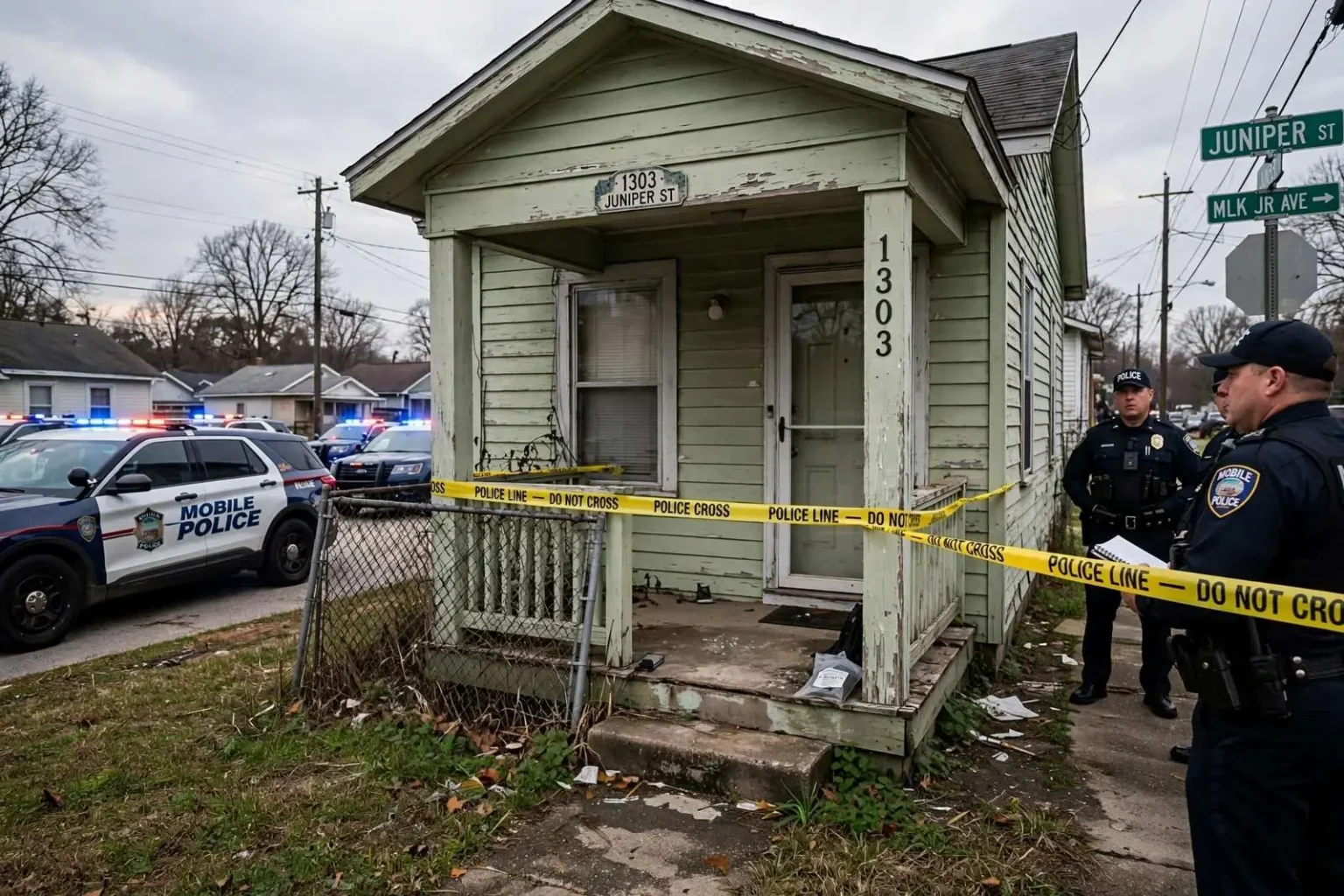
Mobile police obtained a court order closing a home on Juniper Street for the second time in six months after officers descended on the property Friday afternoon and arrested more than 15 people, according to the Mobile Police Department. The sweep is the latest move in a yearlong back-and-forth between the city and a single residence that has tested the limits of the city’s nuisance abatement process.
The house at 1303 Juniper Street, near Martin Luther King Jr. Avenue and known locally as the “Skin House,” has drawn repeated police attention over the past year. Friday’s sweep marked the fourth raid on the property since February and the second time a judge has issued an order barring people from entering the home since June, a pace of enforcement that few addresses in the city have matched.
Officers arriving at the property in the afternoon detained everyone found inside and on the premises, gathering names and evidence before transporting arrestees for booking. Neighbors in the area, who have watched the cycle of raids and reopenings play out since the start of the year, reported heavy police presence along the block for much of the afternoon.
A year of enforcement
During an earlier sweep on June 5, officers arrested 24 people on charges including simple gambling and loitering for the purpose of drug activity. A judge subsequently deemed the property a “drug-related nuisance” and issued a temporary restraining order closing it, putting the city’s nuisance statute to work against a location that police described as a magnet for illegal activity.
In August, Mobile County Circuit Court Judge Rick Stout allowed the homeowner, identified in court records as Falando Wills, to temporarily reopen the house for repairs. The decision gave the property owner a window to address conditions at the home while the broader legal dispute continued, and it briefly quieted the dispute over the house’s future.
City officials withdrew their case against Wills in September after several months passed without reported incidents at the address. The withdrawal, common in nuisance cases when conditions improve, effectively ended the closure order — but it did not end the police department’s attention to the location.
New complaints began reaching narcotics detectives in October, according to a complaint authorities filed in court on Dec. 5. The document laid out the department’s case that activity at the house had resumed, setting the stage for Friday’s raid and the newest closure order, which came barely six months after the first.
Police: monitoring never stopped
Mobile Police Department spokeswoman Ashley Rains said investigators had continued monitoring the location even after the case was dropped. “We constantly go back and check places,” Rains said. “Since June, we’ve made drug buys, gambled and played card games for money at the location.”
Rains’s account describes an uncommonly sustained enforcement effort: detectives who kept an eye on a single address through the summer and fall, gathering firsthand evidence through undercover visits while the court case was on hold. That work, she indicated, is what made the new complaint and the new closure order possible once complaints from the neighborhood resumed.
Everyone arrested during Friday’s raid is expected to face charges of simple gambling, according to police. Detectives said additional details on the charges, including whether any drug-related counts would be added, were expected to be released early the following week. Simple gambling is a misdemeanor under Alabama law, but prosecutors can layer on additional charges where the evidence supports them, and police said that determination was still being worked through.
A neighborhood’s repeating problem
Rains described the property as a persistent problem for the surrounding neighborhood. “It is a constant nuisance,” she said, pointing to the repeated cycle of closures, reopenings and new complaints that has played out at the address since the start of the year.
For residents along Juniper Street and the surrounding blocks near Martin Luther King Jr. Avenue, the cycle has been more than a legal curiosity. Nuisance properties of this kind bring steady streams of foot traffic at all hours, periodic disturbances, and the sense that progress made after one raid can evaporate within weeks. Community leaders in Mobile’s older neighborhoods north of downtown have repeatedly raised nuisance properties among their most persistent quality-of-life complaints.
The Juniper Street case illustrates both the promise and the limits of the nuisance abatement tool. A closure order can empty a problem property quickly, but as the summer showed, the order lasts only as long as the legal case behind it. Once the city withdrew its September case, the property’s reopening was lawful, and the process had to begin again from new complaints and new undercover work.
What comes next
Police were scheduled to appear before Mobile County Circuit Court Judge Charles Graddick later in December for a hearing on the latest court order, as the city continues weighing how to permanently address the property’s history of gambling and drug complaints.
Options available to the city in cases of this kind include extended closure orders, negotiated conditions on the property’s use, and, in the most persistent situations, seeking forfeiture or other long-term restrictions through the courts. Each step requires evidence, and each gives property owners an opportunity to contest the city’s case — which is why nuisance litigation tends to move in exactly the stop-and-start pattern Juniper Street has followed.
What happens after the December hearing will determine whether the second closure holds longer than the first. Police have signaled that the undercover activity documented since June gives them a stronger evidentiary record this time, and neighbors, for their part, are watching to see whether the “Skin House” — closed twice in six months and raided four times since February — stays closed.
How nuisance abatement works in Alabama
The legal tool at the center of the Juniper Street case allows cities to sue properties themselves, not just the people inside them. Under Alabama’s nuisance abatement framework, a municipality can ask a court to declare a property a nuisance when it is regularly used for illegal activity — drug sales, gambling, prostitution or related offenses — and to bar entry while the case is pending. Violating a closure order can itself lead to arrest, which is what makes the orders more than symbolic.
The process demands documentation. Police must connect specific incidents to the property, usually through arrests, undercover purchases and complaint records, and property owners are entitled to contest the evidence and argue that conditions have changed. Judges hold significant discretion over whether to issue orders, how long they last, and what conditions allow a property to reopen — which is why a homeowner’s agreement to make repairs, as happened here in August, can result in a reopening even after a property has been deemed a nuisance.
Mobile police have used the process against a handful of properties across the city in recent years, typically after repeated raids fail to produce lasting change. Officers and neighborhood associations alike describe closure orders as a last resort — effective when they hold, but resource-intensive to obtain and to enforce.
The cost to the surrounding blocks
Residents near Martin Luther King Jr. Avenue have lived with the consequences of the Juniper Street cycle in practical terms. Nuisance properties depress nearby property values, complicate efforts to attract businesses to commercial corridors, and place a visible strain on relationships between neighbors and the property owners involved. Community meetings in the area have repeatedly featured complaints about specific addresses where activity resumed shortly after police attention moved on.
The neighborhood around Juniper Street is among Mobile’s oldest, a mix of modest homes and longtime families within reach of downtown and the Mobile River industries to the south. Community groups there have invested for years in cleanup efforts, youth programs and code enforcement partnerships, and they have consistently identified a small number of chronically problem properties as the chief obstacle to those investments paying off.
Simple gambling and the charges ahead
The simple gambling counts expected against the more than 15 people arrested Friday carry light penalties on their own, but the charges serve a broader purpose in the nuisance strategy: each arrest documents activity at the property, building the record the city needs to justify and extend closure orders. If detectives add drug-related counts after their review, the stakes for those arrested rise accordingly, and the evidentiary picture of what was happening inside the house becomes harder for the property’s defenders to dispute.
Police have also emphasized that the department’s attention to the address is ongoing regardless of how the December hearing comes out. Undercover work of the kind Rains described — repeated visits, drug purchases and gambling sessions documented since June — continues as long as complaints do, and officers have signaled that the location will remain on the narcotics unit’s watch list.
For now, the house at 1303 Juniper Street is closed again by court order, its latest chapter written by more than 15 arrests in a single afternoon. Whether this closure proves more durable than the last will be decided by Judge Graddick’s hearing later in December — and, ultimately, by whether the cycle of complaints that has defined the address all year finally stops.