Mobile Carries Its Courtroom Into Hillsdale, and Puts 500 Employees Through Service Training
Mobile's municipal court moved a session out of Government Plaza and into the Hillsdale Community Center to hear blight and litter cases, while the mayor put more than 500 city employees through customer service training.
Two small initiatives in Mobile city government in the spring of 2007 pointed in the same direction: toward citizens who were not coming downtown, and toward the suspicion at City Hall that the problem might be City Hall.
Neither effort involved a bond issue, a headline ribbon-cutting or a new department. One moved a courtroom into a neighborhood community center; the other moved several hundred city employees through a classroom. Both rested on the same diagnosis — that a city government which expects residents to navigate it on the government’s terms will lose the residents who can least afford to navigate it.
Court, at the community center
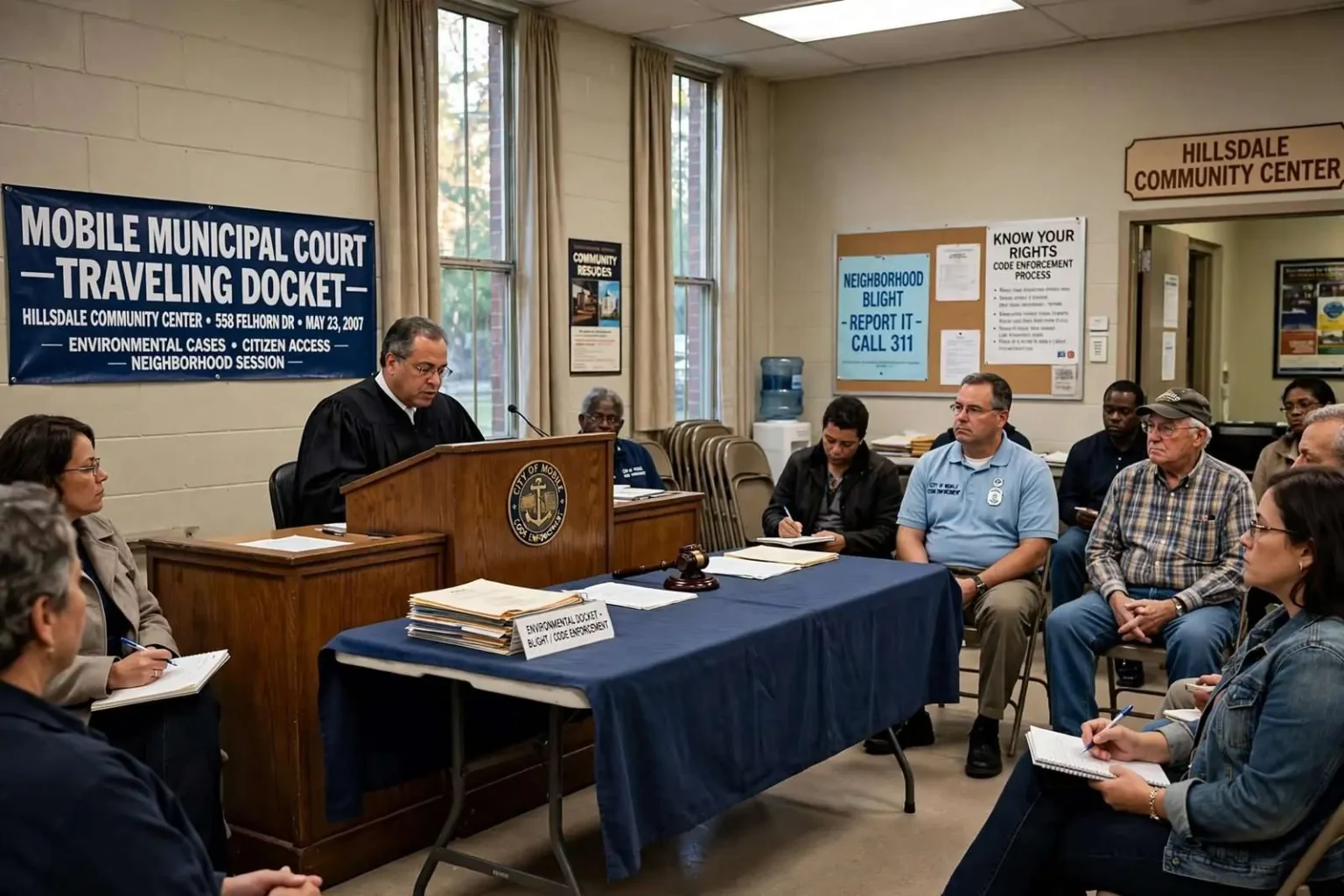
Mobile Municipal Court left Government Plaza and convened at the Hillsdale Community Center at 558 Felhorn Drive, holding a special session on a Wednesday afternoon in late May.
Presiding Judge Holmes Whiddon heard environmental cases there, the category of municipal enforcement that most directly touches how a neighborhood looks and feels. Environmental cases in Mobile’s municipal court cover litter, violations of health and safety regulations, substandard housing, trash and blight.
The environmental docket is municipal court’s most local work. Where traffic cases involve strangers passing through, environmental cases involve next-door neighbors: the rental house with a collapsing porch, the vacant lot collecting appliances, the pile of debris that sits for months. The cases are also the ones where the defendant is most likely to be a property owner who has never set foot in a courtroom, and where an appearance in Government Plaza — with its parking garages and security lines — presents the steepest practical barrier.
The rationale offered by the city was straightforward. Holding court at sites within the community gives residents better access to the judicial system, a spokesman said, and serves a second purpose in revitalizing neighborhoods: it teaches people what the court actually does.
That second purpose was less decorative than it sounds. Code enforcement only functions as well as the community’s understanding of it. When residents know what a citation looks like, what a judge can order and what happens when an owner ignores the order, they file complaints that produce results — and they show up to the hearings that determine those results. A courtroom that appears in their own community center, with their own neighbors’ cases on the docket, is a demonstration as much as a proceeding.
The Hillsdale session was not the first experiment of its kind. Earlier that year Whiddon had convened court at the Dumas Wesley Center in Crichton.
Dumas Wesley, a Crichton institution with deep roots in the neighborhood, gave the experiment its first venue; Hillsdale gave it its second. Two sessions in one spring suggested the city was treating the traveling docket as a program rather than a one-time gesture — a format that could rotate through the neighborhoods where blight complaints concentrated.
The choice of Hillsdale carried weight. The neighborhood was, at that moment, a subject of active argument in Mobile over housing conditions, absentee stewardship of rental property and declining values, with the condition of homes there cited in disputes that reached well beyond city government. Bringing a blight docket into the middle of the neighborhood in question was a pointed gesture, whether or not it was intended as one.
Enforcement where people live
The practical logic of a traveling environmental docket is worth spelling out, because it is easy to dismiss as a public relations exercise.
Blight cases in an American city fail for predictable reasons. Property owners do not appear. Neighbors who complained never learn what happened. Residents do not know that a mechanism exists, or believe it works only for other neighborhoods. Physically relocating the proceeding into the affected community addresses each of those failures at once. The people affected can watch. The owners cited have fewer excuses about the trip downtown. And the abstraction of code enforcement acquires a face and a docket.
The mechanics compound the effect. An owner who appears before the judge in a community center a few blocks from the cited property is confronted not just with a fine but with a room of the neighbors the condition affects. Complainants who watch the proceeding learn what evidence matters, what the court can and cannot order, and what follow-up looks like. City inspectors and prosecutors, for their part, operate under the same public light — which cuts both ways, exposing sloppy cases as readily as absentee owners.
Whether the sessions changed outcomes in Hillsdale is not something a single afternoon can answer. But the approach reflected a theory of municipal government that was gaining ground in Mobile at the time: that services had to be pushed outward rather than waited for.
The theory ran through the decade’s neighborhood-revitalization debates in cities across the country. Downtown institutions — courthouses, city halls, permit offices — were built to serve a city that no longer existed, when nearly everyone worked and shopped in the urban core. As populations spread, the institutions stayed put, and the gap showed up in exactly the places blight concentrates: neighborhoods farthest from Government Plaza, least able to take a morning off work and least practiced in navigating municipal process.
Teaching 500 employees to answer the phone
The same theory drove a less visible effort inside city government.
Mayor Sam Jones implemented citizen service training for frontline employees and their supervisors, conducted across six three-hour sessions at the Brookley Conference Center’s Cypress Room at 254 Old Bay Front Drive. More than 500 City of Mobile employees were slated to take part.
“We are committed to giving the citizens of Mobile the very best service in all aspects of city government,” Jones said. He tied the training to two other initiatives of his administration, Mobile 311 and Mobile CitiSmart, arguing that together they were bringing increased effectiveness and accountability to city government.
The frontline framing was the point of the program. In every city government, the public’s experience of the institution is shaped less by the mayor or the council than by a specific set of employees: the clerk at the counter, the dispatcher, the inspector, the person who picks up the phone. Those employees decide, hundreds of times a day, whether a resident’s question becomes an answer or a runaround. Training aimed at supervisors as well as frontline staff acknowledged that service culture flows from the top of a department or not at all.
The venue itself carried a quiet significance. The Brookley Conference Center sits in the old Brookley Field complex, the Air Force base whose closure in the 1960s cost Mobile thousands of jobs and whose redevelopment — first as an industrial park, later as the aeroplex that would eventually anchor Airbus assembly — became one of the city’s defining economic stories. Holding a city government training there placed the program in a building that symbolized institutional reinvention.
Six three-hour sessions spread across the schedule was also a logistical statement: 500 employees cannot be pulled off the line at once, and a program that aims to change behavior has to reach everyone, not just a leadership cohort. The decision to include supervisors alongside frontline staff mirrored the logic of the service itself — a citizen calling about a missed pickup does not care which employee erred, only whether someone fixes it.
The year before, city department heads had gone through training on working with citizens with special needs.
That earlier round put the 2007 program in context: a two-step build, first teaching department leadership to serve residents with particular challenges, then extending structured service training across the government’s front lines. In sequence, the programs reflected an administration treating customer service not as a slogan but as a trainable skill with a curriculum, a schedule and an attendance list.
The unglamorous half of governing
None of this made headlines in the way that a steel mill announcement or a legislative brawl did. That is roughly the point.
The Jones administration had come into office with a set of commitments about responsiveness, and 311 systems were then spreading across mid-sized American cities as the standard answer to a familiar complaint: that residents could not find out who was responsible for a pothole, a dead streetlight or a collapsing house next door. Training the people who answer those calls is the part of the reform that nobody photographs.
The 311 idea was simple but demanding. A single number, answered by trained operators with access to a tracking system, promised to end the municipal shell game in which a caller is bounced from department to department. But the technology alone accomplished little if the operator on the line could not identify the problem, log it correctly and set expectations — and little still if the work order that resulted died in a department’s queue. Mobile CitiSmart, the administration’s companion effort, supplied the accountability layer the tracking implied.
Viewed separately, the courtroom experiment and the training program look like minor items in a municipal calendar. Viewed together, they describe a coherent theory of what responsiveness actually requires: government that travels to the neighborhoods where its decisions land, and employees equipped to treat the resident on the phone as the reason the job exists.
Taken together, the traveling court and the service training amounted to a modest, coherent proposition. If the residents of Hillsdale and Crichton did not believe city government was theirs, then city government would have to go and show up in Hillsdale and Crichton, and the employee who eventually picked up the phone had better know what to say.