Baldwin County Attorney Accuses DA’s Office of ‘Judge Shopping’ in Court Filing
A Baldwin County defense attorney says the District Attorney's Office is improperly picking judges for criminal cases, a practice she denies.
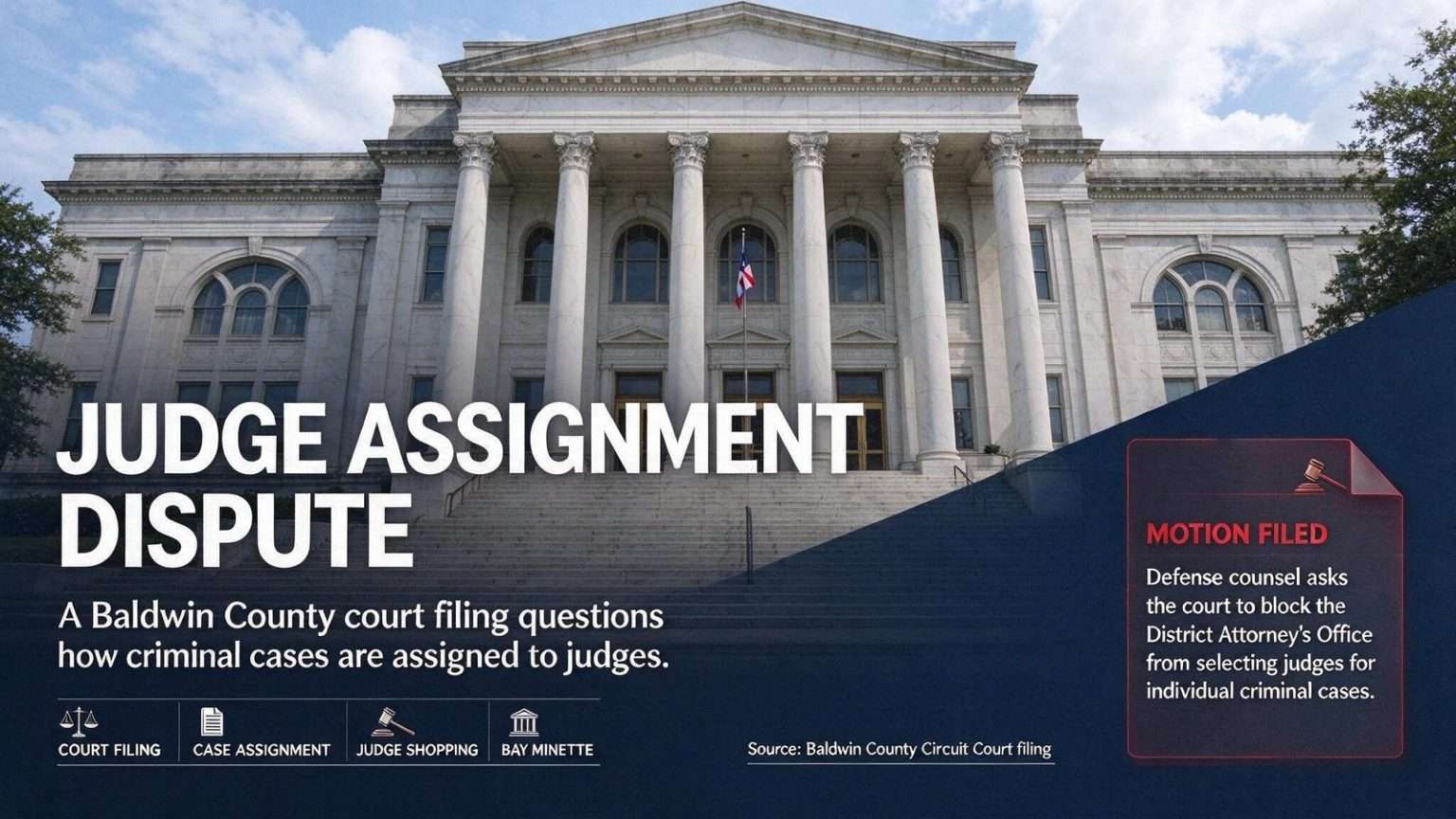
A Baldwin County defense attorney has asked a circuit judge to strip the District Attorney’s Office of its role in deciding which judge hears which criminal case, arguing the practice amounts to improper “judge shopping” that violates defendants’ due process rights.
Attorney Patrick Prendergast, who previously worked in the Baldwin County District Attorney’s Office, filed the motion on behalf of a client charged with reckless manslaughter and criminally negligent homicide in Bay Minette. Prendergast argued that assigning cases to judges should be the job of the Baldwin County Circuit Clerk’s Office, not the DA’s office, and said letting prosecutors choose which judge gets a case gives the state an unfair edge before a trial even begins.
District Attorney Hallie Dixon rejected the accusation as untrue and “absurd,” saying her office has handled case assignments for more than a year using a consistent set of rules rather than any case-by-case judgment about which judge might be more favorable. According to Dixon, cases involving co-defendants are routed to the same judge, cases involving a defendant previously indicted in Baldwin County within five years go back to the same judge who handled that earlier case, and everything else is assigned to whichever judge currently has the lightest caseload.
Dixon said the change followed her decision to move to a “vertical prosecution” system, in which a single prosecutor handles a case from arrest through trial or plea rather than passing it between attorneys. She said the shift was meant to speed up how quickly cases move through the courts, since her office can now assign a case to a judge immediately after an arrest instead of waiting weeks for an indictment, which was how the process worked when the Circuit Clerk’s Office handled assignments.
The presiding judge in the underlying case gave the District Attorney’s Office seven days to respond formally to the motion, and Dixon’s office indicated it planned to do so.
Neither the Circuit Clerk’s Office nor the county’s presiding judge could be reached for comment on the dispute, leaving the question of how future criminal cases in Baldwin County get assigned to judges unresolved for now.
How case assignment works
Baldwin County makes up Alabama’s 28th Judicial Circuit, where felony cases are tried in circuit court. Each judicial circuit in the state has a presiding circuit judge who holds general supervisory authority over the circuit’s courts and dockets, which is why disputes over how cases are distributed among judges ultimately fall to the circuit bench to resolve.