Bay Minette Man Rejects Plea Deal in Wood Family Child Sex Abuse Case
A man charged in the Wood family child sex abuse investigation rejected a plea deal in Baldwin County court, saying he believes he is innocent.
A Last-Minute Change of Heart
A Bay Minette courtroom saw an unexpected turn this week when a man tied to a years-long child sex abuse investigation walked back his decision to accept a plea agreement, telling his attorney just before the hearing that he believed he was innocent. William “Billy” Brownlee, 50, of the Eight Mile community in Mobile County, appeared before Baldwin County Circuit Judge Jody Bishop on what was expected to be the day he formally accepted a negotiated plea.
Instead, defense attorney Thomas Pilcher told the judge his client had changed his mind that morning, saying Brownlee didn’t feel he should go to prison for something he says he didn’t do. The reversal came after both prosecution teams and the defense had prepared to close out a chapter of a case that has stretched across two counties and several years, and it left prosecutors to regroup while the defendant returned to jail to await further proceedings.
Brownlee faces second-degree sexual abuse and second-degree sodomy charges in Baldwin County, along with related sex-abuse charges in Mobile County. The charges grew out of a long-running investigation into the family of Brittney Wood, a Mobile woman who was 19 when she went missing in the spring of 2012 and has not been found.
The Wood Case Background
That investigation has led to multiple arrests across Baldwin and Mobile counties, with authorities alleging that several people connected to the Wood family were involved in passing children among themselves for sexual abuse. The allegations, which surfaced in the weeks and months after Wood’s disappearance, stunned both sides of Mobile Bay and drew sustained coverage as one deputy after another relative or associate was taken into custody.
For investigators, the case has been unusual in both scale and posture: the central figure — Wood herself — has never been found, and much of the evidence has come from the victims themselves, children who were interviewed at length as the investigation widened. Court proceedings for the various defendants have moved at different speeds in the two counties, with some defendants accepting pleas while others, like Brownlee, chose to fight the charges.
Brownlee had been friends with Donald Holland, an uncle of Wood’s who took his own life along the Fish River in Baldwin County’s Marlow community shortly after Wood disappeared. Holland’s death, coming at the very start of the investigation, removed one of the case’s central figures and left prosecutors to build their accounts from the statements of others.
The Deal He Turned Down
Under the offer Brownlee turned down, Baldwin County prosecutors had recommended a 10-year sentence, while Mobile County’s portion of the deal carried a recommended 15 years, with both terms to run at the same time. Because the two counties’ offers were negotiated together, walking away from the Baldwin County deal also killed the agreement in Mobile County, according to his attorney.
Coordinated pleas are common in cases that span county lines, since defendants and prosecutors alike want certainty about the total exposure. That structure also means the risk runs both ways: a defendant who rejects one half of the package loses the other, and prosecutors in each county are freed to seek their own outcomes without any commitment to coordination. Brownlee’s decision put him back at the starting line in both jurisdictions on the same morning.
Pilcher told the judge that his client’s decision was his own, made the morning of the hearing after weeks in which the agreement had been expected to go through. The attorney said Brownlee had come to feel he could not admit guilt to crimes he insists he did not commit, whatever the price of taking the case to trial.
What He Now Faces
No trial date has been set, but Brownlee now faces the possibility of consecutive sentences: the Baldwin County charges each carry up to 20 years, while some of the Mobile County charges carry a mandatory minimum that would apply if a jury convicted him. Stacked against the 10 years Baldwin had offered and the 15 recommended in Mobile, the arithmetic of going to trial is stark — the potential combined exposure runs to decades if sentences were ordered to run one after another.
Second-degree sexual abuse and second-degree sodomy are felony charges under Alabama law, and convictions would also carry the sex-offender registration requirements that follow defendants for the rest of their lives. For a 50-year-old defendant, the difference between a coordinated sentence and a worst-case outcome at trial is the difference between eventual release in middle age and the likelihood of dying in prison.
For the victims and their families, the reversal means continued waiting. Plea hearings offer certainty and, in many cases, finality; trials require children to testify and relive events in a public courtroom. Prosecutors in both counties have emphasized throughout the Wood case proceedings that the children at the center of the allegations remain their first concern, whatever path any individual defendant chooses.
The Courtroom Setting
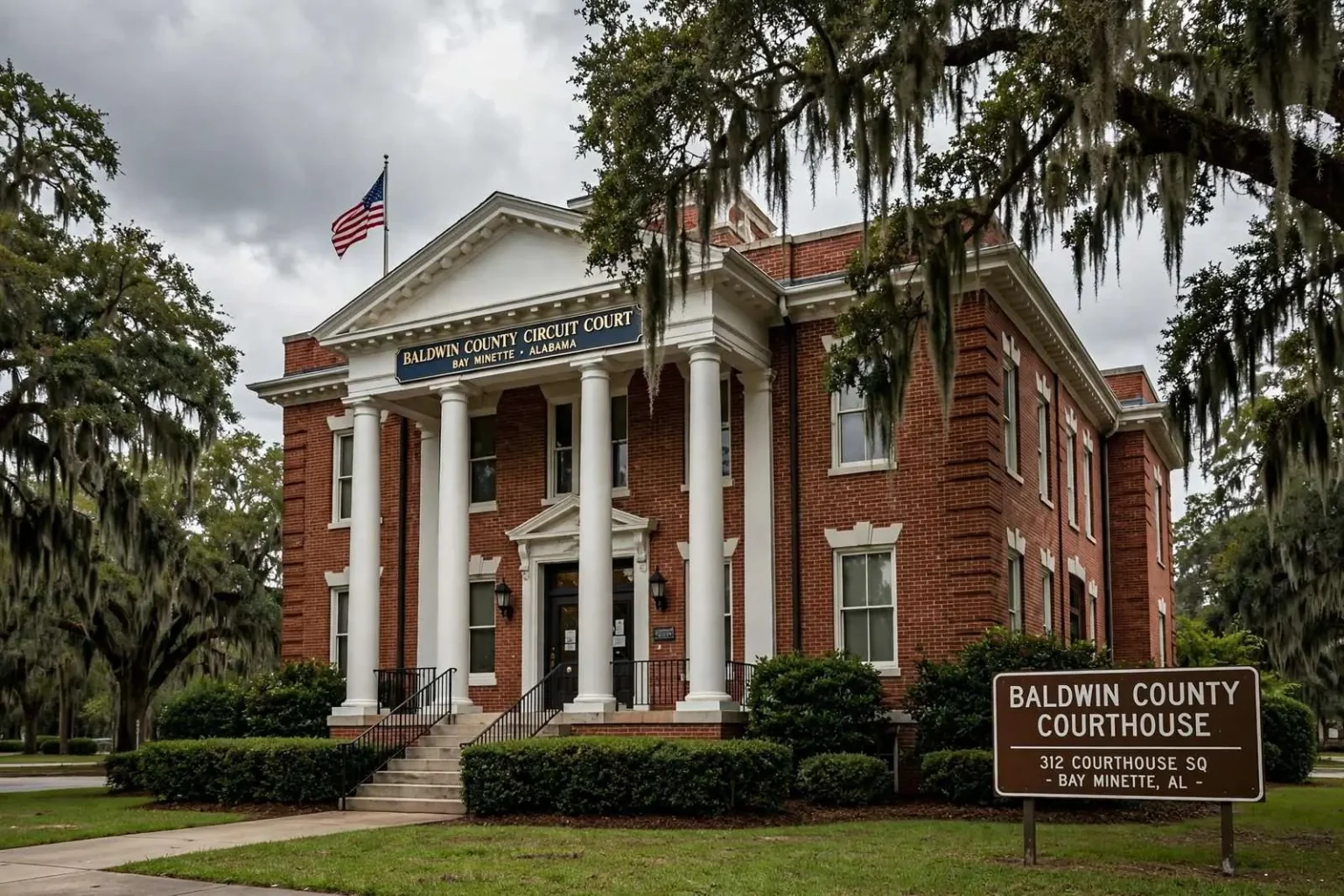
Baldwin County Circuit Court in Bay Minette handles felony cases from across the county, and Judge Jody Bishop’s courtroom has seen a share of the Wood case proceedings as they have wound through the system. Hearings that might have been routine — a plea accepted, a sentence scheduled, a case crossed off the docket — instead ended with the case still open and the parties returning to their corners.
The hearing itself was brief by the standards of the case’s history. Pilcher informed the court of his client’s decision, the judge acknowledged the change, and the expected plea was formally off. What takes minutes in a courtroom, though, represents months of negotiation between two prosecutors’ offices and the defense, all of which now has to be rebuilt from nothing if any agreement is ever to be reached.
A Case That Keeps Testing the System
The Wood investigation has stretched the resources of law enforcement in both counties in ways few local cases ever do. Multiple defendants mean multiple defense attorneys, multiple trial schedules and victims who must be prepared for proceedings that can shift without warning, as Brownlee’s reversal demonstrated. Court watchers in Baldwin and Mobile counties have followed the case not only for its disturbing allegations but for how the two judicial systems handle a case with so many moving parts.
Brittney Wood’s disappearance remains the shadow over all of it. She was 19 when she went missing in the spring of 2012, and the search for her gave way to an investigation that has already produced convictions and plea agreements from other defendants. Her family has continued to press for answers about what happened to her even as the criminal cases against others move forward.
Brownlee remains in custody pending further proceedings. Whether he ultimately returns to the negotiation table or insists on a jury, the choice he made in that Bay Minette courtroom ensured that the case named for the family at its center will keep his name on its docket for a long time to come.
How the Plea Process Unraveled
Negotiations in multi-county cases typically proceed in parallel, with defense counsel shuttling between prosecutors’ offices to keep the terms aligned. Brownlee’s agreement had reportedly been discussed for weeks, and the hearing had been placed on Judge Bishop’s docket precisely because both sides believed the deal was ready. That a defendant can change course the same morning underscores how much control defendants retain until the plea is actually entered in open court — a moment Alabama judges treat as irrevocable, and one reason they question defendants carefully before accepting any guilty plea.
Had Brownlee gone through with it, the judge would have reviewed the recommended sentences, questioned him about the voluntariness of the plea and, if satisfied, imposed the coordinated terms. Instead, the case returns to the pretrial track in both counties, with discovery already largely complete and the question of trial scheduling now in front of the courts. Prosecutors, having watched a prepared deal collapse, must decide whether to extend new offers or press for trial dates.
The Broader Weight of the Case
Few local cases have tested the two-county legal machinery the way this one has. Witnesses, victims and evidence cross the bay in both directions; two district attorneys’ offices must coordinate strategy while answering to two separate electorates. Each defendant’s choice — plea or trial — ripples through the others, since testimony and rulings in one courtroom shape expectations in another.
For now, Brownlee’s case stands as the clearest recent illustration of how high the stakes run for every participant. A deal once on the table offered roughly a decade or more in prison with a known end date; rejecting it preserved his protest of innocence but exposed him to decades behind bars if juries in two counties disagree with him. The next chapter belongs to the trial calendar, and to a defendant who told his lawyer, hours before he was set to give up that gamble, that he wanted to take his chances instead.