Bay Minette Man Convicted of Making Meth Faces Life as Habitual Offender
A Bay Minette man with a long criminal record was convicted of manufacturing methamphetamine and, as a habitual offender, faced a minimum of life in prison, Baldwin County prosecutors said.
A Bay Minette man with a lengthy criminal history was convicted this week of manufacturing methamphetamine and, because of his record, faced a minimum sentence of life in prison, Baldwin County District Attorney Hallie Dixon announced.
The Verdict
After a two-day trial in Circuit Judge Bob Wilters’ court, Tommy Roscoe Bryars Jr. was found guilty of Unlawful Manufacturing of a Controlled Substance in the first degree, Unlawful Possession of a Controlled Substance and Unlawful Possession of Drug Paraphernalia.
As a habitual offender, Bryars faced a minimum of life and up to 99 years in prison, said Assistant District Attorney Brett Anderson, who prosecuted the case. Sentencing was set for Jan. 5.
The jury’s verdict capped a prosecution built around the circumstances of a single arrest — a probation warrant, a search that turned up drugs in a suspect’s pockets, and an active meth lab discovered in a car parked in a family member’s yard. Together, the three convictions covered the full chain of methamphetamine involvement, from production to possession to the paraphernalia of use, and they combined with Bryars’ criminal history to produce one of the harshest sentence ranges Alabama law allows.
Alabama’s habitual offender statute escalates punishment sharply for repeat felons, and prosecutors in Baldwin County have used it consistently against defendants whose records show a pattern of reoffending. Under the law, a defendant with enough prior felonies can face life without parole even for offenses that would otherwise carry far shorter terms — a structure designed to remove career offenders from circulation rather than cycle them through short sentences.
An Arrest, and a Lab in the Yard
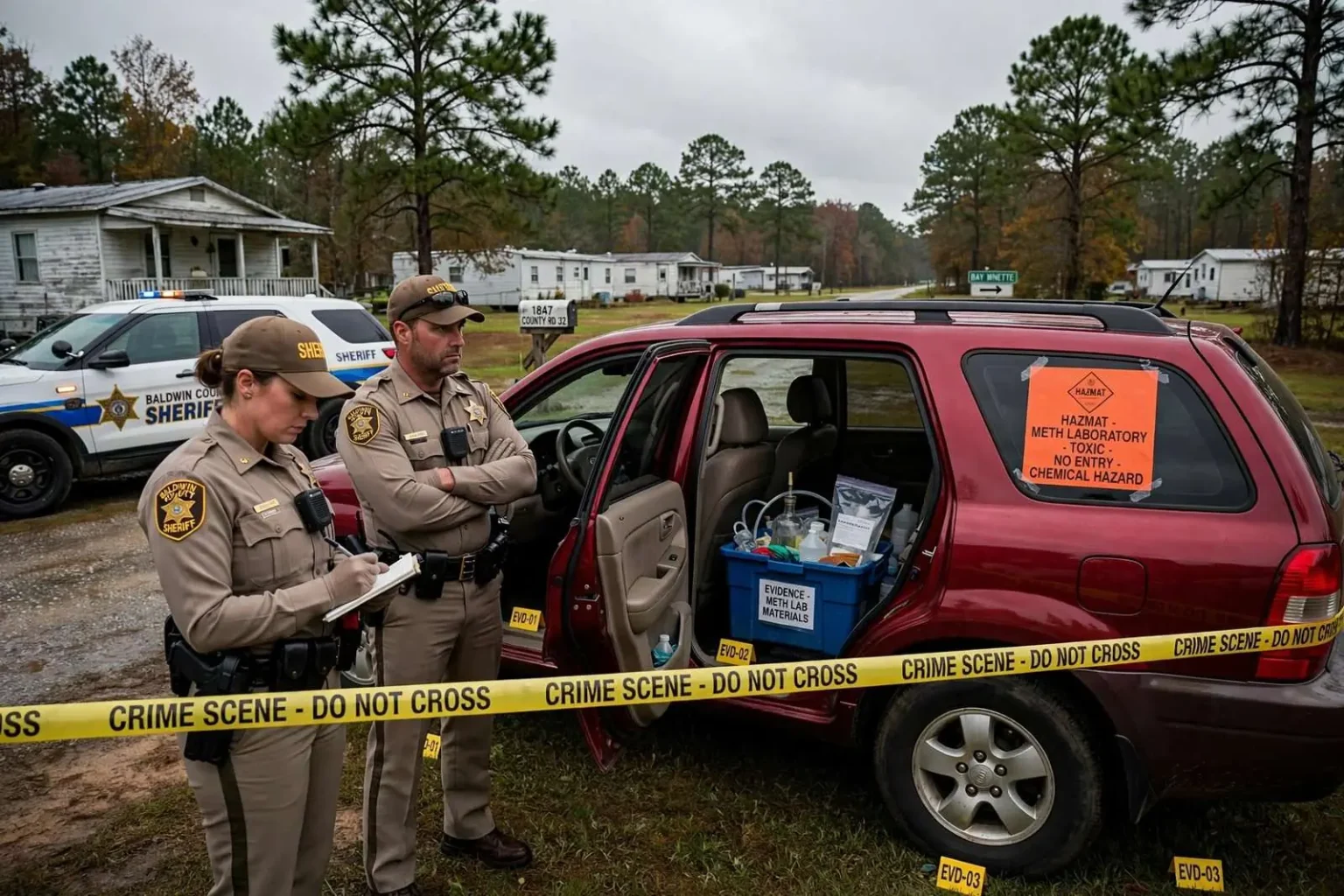
Anderson said deputies from the Baldwin County Sheriff’s Office went to the home of Bryars’ father to serve a probation warrant. “When they found and arrested him, deputies pulled meth and a homemade drug pipe from Bryars’ pants pockets, and found an active meth lab in Bryars’ maroon Kia in the yard,” Anderson said.
The discovery transformed a routine warrant service into a hazardous-materials response. Active meth labs — particularly the portable “one-pot” or “shake-and-bake” style labs common in the era the arrest was made — are unstable, toxic and prone to fire, and a lab inside a vehicle multiplies the danger. Deputies trained in lab recognition secure the area, keep everyone at a distance, and call in certified cleanup teams, because the chemical residue from meth production can poison soil, linger on surfaces and ignite from a single spark.
The arrest came against the backdrop of a family tragedy. Just two weeks earlier, Bryars’ wife had accidentally backed over their two-year-old son in the driveway of their home at a Bay Minette trailer park. The boy died after being taken to North Baldwin Infirmary.
The toddler’s death had already shaken the Bay Minette community, and its collision with the meth arrest two weeks later left the family’s story among the most tragic local prosecutors could recall. North Baldwin Infirmary, the community hospital that serves the northern half of the county, received the boy after the driveway accident, and despite efforts to save him, his injuries proved fatal. No charges were reported in connection with the accident itself, which authorities treated as a tragedy rather than a crime.
The proximity of the two events — a child’s funeral and a father’s arrest on meth charges within the same month — framed everything that followed in the courthouse in Bay Minette.
A Predictable End
Dixon described the outcome as sorrowful but not surprising. “This is a very sad story that had an unfortunate, yet predictable, end,” she said. “The system gave Bryars many chances to clean up his act, but he continued to manufacture the poison that is methamphetamine and put our citizens at risk. He will no longer be a threat to Baldwin County.”
The district attorney’s comments reflected a frustration that prosecutors across south Alabama have voiced for years: that the cycle of methamphetamine arrests — treatment offered, sentences served, release, reoffending — continues until a sentence long enough to break the pattern finally intervenes. In Bryars’ case, the habitual offender designation ensured that point had arrived.
The district attorney credited the deputies who made the arrest — Matt Morrison, Clarence Herring and Frankie Stephens — along with Anderson and Assistant District Attorney Megan Webb for the prosecution.
The recognition extended to the full chain of the case, from the deputies who spotted the lab in the yard and handled a dangerous scene, to the prosecutors who converted two days of evidence into three felony convictions. Drug prosecutions of this kind depend on careful work at every step, because lab cases in particular involve evidence — chemicals, equipment, contaminated vehicles — that must be documented, collected and preserved under protocols that can withstand courtroom challenge.
The conviction added to a series of methamphetamine cases that had strained rural communities across south Alabama, where clandestine labs posed dangers not only to those who ran them but to neighbors and first responders as well.
The meth problem that took root across Alabama in the 2000s reshaped rural law enforcement. Small sheriff’s offices that once spent their resources on property crimes and traffic enforcement found themselves handling toxic lab seizures, training deputies in hazmat response, and coordinating with state agencies for cleanup. Children found in homes where meth is manufactured face immediate removal and medical evaluation, and counties absorbed the costs — from foster care to lab remediation — that the drug’s production leaves behind.
Alabama responded with some of the toughest laws in the country. The state restricted the sale of pseudoephedrine, the key precursor chemical, tracked purchases in real time through a statewide database, and created the crime of chemical endangerment of a child to reach adults whose drug activity exposes children to harm. Prosecutors in counties like Baldwin have paired those tools with habitual offender prosecutions aimed at the repeat offenders who drive much of the meth trade.
Baldwin County itself has changed dramatically around cases like this one. Long a rural county of farms and small towns, it has become one of the fastest-growing counties in Alabama, drawn by the Eastern Shore’s boom and the beaches of the south. But the northern half of the county, around Bay Minette, retains its rural character — trailer parks, pine forest, and the kinds of communities where clandestine labs have historically been found. The Sheriff’s Office patrols that expanse, and deputies there have repeatedly encountered meth production in vehicles, storage units and outbuildings rather than fixed laboratories.
For Bay Minette, the case closed a chapter that began with the death of a two-year-old and ended with a life sentence hanging over the man at the center of it. A courtroom that had heard the details of a meth lab in a family member’s yard — two weeks after a driveway accident took a toddler from the same family — delivered the outcome the law prescribed, and a district attorney who had watched the cycle repeat one time too many said plainly what she thought of it.
Sentencing was set for Jan. 5, when Judge Wilters would impose the term the habitual offender law required, closing the case with Bryars facing the likelihood that he would spend the rest of his life in prison.
The trial itself was compact by design. Two days of testimony covered the warrant service, the search of Bryars’ pockets, the discovery of the lab in the maroon Kia, and the forensic work that tied each item to the charges. Witnesses from the Sheriff’s Office walked the jury through the scene step by step, and the evidence — the meth, the homemade pipe, the components of the lab — spoke in ways that required little elaboration. The defense presented its case within the same short span, and jurors needed little time to reach guilty verdicts on all three counts.
First-degree manufacturing charges under Alabama law reach the most serious category of meth production cases, carrying the enhanced penalties that reflect the danger clandestine labs pose to the surrounding community. The paraphernalia and possession counts, while minor by comparison, complete the picture prosecutors present when a defendant is caught in full possession of an active operation.
The habitual offender designation that followed from Bryars’ record converted the sentencing range from a matter of years to a matter of life. Under the statute, prosecutors file notice of a defendant’s prior convictions, the court confirms them, and the sentencing options shift accordingly — a mechanical process that leaves the final number up to the judge within the boundaries the law sets. In Bryars’ case, that meant a floor of life in prison, with 99 years as the ceiling, when Judge Wilters convened the sentencing hearing on Jan. 5.
For the deputies who made the arrest, the outcome validated the quick recognition that turned a probation warrant into a lab seizure. For the prosecutors, it closed a case that had begun with tragedy and ended with the longest sentence the law could deliver. And for a Bay Minette community that had watched the family’s story unfold in public, the January hearing marked the final entry in a file that held more grief than any single case should.