Foley Man Convicted of Stealing Crab Traps From Baldwin Fishermen
A Foley man faced up to 10 years in prison after a Baldwin County jury convicted him of stealing crab traps from commercial fishermen, a case prosecutors said struck at the livelihood of coastal families.
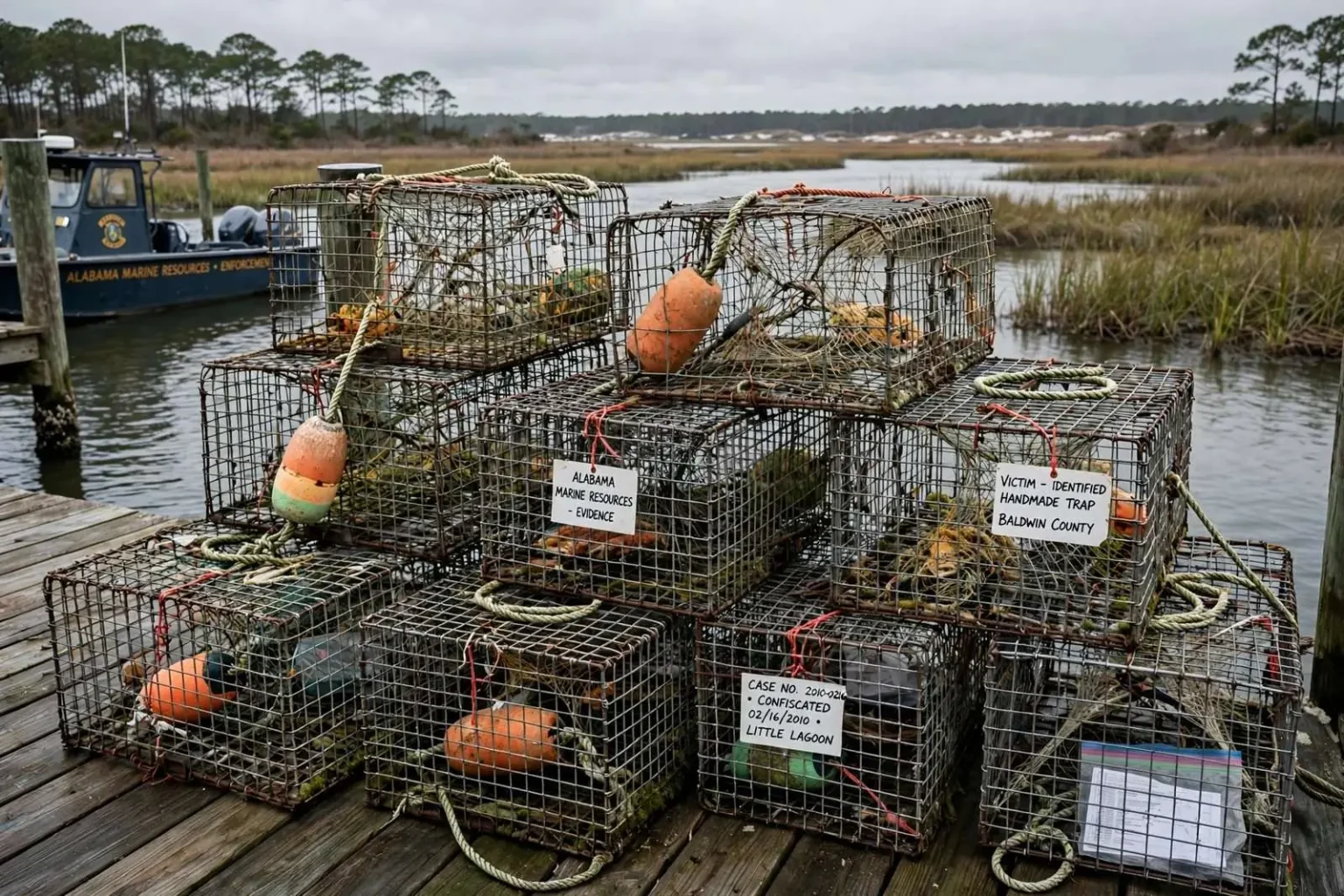
A Foley man was convicted this week of stealing crab traps from commercial fishermen along the Baldwin County coast, a felony that could send him to prison for up to a decade, District Attorney Hallie Dixon announced.
Steven Randall Shutt, 35, was found guilty of taking traps from working fishermen in late 2009 and early 2010. Prosecutors said the case began when several commercial crabbers reported to Alabama Marine Resources Enforcement that numerous traps had disappeared from local waters.
A case built on marked traps
“On February 16, 2010, Steven Shutt was cited for having improperly marked crab traps in Little Lagoon,” said Assistant District Attorney Chandra Paul, who prosecuted the case. “His traps were pulled from the water and 45 of them were confiscated by Marine Resources. Three victims were able to positively identify their traps among those confiscated, which had been handmade by them and/or their families.”
That personal touch — traps built by hand, often passed down and maintained within families — helped investigators tie the confiscated gear back to the men who had reported it missing. Wire crab traps carry few serial numbers, but a waterman’s trap is as distinctive as a signature: the wire gauge, the frame welds, the buoys and tie-offs, and the wear patterns of seasons in the water all tell an experienced fisherman whose trap he is looking at.
Trap marking rules exist precisely to make that kind of identification possible. Alabama requires commercial crabbers to mark their traps with identifying buoys or tags, so that marine resources officers can tell working gear from abandoned equipment — and so that gear pulled from the water improperly marked can be traced. The same rule that keeps the public fishery orderly became the thread that unraveled the thefts.
Little Lagoon, the brackish waterway behind the dunes at Gulf Shores, is one of Baldwin County’s most productive crabbing grounds, connecting to the Gulf through a periodically opened pass and feeding blue crabs into the local commercial catch. Its shallow, weedy bottom holds crabs through the warm months, and its confined waters make unmarked traps conspicuous to officers patrolling by boat.
Multiple counts
Shutt was convicted of Theft of Property in the second degree, a felony, along with Theft of Property in the third degree and Receiving Stolen Property in the third degree, both misdemeanors, and a marine violation for having improperly marked crab traps. The felony carried a possible sentence of up to 10 years in prison, while the misdemeanors could each add up to a year in jail.
Alabama’s theft statutes grade offenses by value, and the second-degree charge means prosecutors proved the stolen gear’s worth exceeded the felony threshold — a measure of how expensive commercial crabbing equipment has become. A working trap represents not just wire and frame but the labor of building and baiting it, and a full string of traps represents a significant share of a small crabber’s operating capital.
Sentencing was set for Jan. 12 before Circuit Judge James H. Reid. At sentencing, victims are typically afforded the opportunity to describe their losses, and the court weighs restitution alongside any prison or jail time — a meaningful factor in cases where the stolen property is the defendant’s only gain and the victims’ only compensation.
Dixon framed the prosecution as a defense of one of the region’s foundational industries.
“It is important that we take these offenses seriously,” she said. “Commercial fishing is the lifeblood of Baldwin County, and our fishermen are hardworking citizens who rely on these traps to earn a living.”
The district attorney credited Lt. George “Trey” Pose of Alabama Marine Resources Enforcement for his work on the case and praised Paul’s prosecution. The partnership between the district attorney’s office and the state’s marine law enforcement officers is what made the conviction possible — officers who know the lagoons and bays well enough to notice when gear goes missing, and prosecutors willing to build a felony case around wire traps and hand-tied buoys.
For the crabbers who had watched their equipment vanish from the water, the verdict offered a measure of vindication — and a signal that thefts targeting the coastal fishing trade would be pursued as serious crimes rather than shrugged off as petty losses.
Why crab traps matter so much
Crabbing occupies a distinctive place in Baldwin County’s seafood economy. Blue crabs move through the county’s bays, lagoons and bayous from spring through fall, and commercial crabbers work strings of traps — baited, flagged and checked on a rotation — to supply local markets, seafood houses and restaurants along the coast. The work is small-boat, weather-bound and labor-intensive, and its economics leave little margin: a crabber whose gear disappears loses not just the trap but the days of catch it would have produced until it was replaced.
The losses compound in ways that aren’t obvious from shore. Every trap pulled from a crabber’s string is a hole in a rotation that took years to map — the spots that hold crabs in June, the depths that produce after a rain, the runs that pay for fuel and bait. Replacing a stolen trap means re-learning water the fisherman already knew, which is why fishermen describe trap theft as something between burglary and sabotage.
Handmade traps carry the loss a step further. Many Gulf Coast crabbers build their own gear, cutting and wiring each trap by hand in yards and workshops between fishing days, and families often share the work across generations. A handmade trap can’t be reordered from a supplier; replacing it means starting from scratch, and the three victims in this case who picked their own handiwork out of a pile of confiscated gear were identifying months of their own labor.
Marine Resources Enforcement, the law enforcement arm of the state’s marine resources division, patrols the same waters the crabbers work, checking licenses, trap markings and catch records. Its officers are often the first to hear when gear starts disappearing, because watermen report losses to the office they already deal with — and in this case, those reports set the investigation in motion that ended in a felony conviction.
The case also illustrates how unmarked gear draws attention. A string of traps with no identifying markers is a red flag in itself: it can mean abandoned gear, which damages the fishery by continuing to catch and kill crabs with nobody to harvest them, or it can mean stolen gear, re-rigged by a thief who couldn’t reproduce the victims’ markings. Either way, officers who pull unmarked traps create a record — and a pile of evidence.
The charges Shutt faced track the different ways stolen gear moved through the case. Theft counts cover the taking of the traps; receiving stolen property covers possessing gear known to be taken from someone else; and the marine violation covers the improperly marked traps cited in Little Lagoon. Together they let a jury account for both the original thefts and the confiscated haul that surfaced in February 2010.
Felony exposure of up to 10 years signals how seriously Baldwin County treats crimes against its fishing trade. Coastal prosecutors see commercial fishing as infrastructure — an industry that feeds seafood houses, jobs and the county’s identity — and cases like this one are prosecuted with the same weight applied to thefts from any other working business. The difference is that the victims’ workplace is a lagoon, and the stolen inventory sits in plain view of anyone with a boat and a mind to take it.
Trap theft is a chronic problem in crab fisheries across the Gulf, and states have responded with increasingly specific rules: defined trap seasons, required markings, amnesty days for abandoned gear and stepped-up penalties for tampering with someone else’s equipment. The rules protect crabbers from each other’s lost gear as much as from thieves — ghost traps that keep fishing unattended waste crabs and foul propellers — and the enforcement presence that enforces them is the same one that caught this case.
Prosecutors and officers also leaned on the calendar. The thefts spanned late 2009 and early 2010, and the February citation gave investigators a fixed date, a named suspect and 45 confiscated traps to work backward from. Cases built on physical gear rather than testimony are unusual in theft prosecutions, and the officers’ decision to impound the traps — rather than release them — preserved the evidence that let victims make identifications weeks later.
The January sentencing will close the case, but its effects travel further than one defendant. The verdict tells every fisherman along the coast that a report to Marine Resources can end in a prosecution, and it tells anyone eyeing gear in someone else’s string that the wire traps scattered across Baldwin County’s waters are not unwatched property. For an industry built on honor-system gear left in public water, that message is the most valuable thing the case produced.