Daphne Officials Tout Growing National Spotlight on Algae Systems Pilot Plant
Daphne leaders celebrated national media attention on a Mobile Bay algae-to-fuel pilot project that has invested millions in the local economy.
City leaders in Daphne are celebrating a wave of national attention on an unusual energy venture operating along the shores of Mobile Bay, one that converts treated wastewater into crude biofuel using algae. The project, which began as a modest experiment on the city’s bayfront, has grown into a story that energy writers and business reporters far beyond Baldwin County are now following, and Daphne officials are eager to make the most of the spotlight.
In 2012, the city agreed to a lease allowing Daphne Utilities to partner with an out-of-state clean-energy company on a pilot facility near Bayfront Park. The arrangement gave the company, which had already shown promise in laboratory settings, a real-world site to test its process at a larger scale — and gave Daphne a front-row seat to a technology that could reshape how municipalities think about wastewater, energy and the value of what most cities simply pump away.
That process relies on the city’s treated wastewater as a nutrient source for controlled algae growth. Municipal wastewater, even after treatment, carries nitrogen and phosphorus that algae consume readily, and feeding that nutrient stream to cultivated algae turns an environmental liability into a raw material. In effect, the city’s effluent becomes fertilizer for an industrial crop grown on the bay itself.
How the process works
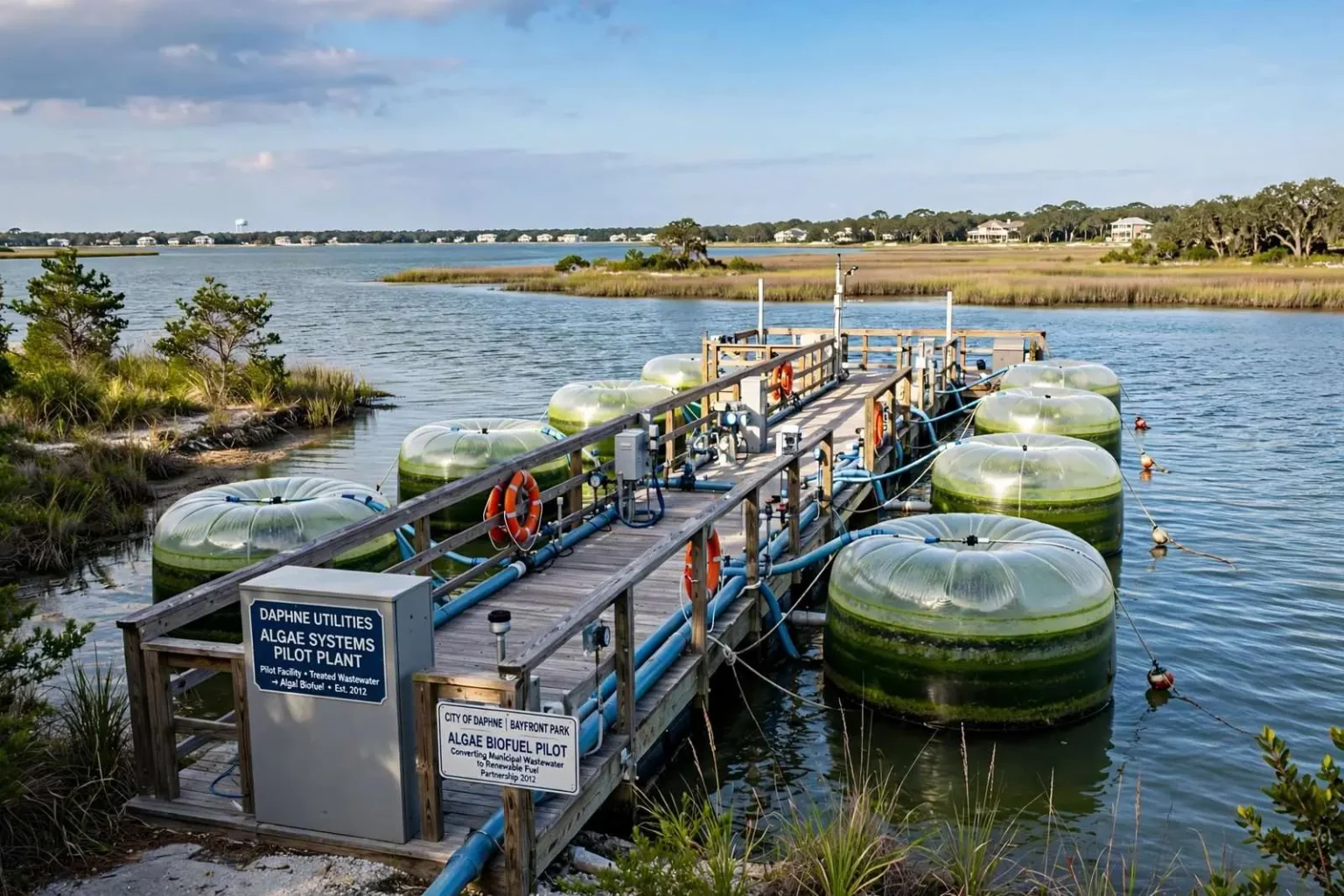
The algae is cultivated in large floating bags anchored to a dock extending into the bay, where sunlight and wave motion help drive the reaction. The floating-bag design is central to the economics of the operation: rather than building energy-hungry tanks and artificial lighting, the company harnesses the free inputs of the Gulf Coast environment — abundant sunshine, warm temperatures and the constant, gentle agitation of bay waters — to keep the algae growing at commercially useful rates.
The resulting organic material is then converted through a heating process into a crude oil substitute that can ultimately be refined into diesel fuel. Because the algae is harvested continuously and the nutrients are drawn from the wastewater stream, the production cycle renews itself daily, in contrast to fossil crude that takes millions of years to form. Advocates of algae-based biofuel point to that renewability, along with the fact that algae production does not compete with food crops for farmland, as the technology’s core advantages.
The Daphne pilot is small by refinery standards, but pilot plants of this kind are how laboratory discoveries prove — or disprove — their viability at scale. Salinity tolerance, storm survival, harvest yield and the energy balance of the heating process are all questions that can only be answered on the water, which is what made the city’s dock and its wastewater stream so valuable to the company.
Council hears of growing momentum
During a Monday night council meeting, Daphne Mayor Dane Haygood invited the outgoing general manager of Daphne Utilities to update council members on the project’s momentum, including a feature the venture had just received in a major national newspaper. The utilities executive is departing his post to take an operations role directly with the energy company, a move that speaks to how central the Daphne operation has become to the firm’s development plans — the executive is not leaving the technology behind, but following it into its next phase.
“We’re real privileged to be noticed by an organization of that stature, and we’re very pleased to be able to bring the light of the news of the nation on the city of Daphne,” the outgoing manager told the council, according to a summary of the meeting. For a city of Daphne’s size, national business coverage of a municipal utility partnership is rare, and officials clearly view the attention as a form of recognition that cannot be purchased.
He added that the project’s success reflected years of cooperation between a city “open for business” and a utility willing to back innovative ideas. That combination — a municipal government willing to sign a lease on an unproven concept and a utility board prepared to host the experiment — is, in the manager’s telling, the reason the company chose Daphne over other candidate sites on the Gulf Coast.
A real investment in the local economy
Since establishing its pilot operation on the bay, the company has poured more than $5 million into the local economy, the outgoing manager said. Spending of that scale at a pilot facility — construction of the dock installation, equipment, operations staffing and the purchase of local services — represents meaningful economic activity for the Eastern Shore city, all of it attached to a project that continues to grow.
The $5 million figure also illustrates why economic development officials watch pilot projects closely. An experimental facility that succeeds does not simply wind down; it scales, and the community that hosted the experiment is positioned to capture the expanded investment, the skilled jobs and the supplier relationships that follow. A facility that fails, by contrast, leaves a city with a dock and a story. Daphne’s officials are betting — with national media now watching — on the former outcome.
Haygood described the partnership as evidence that Daphne is becoming known as a hub for innovation, adding that he hopes it is “the first of many projects” to draw similar attention to the city. For the mayor, the national feature is as much a marketing asset as a news item: a city mentioned in national coverage as a place where new energy technology is being proven has a credential that no recruitment brochure can match.
What the technology could mean
If the Daphne process continues to prove itself, the implications extend well past one dock on Mobile Bay. Communities across the country operate wastewater systems that discharge nutrient-rich water every day, and any utility that could convert that stream into fuel feedstock would gain a new revenue source while reducing the nutrient load that contributes to problems like algal blooms downstream. The model that Daphne is hosting applies, in principle, wherever sunshine and wastewater coexist — which is to say, nearly everywhere.
The diesel market is also a demanding test for any alternative fuel. Diesel powers the trucks, buses, farm equipment and marine vessels that keep the Gulf Coast economy moving, and a biofuel that slots into existing diesel refining and distribution without new engines or new infrastructure would find customers quickly. That compatibility with existing fuel supply chains is exactly what the company’s crude oil substitute is designed to offer.
Energy industry analysts have long noted the obstacles algae biofuel must clear: keeping contamination out of the cultures, maintaining growth through the winter, and ensuring that the energy required for harvesting and conversion does not consume the value of the fuel produced. The Daphne pilot’s continued operation — and the company’s willingness to keep investing — suggests the venture has cleared enough of those hurdles to keep its backers committed.
A model partnership for the Eastern Shore
For Daphne, the arrangement showcases a model of municipal innovation that officials hope to repeat. The city did not fund the venture or guarantee its success; it provided the lease, the site, the wastewater stream and the institutional patience to let a company test its idea in public. The utility gained national recognition and a partner investing millions locally, and the company gained a proving ground that no laboratory could replicate.
Bayfront Park’s role as the host site has also given residents a visible reminder of the project — floating bags and the dock installation sit in plain view along the bay, turning a piece of infrastructure into a local landmark and, for visiting students and civic groups, an impromptu classroom on renewable energy and water treatment.
City officials familiar with the partnership describe the lease as deliberately structured for a project at this stage. A pilot operation needs freedom to modify equipment, extend timelines and absorb setbacks without renegotiating from scratch, and the 2012 agreement gave the company that flexibility while keeping Daphne Utilities’ customers and the park’s public uses protected. That balance — real access for the company, real safeguards for the city — is part of what officials point to when they describe the deal as a template for future ventures.
The outgoing general manager’s move to the energy company adds a personal dimension to the story: the executive who helped shepherd the partnership from lease to national feature will now work on the venture’s operations full time, carrying institutional knowledge from the utility side across to the company. City officials said the transition reflects the depth of the company’s commitment to the Daphne site rather than any change in the partnership itself.
With a major national newspaper having taken notice, more than $5 million already invested, and a mayor who speaks of the project as the first of many, the algae pilot on Mobile Bay has moved from curiosity to calling card — and Daphne intends to keep the light shining on it.