BP Engineers Race to Fit a Cap Over the Blown-Out Gulf Well
With oil still pouring into the Gulf of Mexico, engineers worked to shear off a broken riser pipe a mile below the surface and seat a containment cap over the failed blowout preventer.
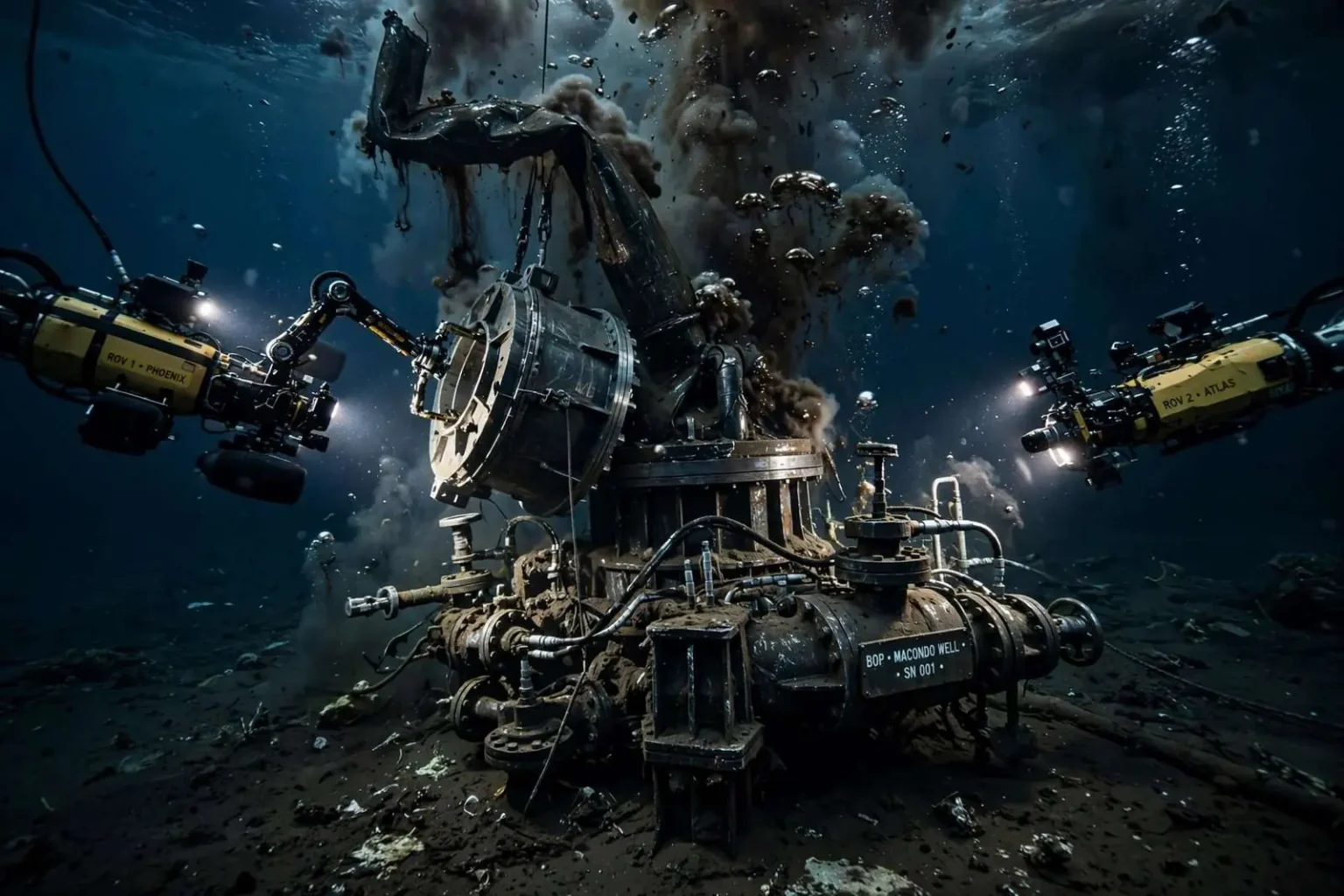
Six weeks after the Deepwater Horizon drilling rig exploded and sank in the Gulf of Mexico, engineers working a mile below the surface were attempting the most delicate maneuver yet in the effort to contain the ruptured Macondo well: cutting away a broken pipe and seating a containment cap over the equipment that had failed to shut the well in.
The operation was playing out on the sea floor, roughly 5,000 feet beneath the surface, where the well’s blowout preventer sat in permanent darkness, reachable only through remotely operated vehicles tethered to ships above. Everything that followed — every cut, every placement, every seal — had to be executed through cameras and robotic arms at that depth, with no divers able to assist and no second chances once the riser was severed.
The Stakes for South Alabama
For communities along the Alabama Gulf Coast, the stakes were immediate and measurable. Oil had already reached parts of the coastline, and the region’s two economic engines — tourism and seafood — were taking on water at the same time. Along the beaches of Gulf Shores and Orange Beach, tourism bookings were collapsing as travelers canceled summer reservations, leaving rental companies, restaurants and charter boat operators staring at a season that had promised to be one of their strongest in years.
Commercial fishermen were suffering in parallel. Shrimpers and oystermen working out of Bayou La Batre — long known as one of the state’s principal seafood landing towns — and the oyster harvesting areas around Bon Secour were watching their season disappear as closures pushed them off productive waters. For crews whose annual income is concentrated in a few warm months, each week of closed fishing grounds translated directly into household hardship, and the uncertainty about how long the well would keep leaking made planning nearly impossible.
The new containment attempt was therefore watched on the coast less as an engineering story than as an economic one. Every barrel captured instead of spilled reduced the volume of oil that could still reach passes, sounds and nearshore waters later in the summer, and every day the well flowed without containment extended the period during which fishing grounds and swimming beaches remained under threat.
What Was Actually Leaking
The leak was a mixture of oil and methane gas passing upward through the blowout preventer, or BOP — the stack of valves sitting on the sea floor that was supposed to seal the well in an emergency and did not. The device, a stack of rams and annular preventers assembled atop the wellhead, is the primary mechanical safeguard on any deepwater well, and its failure during the initial blowout was at the center of the disaster.
Before the rig was lost, the BOP had been connected to the surface by a riser tube — a steel pipe running roughly 5,000 feet from the rig floor down to the sea floor, carrying drilling mud, equipment and, during normal operations, the returning fluids of the well. When the Deepwater Horizon platform exploded and sank, the riser fell with it and broke apart on the way down.
A portion of that riser remained attached to the top of the BOP, kinked and crimped where the pipe had bent and folded. That damaged stub became the focal point of the entire containment effort. Oil and gas were escaping through it and around its connections, and the first major step in capping the well was deciding what to do about that remaining pipe.
The Plan: Cut, Then Cap
The strategy involved shearing the damaged riser off cleanly just above the BOP, then lowering a containment device known as an LMRP cap — named for the lower marine riser package it was designed to sit atop — directly onto the stub. A sealing grommet at the base of the cap would, engineers hoped, grip the cut pipe tightly enough to funnel the escaping oil and gas up a new riser to a recovery ship on the surface, where the fluids could be separated and stored rather than released into the Gulf.
The trade-off in the plan was ugly, and officials were candid about it. Once the cut was made, the well would flow freely into the Gulf for roughly 24 hours until the cap could be lowered and seated — a day of uncontained discharge accepted as the price of moving toward containment. Engineers also knew that the flow rate after the cut would run about 20 percent higher than before, because the crimped, twisted pipe had been acting as a partial restriction on the flow, choke-like in effect. Removing the restriction meant the well would discharge more violently until the cap took its place.
Seating the cap would not be a matter of lowering it and hoping gravity did the work. A heavy drilling collar — a thick, weighty segment of drill string — would be used to press the cap firmly into place on the stub, forcing the grommet to compress and seal. And because no one could guarantee a perfect fit on a pipe that had been sheared by a machine a mile down, a backup was ready: if oil leaked around the seal, an “overshot tool” — a heavy-duty collar that fits over the entire cap — would be installed to capture what escaped, adding a second layer of containment around the first.
The Ice Problem
Cutting the riser close to the BOP served a second purpose beyond giving the cap a clean surface to seal against. The oil and gas mixture emerging from the well comes out at about 140 degrees, and that heat is not incidental: it helps prevent the formation of a slush-like icy material known as hydrate, which forms when natural gas combines with cold seawater under pressure. Hydrate can plug the inside of a containment device, choking off the very riser meant to carry oil to the surface.
A similar icing problem had defeated an earlier containment attempt — the large cofferdam-style dome lowered over the largest of the leaks, which filled with hydrates within hours of deployment and had to be set aside on the sea floor. That experience shaped the new plan. Cutting near the BOP meant cutting near the hottest point of the escaping flow, and the designers of the LMRP cap counted on the warmth of the crude and gas to keep the interior of the device clear.
Two failure modes worried engineers most, and they were the mirror images of each other. The first was large volumes of oil escaping around the seal — a sign that the grommet had failed to grip the cut pipe, and that the well was discharging as freely as ever while the recovery effort looked productive from above. The second was cold seawater entering the cap, which would drop the internal temperature, feed hydrate formation and plug the device from the inside. Either development would doom the process, and both had to be monitored continuously through the cameras of the ROVs working around the cap.
Trouble With the Saw
As the operation progressed, the latest reports indicated the cut itself was not going well. The robotic arm was using a diamond-wire saw — a loop of abrasive-coated cable running over pulleys — to slice through steel that had been bent, twisted and hardened by its fall from the surface. Keeping the saw at a precise angle, so that the blade would not jam or bind in the damaged pipe, proved harder than planned.
The geometry was hostile. The riser stub on top of the BOP was not a straight, vertical cylinder but a kinked mass of collapsed steel, and the saw had to work through it in a position that left little clearance. Several smaller tubes running alongside the main riser also had to be severed to make room for the cap to descend onto the stub — smaller cuts, but each one requiring repositioning of the saw and a fresh attempt at holding the correct angle.
Compounding the difficulty, the cameras on the remotely operated vehicles could not see as clearly as expected. The discharge from the well had been churning crude into the surrounding water, and the fluid clouded the view of the cutting site. Additional dispersants were being applied at the wellhead to break up the oil and improve visibility, a deviation from the dispersants being sprayed on surface slicks and another reminder of how much of the operation depended on what the ROV pilots could actually see.
If the Cap Fails
Engineers had fallbacks in reserve, none of them attractive. The first was a second LMRP cap with a different sealing mechanism, held on a vessel at the site, which would be tried if the grommet seal failed to hold. Beyond that, the options narrowed quickly.
Placing an entirely new blowout preventer on top of the existing one had been effectively ruled out. Two constraints killed the idea. First, well pressure was judged too high to hold a new BOP in position long enough to bolt it down — the escaping flow was simply too forceful for a new stack to be landed and secured on top of the old one. Second, the wellhead structure itself, the steel foundation on the sea floor, was not believed capable of bearing the load of an additional stack — or of surviving the pressures that would build up if a new BOP were closed on top of the old one in an attempt to shut off the flow outright.
The next option under consideration was more improvisational: inserting several recovery tubes into the BOP and creating a powerful vacuum to pull oil and gas up to the surface. The concept was, in effect, the earlier “top kill” operation run in reverse and at far greater scale — instead of pumping heavy mud down into the well to smother the flow, engineers would suck the flow upward through a limited number of small passages, capturing as much as the narrow tubes could carry. No one pretended that a handful of recovery tubes could match the volume of an open well; it was containment as triage, not as cure.
Hurricane Season and the Relief Wells
Even a working cap did not end the planning, because hurricane season was under way and the recovery system extended thousands of feet into the water column where it could not survive a direct hit. Planners intended to hang the new riser from a large buoyant “can” suspended about 300 feet below the surface, connected to recovery ships by flexible hoses that could be disconnected quickly if a storm bore down on the site. That arrangement was expected to be in place by July 1, giving the operation a way to clear the area when a storm approached and return afterward without abandoning containment altogether.
The permanent solution, meanwhile, remained the two relief wells being drilled by dedicated rigs at the site. One had reached roughly 12,200 feet below the surface and the other about 8,700 feet, against a target reservoir depth near 18,000 feet — meaning both were approaching the halfway point in what remained the only method capable of actually killing the well by intersecting its bore and pumping it full of heavy fluid. Both were experiencing the normal difficulties of deepwater drilling, where a single complex well can take months even without the pressure of a national emergency.
The relief wells were expected to reach the Macondo well bore by mid-August. Until then, the cap, whatever it captured, was the difference between partial containment and none — and the estimates of the leak at that point ranged between 12,000 and 19,000 barrels per day, varying with how much gas was mixed into the flow. For residents of coastal Alabama, the arithmetic was plain: nearly two more months of watching the weather, the fishing closures and the tide of bookings, while the machinery a mile down determined how much of the summer the Gulf would keep to itself.