Foley Man to Pay Restitution as Charge Dropped in Gulf Shores Hotel Robbery
A Foley man's felony theft charge in a Gulf Shores hotel robbery will be dropped once he pays restitution under a deal with Baldwin County prosecutors.
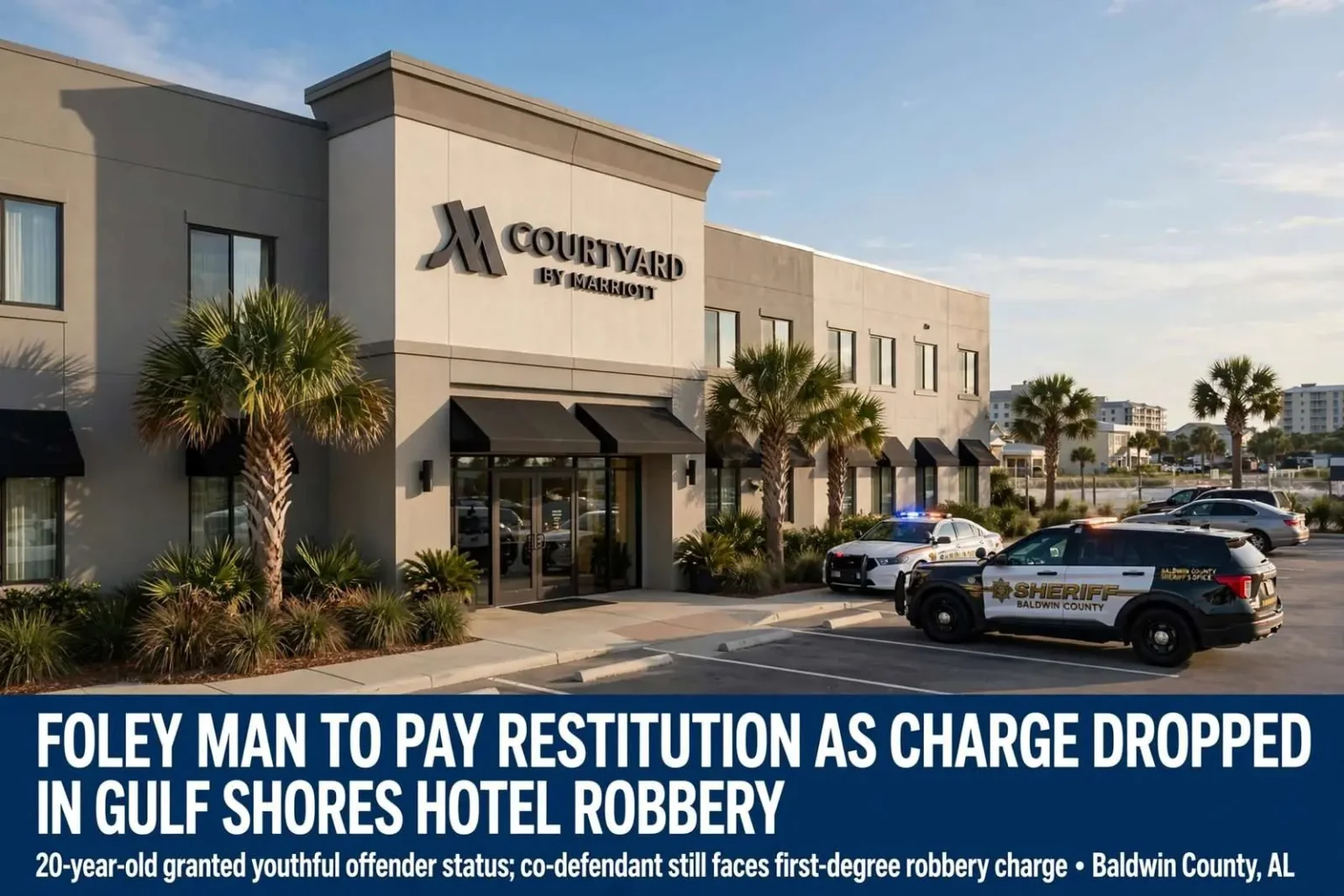
A felony charge against a 20-year-old Foley man tied to a hotel robbery in Gulf Shores is set to be dismissed after he agreed to pay restitution as part of a deal with the Baldwin County District Attorney’s Office, according to court records.
Joshua Thomas had been charged with second-degree property theft in connection with a July 22 robbery at the Courtyard Marriott in Gulf Shores. He was also arrested on a separate robbery charge related to the same incident, but that charge was resolved through youthful offender status, a designation reserved for younger defendants that seals the case record and can result in a suspended sentence, probation of up to three years, or up to three years in jail rather than a standard felony conviction.
The youthful offender route is one of the distinctive features of Alabama’s criminal justice system. Defendants charged before their 21st birthday can ask a judge to designate them youthful offenders, and if the request is granted, the case leaves the public record, the defendant is tried without a jury, and the sentencing options shift toward rehabilitation. A youthful offender adjudication is not a felony conviction, which means it does not carry the lifelong collateral consequences — lost voting rights, restricted employment, damaged housing prospects — that follow a standard felony.
For a 20-year-old with little or no prior record, that pathway often determines the direction of a young life. Employers running background checks will not find a youthful offender adjudication, and the sealed record means the incident does not follow the defendant into every future application. Judges weigh the seriousness of the offense, the defendant’s age and history, and the interests of justice before granting the designation, and serious violent charges are often excluded from eligibility.
The Deal and What It Resolves
Court records show Thomas and another Foley man, 30-year-old Justin Miller, were accused of taking $556 from the hotel during the incident, according to affidavits filed in the case.
Under the new arrangement, prosecutors agreed to drop the property theft charge against Thomas once he pays back the amount in restitution, though the exact figure had not yet been finalized as of this week. Restitution agreements of this kind are a staple of Baldwin County’s docket for lower-level property offenses: the charge formally remains on the books until the money is paid, giving the defendant a concrete incentive to complete the deal, and the dismissal follows once the state confirms payment.
Miller’s case has not been resolved in the same way. He continues to face both a first-degree robbery charge and a second-degree property theft charge stemming from the same July incident, and those charges remain pending in Baldwin County court.
The difference in treatment between the two co-defendants reflects the way prosecutors sort culpability in multi-defendant cases. First-degree robbery — charged against Miller — involves the use or threatened use of force or a dangerous instrument, and it carries a prison range measured in decades rather than years. A defendant facing that exposure does not leave the docket through a restitution agreement; the case proceeds toward trial or a negotiated plea, with the full weight of the evidence tested in open court.
Co-defendant outcomes also serve a practical purpose for the prosecution. A resolved co-defendant can become a witness, and the terms of a cooperation arrangement are typically worked out before the remaining defendant’s trial. What prosecutors agreed to with Thomas, and whether his account of the July incident figures in Miller’s case, are questions court records do not answer, but the sequencing — the younger defendant resolved first, the more serious charges left pending — follows a recognizable pattern.
The Law Behind the Charges
Second-degree theft in Alabama generally covers stolen property valued between roughly $500 and $2,500, which is why a $556 loss lands in felony territory; thefts below the felony threshold are misdemeanors handled in district court. First-degree robbery sits at the top of the state’s robbery statute and carries a sentencing range of 20 years to life, with harsher ranges available when a firearm is involved. The gap between those two charges — a dismissal for restitution on one side, potential decades in prison on the other — is the landscape the two Foley men now face from opposite ends.
The youthful offender statute, for its part, dates to the 1970s and reflects a longstanding legislative judgment that defendants at the edge of adulthood deserve a separate track. Prosecutors can object to the designation, and judges have discretion to deny it, but when it is granted, the proceedings close to the public. Supporters of the law point to recidivism research showing that young defendants diverted this way reoffend at lower rates; critics argue the sealing of records deprives the public of information about serious cases.
Property Crime in the Tourist Corridor
The resolution of Thomas’ case reflects a common path for lower-level co-defendants in property crime cases, particularly younger offenders without extensive criminal histories, where restitution agreements can resolve charges more quickly than a full trial.
For hotels and other businesses in the Gulf Shores tourist corridor, incidents like the Courtyard Marriott robbery underscore ongoing concerns about property crime tied to the area’s large seasonal visitor population.
Gulf Shores and the neighboring beach communities absorb an enormous seasonal population swing each summer, and the crime picture moves with it. Hotels handle streams of transient guests, cash moves through front desks and on-site businesses, and parking lots fill with visitors’ vehicles and belongings. Police in the beach towns work a rhythm shaped by the calendar — heavier staffing and higher call volumes in summer, quieter winters — and property offenses at lodging businesses are a recurring entry in the logs.
Hotels respond with their own measures: camera systems covering lobbies and lots, controlled key access, staff training on suspicious behavior, and coordination with police on known offenders. When an incident occurs, the footage and records that hotels keep often become the backbone of the prosecution, as they did in this case, where affidavits filed in Baldwin County court document the amount taken and the identities of the two accused.
The economics matter too. A robbery at a hotel touches more than the amount on the affidavits; it touches the sense of safety that the tourism economy depends on. Guests who read about an incident at a property they use take their bookings elsewhere, and hotel managers along the corridor know that quick police response and visible prosecution are part of protecting the area’s reputation as a family destination.
What Comes Next
Baldwin County prosecutors did not immediately detail additional conditions attached to the restitution agreement. Until the payment is confirmed and the dismissal formally entered, the theft charge remains pending, and Thomas’ compliance with the agreement is what stands between him and a felony on his record.
Miller’s pending charges will move at their own pace. Cases heading toward trial in Baldwin County circuit court typically take months to resolve, with pretrial hearings, motion practice and plea negotiations along the way, and a first-degree robbery charge brings the most serious consequences the county’s courts can impose. The July 22 incident at the Courtyard Marriott will therefore stay on the docket long after the younger defendant’s portion of it has been sealed away.
The case, small in dollar terms, sketches the whole arc of how Baldwin County handles crime in its tourist towns: an incident at a business that serves visitors, charges split between two defendants of different ages and exposure, a diversion for the young one and a felony prosecution for the other, and a restitution deal that converts a criminal case into a payment plan. For the hotel, the loss was $556. For the two Foley men, the same night cost one a sealed youthful offender record and the other a pending first-degree robbery charge — a difference measured in the rest of two young lives.
How Restitution Deals Work
Restitution agreements follow a familiar choreography in Baldwin County. The defendant agrees in open court to repay the loss, the judge sets a payment schedule or deadline, and the case is continued — kept alive but dormant — while the payments come in. Clerks track the balance, the court notifies the district attorney’s office when the obligation is satisfied, and prosecutors then dismiss the charge or reduce it to something that can be cleared. Miss a payment, and the case comes off pause and heads toward conviction.
The arrangement benefits everyone involved except, arguably, the paperwork. The victim is made whole without a trial, the defendant avoids a felony record and the state conserves its trial resources for cases that need them. Judges in Baldwin County’s circuit court see a steady stream of such deals in property cases, and defense attorneys negotiate for them aggressively for young clients whose futures depend on what a background check will show.
The trade-off is accountability. A restitution deal does not test the evidence in public or produce a jury verdict; it resolves the case on the strength of the parties’ agreement. For low-level property offenses that trade is widely accepted. For the more serious charges a co-defendant faces, like the first-degree robbery count still pending against Miller, prosecutors do not make the same trade, and the full machinery of trial — witnesses, exhibits, cross-examination and a jury’s verdict — remains ahead.