Citronelle Man Killed in Overnight Crash North of Saraland
A Citronelle man died and a passenger was airlifted after a single-vehicle crash on Celeste Road near Saraland Tuesday night.
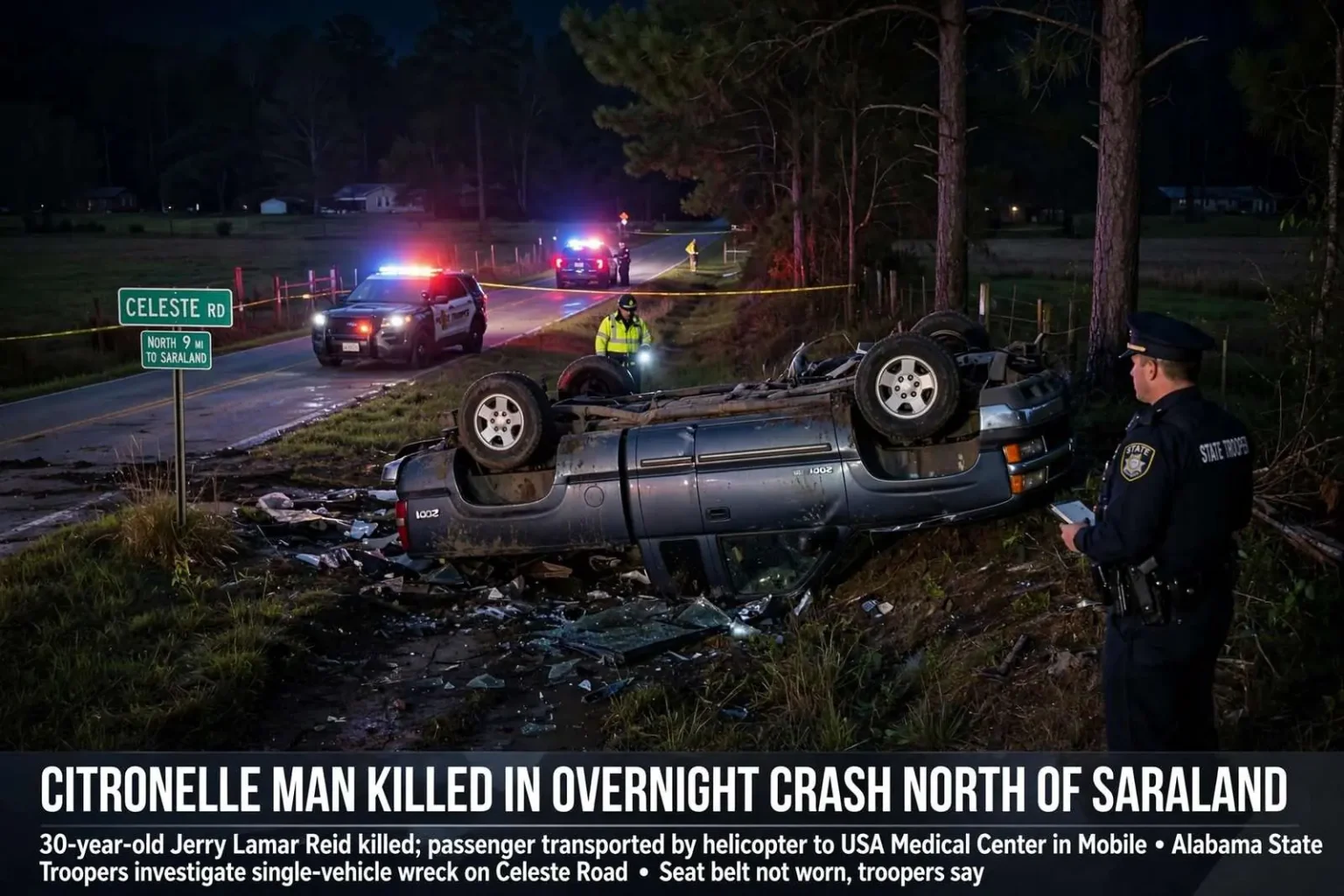
A Citronelle man was killed and a passenger was seriously injured late Tuesday night after their pickup truck left the road and overturned on Celeste Road, roughly nine miles north of Saraland, according to Alabama State Troopers. The single-vehicle wreck happened in a stretch of rural northern Mobile County where two-lane roads wind past farms, timberland and scattered homes, far from the streetlights of the city. Troopers with the Alabama Law Enforcement Agency responded to the scene and began working to piece together what caused the truck to leave the roadway.
Troopers identified the man killed as 30-year-old Jerry Lamar Reid. Investigators say Reid was behind the wheel of a 2001 Chevrolet pickup truck when it ran off the roadway and rolled over at around 9:15 p.m. By the time emergency crews arrived, the truck had come to rest off the shoulder, and Reid was pronounced dead at the scene. The darkness of the rural corridor complicated the initial response, as deputies and first responders worked under emergency lighting to document the scene and clear the roadway.
A spokesperson for the Alabama Law Enforcement Agency’s state trooper division said Reid was not wearing a seat belt at the time of the crash, a detail investigators noted in their preliminary report. Under Alabama law, seat belt use is a primary offense for drivers and front-seat passengers, meaning troopers can stop a vehicle for that violation alone. Investigators routinely record restraint use in every fatal crash report, both because it shapes the official cause analysis and because the data feeds the state’s ongoing traffic safety campaigns.
A Passenger Fought to Survive
A passenger riding in the truck, identified as Johnny Dwan Gardner, survived the crash but sustained injuries serious enough to require air transport. He was flown by helicopter to USA Medical Center in Mobile for treatment. The decision to call in an air ambulance reflected the seriousness of his condition and the distance to the nearest level of trauma care; the USA Medical Center, part of the University of South Alabama’s health system, serves as the region’s major trauma center and regularly receives patients from wrecks across Mobile, Baldwin and Washington counties.
The response to a wreck like Tuesday night’s also illustrates how emergency medical care is layered along the Gulf Coast. Volunteer fire departments and first responders from the small communities north of Saraland are typically on scene quickly because they are close by, but the care required for serious trauma almost always means a transfer toward Mobile. Air medical crews stationed around the region can bridge that distance in minutes, which is why helicopters are requested so often for rural wrecks where the ground ambulance ride to a trauma center would take too long.
Hospital officials could not immediately confirm his condition or that he had arrived, and further updates on his recovery were not available in the days following the wreck. In cases like this one, hospitals typically defer detailed condition updates to the family and to investigating agencies, leaving relatives and neighbors waiting for word. Residents in the Citronelle area followed news of the wreck closely, with many taking to community pages to ask about the passenger’s condition and to offer help to both families.
State troopers said the crash remained under investigation, with additional details about road conditions, speed, and the exact cause of the rollover expected to follow as the inquiry continued. Standard practice in a fatal single-vehicle wreck calls for investigators to reconstruct the vehicle’s path, examine the roadway surface and shoulders, check for mechanical problems, and determine whether darkness, wildlife or weather played any role. Findings from that work usually become public only when the final report is complete.
Troopers’ preliminary reports in cases like this one are just that: preliminary. Reconstruction specialists may spend days mapping skid marks, measuring the final resting position of the vehicle and downloading any available data from the truck’s systems. Weather records, visibility conditions and the maintenance history of the roadway can all become part of the file, and findings are typically reviewed by supervisors before the investigation is formally closed.
A Rural Corridor with a History of Serious Wrecks
Celeste Road, a rural corridor connecting communities north of Saraland toward Citronelle, has seen periodic serious wrecks over the years, and safety advocates in the area have long pushed for improved lighting and shoulder maintenance along some of its darker stretches. The road carries a steady mix of commuter traffic between northern Mobile County and the Saraland area, along with pickup trucks, trailers and farm equipment moving between rural properties. Paved shoulders narrow in places, and long stretches run without illumination, conditions that become more hazardous after heavy rain or at night.
Neighbors along the Celeste Road corridor said the stretch of roadway can be poorly lit at night and is frequented by pickup trucks and farm equipment moving between rural properties, conditions that can make single-vehicle wrecks especially dangerous after dark. When a vehicle runs off a narrow rural shoulder at highway speed, the transition from pavement to soft ground can trigger a rollover before a driver has a chance to correct, which is one reason run-off-road crashes account for a disproportionate share of serious rural wrecks nationwide.
For residents of the area, the wreck was a grim reminder of the stakes on the roads they drive daily. Mobile County’s northern communities sit at the edge of the region’s growth corridor, and as subdivisions push farther out from Mobile and Saraland, rural roads built for farm traffic carry increasing volumes of commuters. Local officials have periodically discussed widening, lighting and shoulder projects for corridors like Celeste Road, though funding for rural road improvements tends to move slowly and compete with demands in faster-growing areas.
Another Loss for Citronelle
Citronelle, a small city in northern Mobile County known for its rural character and close-knit community, was left mourning the loss of one of its own. The city sits near the northern boundary of Mobile County, roughly 35 miles from downtown Mobile, and serves as a hub for the small farming and timber communities that surround it. In communities of that size, a fatal crash involving a young resident reverberates quickly, through churches, schools and the network of families that spans the area.
The fatality adds to a sobering statistic troopers have highlighted throughout the year: a majority of people killed in Alabama traffic crashes in 2014 were not using seat belts at the time of the collision. State troopers have repeatedly urged drivers and passengers in rural Mobile County and across the region to buckle up, noting that unrestrained occupants are far more likely to be killed or severely injured when a vehicle leaves the roadway or rolls over, as investigators believe happened in this case. In a rollover, an unbelted occupant can be thrown from the vehicle entirely, and ejection multiplies the risk of fatal injury.
Troopers and highway safety officials across Alabama have leaned on that message for years, combining enforcement waves with public education campaigns aimed especially at rural drivers, who statistically face longer emergency response times and greater distances to trauma care. Rural crashes also tend to involve higher speeds on two-lane roads, and rollovers are more common among pickups and SUVs, which sit higher and handle differently than passenger cars when they leave the pavement. Safety advocates say those realities make restraint use and careful speeds all the more important on roads like Celeste Road.
How the Investigation Proceeds
Alabama State Troopers asked anyone with information about the crash to contact their local post as the investigation continues. Witnesses who traveled Celeste Road that evening, or residents whose homes and cameras face the roadway, can provide details that help investigators fix a timeline, from the direction of travel to the moments just before the truck left the road. Such tips are often the difference between a preliminary account and a complete reconstruction.
No charges had been announced in connection with the wreck as of the initial report. Investigators will weigh factors including speed, impairment, distraction, mechanical condition and any roadway contribution before determining whether a violation occurred, a process that can take weeks in a fatal case. Until then, the truck’s movements and the exact sequence of the rollover remain matters for the reconstruction file rather than the public record.
For now, the intersection of grief and questions is familiar to families across rural Alabama, where traffic crashes remain a leading cause of death for adults in their twenties and thirties. Each fatal wreck on a corridor like Celeste Road renews local conversations about speed, darkness and the simple habit of buckling a seat belt, conversations that safety advocates hope will outlast the news cycle that follows each crash.
What is already clear is the cost of the night. A 30-year-old man is gone, a passenger is fighting to recover in a Mobile hospital, and two families in northern Mobile County are living out the aftermath of a wreck that took seconds to happen on a dark stretch of road they had traveled many times before. Troopers’ message to the drivers who will follow them down Celeste Road is unchanged: slow down after dark, watch the shoulders, and buckle up every time.