Two Killed in Head-On Crash Near Theodore
A Mobile woman and an Irvington man died after their vehicles collided head-on Half Mile Road south of Theodore on a Friday evening in September.
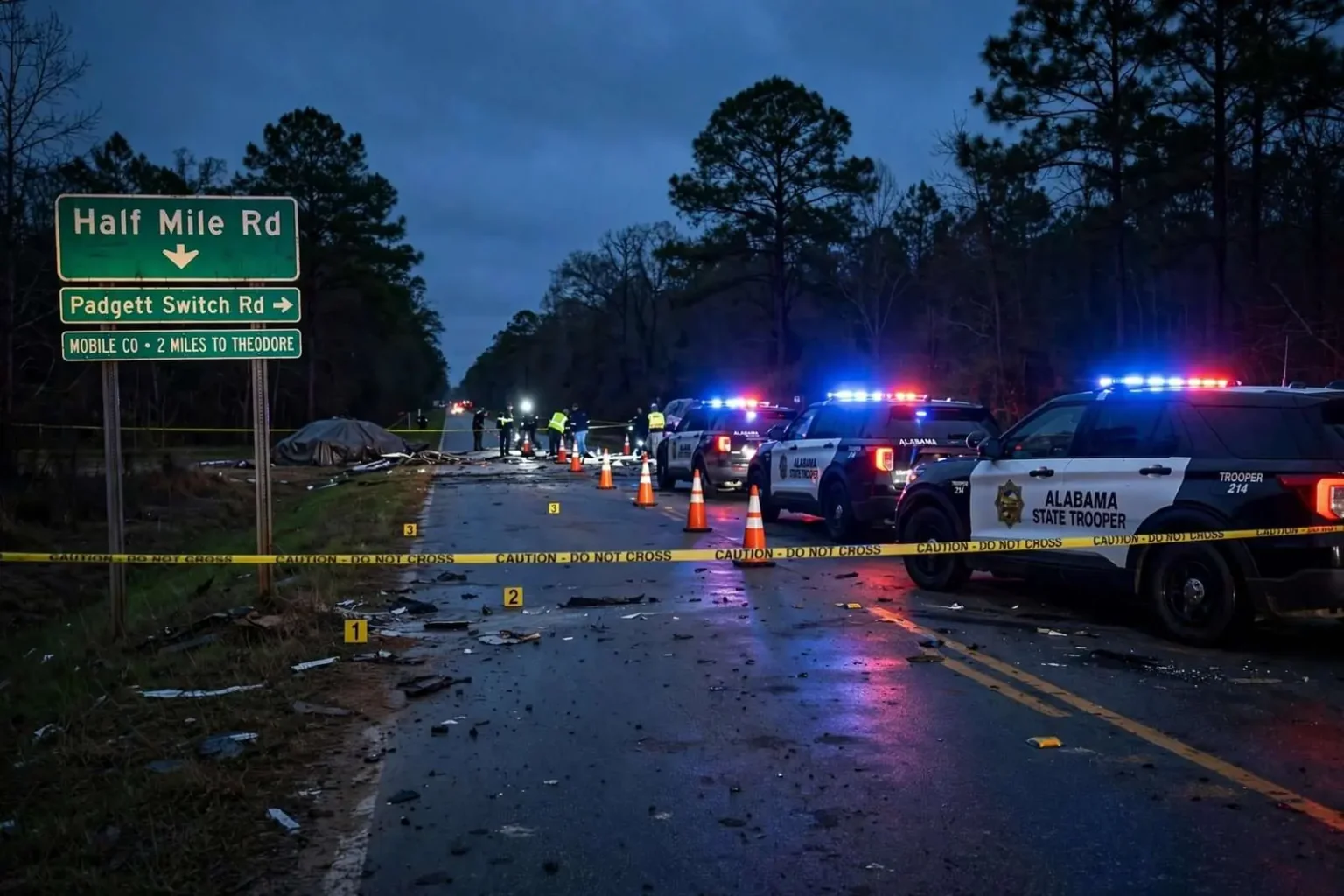
Two South Alabama residents died following a head-on collision on Half Mile Road south of Theodore, according to Alabama State Troopers. The crash, which occurred on a Friday evening in a rural corridor south of Mobile, claimed the lives of both drivers involved and left investigators working into the weekend to determine what brought the two vehicles together on a stretch of two-lane road with no center divider between them.
The crash happened around 7:30 p.m. on a Friday evening near the intersection of Half Mile Road and Padgett Switch Road, roughly two miles south of Theodore. Troopers say a Mobile woman, 58, was driving a 1995 Honda Civic when it collided head-on with a 1998 Honda occupied by a 58-year-old man from Irvington. The two vehicles met head-on in the evening darkness on a road that sees steady local traffic between the communities south of the city, and the force of the impact left both drivers with fatal or critical injuries.
The woman was pronounced dead at the scene. Investigators noted she was not wearing a seat belt at the time of the crash, a detail that figures prominently in the outcome of nearly every high-speed collision of this kind and one that troopers cite routinely in their public safety reminders. The man was transported to USA Medical Center with serious injuries and later died from those injuries at the hospital, making the wreck a double fatality before the night was over.
Alabama State Troopers said the investigation into the exact cause of the collision was ongoing in the days following the crash. Investigators had not released any determination about why the vehicles crossed paths head-on, and with both drivers killed, the answers will have to come from the physical evidence at the scene — vehicle positions, skid marks, roadway conditions and damage patterns — rather than from the accounts of those involved.
A Rural Corridor With a Safety History
Half Mile Road is a rural two-lane roadway that connects several communities south of Mobile, and troopers have periodically flagged stretches of the road for traffic safety concerns. Roads of this kind — two lanes, undivided, with traffic moving in opposite directions at highway speeds — are where a momentary drift across the center line can produce a head-on impact, the most violent and least survivable category of crash on the road network. Local traffic monitoring accounts flagged the crash the night it happened, noting that the collision resulted in two fatalities and briefly affected travel in the area while troopers worked the scene.
Emergency crews closed the roadway for a period as investigators documented the crash site and cleared the vehicles. Closing a rural connector like Half Mile Road forces local traffic onto alternate routes through the surrounding communities, and residents in the area experienced the disruption for several hours while the investigation proceeded. The work that takes place during such a closure — photographing the scene, measuring vehicle rest positions, mapping debris fields — forms the foundation of the reconstruction that will eventually explain what happened.
The Crash Reconstruction Process
No additional details about potential charges or contributing factors, such as speed or impairment, had been released by investigators in the days following the wreck. That silence is normal at this stage. Until a reconstruction is complete, troopers generally decline to speculate about speed, impairment, distraction or mechanical failure, and in a case where both drivers died, there are no surviving participants to interview about the moments before impact.
The Alabama Law Enforcement Agency, which oversees State Trooper investigations, typically completes a full crash reconstruction report in fatal collision cases, though those findings can take weeks or months to finalize. Reconstruction specialists work from the evidence collected at the scene to estimate vehicle speeds, points of impact and the sequence of events, and their reports are used both to answer families’ questions and to inform any enforcement decisions that follow. In Mobile County, fatal crash reconstructions of this kind are a regular part of the troopers’ workload given the volume of high-speed travel on the county’s rural and suburban roads.
Fatal head-on collisions on rural roads in Mobile County have periodically prompted renewed attention to seat belt use and roadway design in less-traveled corridors outside the city center. Safety officials point out that rural roads carry a disproportionate share of the region’s serious crashes despite carrying a fraction of the traffic that divided highways do, a pattern driven by the combination of higher speeds, the absence of median barriers and longer emergency response times in outlying areas.
What Seat Belts Mean in a Head-On Crash
Troopers routinely remind drivers that seat belts significantly reduce the risk of death or serious injury in high-speed collisions, particularly on two-lane roads where head-on crashes tend to be more severe than on divided highways. In a head-on impact, unrestrained occupants are at risk of being thrown from the vehicle or striking the interior with full force, and investigators’ notation that the woman killed at the scene was unbelted reflects the standard documentation troopers record in every fatality.
The physics of a two-lane head-on collision leave little margin. Two vehicles closing on one another at highway speeds combine their velocities in the impact, and the occupant protection systems of vehicles from the mid-1990s — the model years of the two Hondas involved — offer less crash protection than modern designs with advanced airbag systems and reinforced passenger compartments. Troopers note these factors not to assign fault before the evidence is in, but to explain why such crashes so often end in death when a fender-bender on a divided road might not injure anyone.
The intersection where the crash occurred, at Half Mile Road and Padgett Switch Road, sits in a stretch of southern Mobile County where residential growth has gradually increased traffic on roadways originally built for far lighter use. As communities like Theodore, Irvington and Grand Bay have grown, once-quiet farm roads have absorbed commuter and commercial traffic without the widening, median work or signalization that busier corridors receive, a mismatch that safety advocates have raised in connection with serious crashes across the region.
After the Scene Is Cleared
Officials did not immediately say whether any additional safety measures, such as signage or speed limit review, would be considered for the stretch of Half Mile Road where the crash occurred. When fatal crashes occur on rural corridors, county and state engineers sometimes revisit the roadway — examining sight distances, pavement markings, shoulder conditions and speed limits — though any changes follow the findings of the investigation rather than preceding them. Residents along such roads occasionally petition for centerline rumble strips or additional warning signage after serious crashes, and decisions about those measures rest with the road’s governing authority once the data is complete.
Community members in the Theodore and Irvington areas were asked to keep both families in their thoughts as the investigation continued. Fatal crashes in small communities land differently than they do in the city: the victims are frequently known to the first responders who work the scene, and the grief that follows a double fatality on a local road extends through schools, churches and workplaces across the area.
For now, the investigative record contains the essential facts: a Friday evening around 7:30 p.m., a 1995 Honda Civic and a 1998 Honda meeting head-on near Half Mile Road and Padgett Switch Road, a 58-year-old Mobile woman dead at the scene without a seat belt, and a 58-year-old Irvington man who died at USA Medical Center after being transported with serious injuries. The reconstruction report that follows will fill in what those facts cannot yet say, and its conclusions — however long they take — will stand as the official account of a crash that took two lives on a two-lane road south of Theodore.
A Reminder for Drivers in the Region
Troopers use crashes like this one to renew their standing advice for drivers on the region’s rural roads: buckle up on every trip, whatever the distance; reduce speed on undivided two-lane roads, especially after dark; and avoid distractions that can let a vehicle drift across the center line for even a second. Those reminders carry particular weight in southern Mobile County, where long, straight rural roads can invite speeds the roadway cannot safely absorb and where a single moment of inattention can close the distance between two vehicles in a way no driver can correct.
The investigation remains open, and additional information will be released as the reconstruction work is completed. In the meantime, the crash stands as the latest fatal head-on collision on the county’s rural roads, and the questions it raises — about seat belt use, roadway design and the safety of the corridors that connect the communities south of Mobile — are the same questions investigators, engineers and residents will be weighing as the official findings come in.