Mobile TIF Districts Stall for Two Weeks as County Commissioner Says City Skipped the Partnership
The Mobile City Council held four tax increment financing proposals for two weeks after Commissioner Randall Dueitt and Councilman Ben Reynolds said the county and schools needed more time to review the maps.
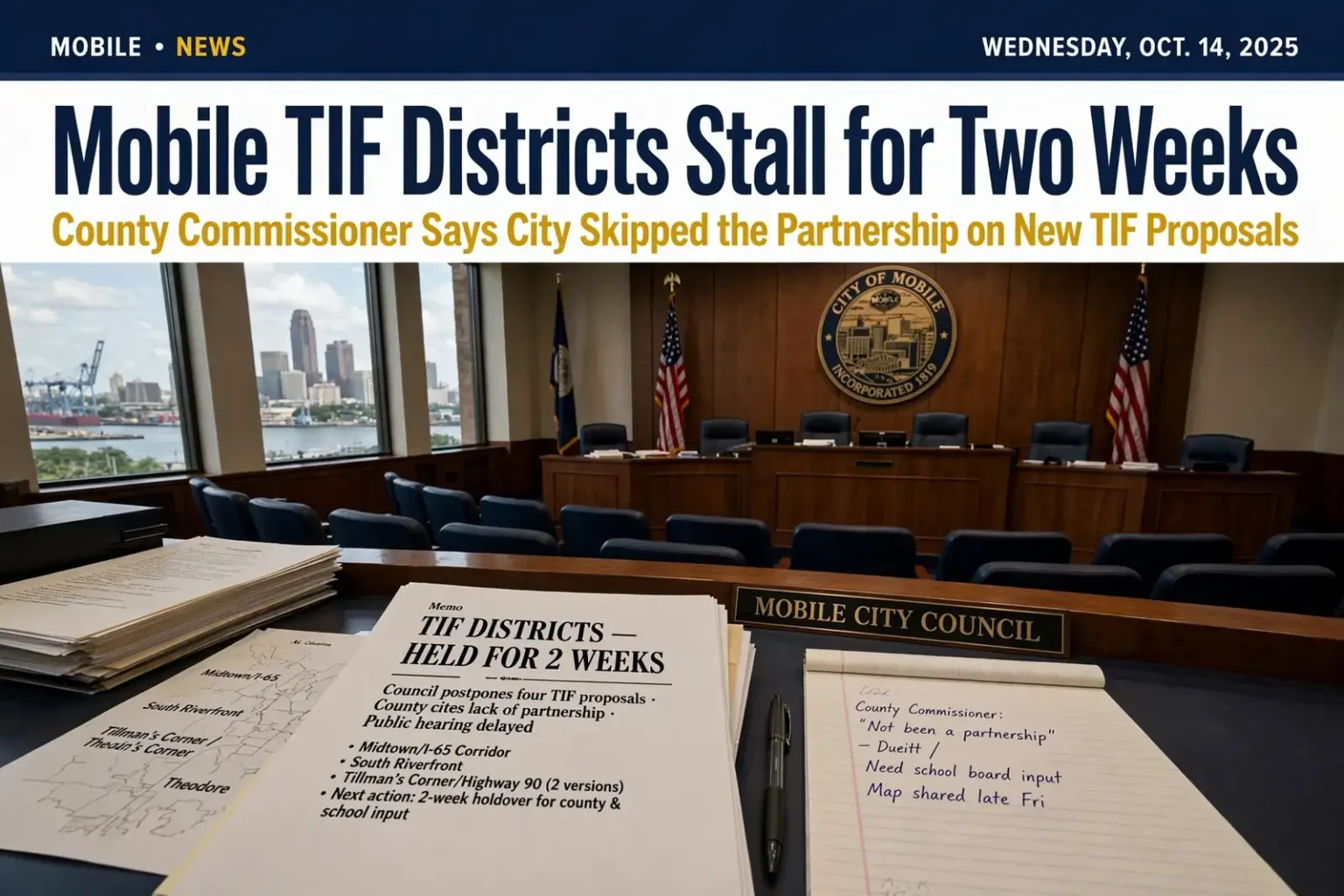
MOBILE, Ala. — The Mobile City Council on Wednesday, Oct. 14, put the brakes on Mayor Spiro Cheriogotis’ plan to create sweeping new Mobile TIF districts, holding the proposals for two weeks after a councilman and a Mobile County commissioner said the county and the public school system had not been given enough time to weigh in on how the districts could affect their future tax revenue.
The delay covers four proposals spread across three parts of the city: a Midtown/Interstate 65 corridor district, a South Riverfront district along the Mobile River just south of downtown, and a Tillman’s Corner/U.S. Highway 90 district that includes areas of Theodore near Interstate 10. Two competing versions of the Tillman’s Corner proposal are on the table, one from the mayor and one from District 4 Councilman Ben Reynolds.
No districts, boundaries, project plans or financing arrangements were approved. The council was being asked only to start the process and schedule public hearings, but that step proved contentious enough to stall for now.
What the council held over
All four resolutions that would begin the TIF planning and public hearing process were held for two weeks, along with four companion resolutions that would have called public hearings later this month. Because those hearings were postponed, new hearing dates will have to be set once the council acts.
- Midtown/I-65 Corridor: One resolution to start the process and one to call a public hearing, both held.
- South Riverfront: One resolution to start the process and one to call a public hearing, both held.
- Tillman’s Corner/Highway 90 (mayor’s version): Held.
- Tillman’s Corner/Highway 90 (Reynolds’ version): Held.
The proposals are expected to return to the council after the two-week holdover while the city, Mobile County and the Mobile County Public School System continue talking. The Midtown and South Riverfront districts were first unveiled by Cheriogotis at the council’s Oct. 6 meeting, where he called TIFs “the biggest tool in our back pocket” for transforming the city.
How tax increment financing works
Tax increment financing freezes the property tax revenue inside a designated district at a baseline when the district is created. Taxes on that baseline continue to flow to the governments that already receive them. As property values rise and generate more revenue, that additional money, known as the “increment,” is set aside and reinvested inside the district instead of going into the normal budgets of the city, county and school system.
The money can be used for infrastructure, redevelopment, blight removal and other public improvements meant to attract private investment. TIF districts do not raise property tax rates. But the growth in revenue they capture is diverted from regular city, county and school operations for up to 30 years, unless the Legislature extends that timeframe. That trade-off, and who gets a say in it, was at the heart of Wednesday’s debate.
The three proposed districts would join Mobile’s existing TIF districts downtown and along Dauphin Island Parkway. The downtown district has been in place since 1993. Two of the new districts would be larger than any existing TIF district in Alabama, and Reynolds said the Tillman’s Corner district alone would cover roughly 12,000 acres.
County commissioner: ‘I don’t feel like it has been’ a partnership
The debate began during the council’s morning pre-conference session, when Reynolds asked for the two-week delay and invited Mobile County Commissioner Randall Dueitt to speak.
“I would like for this to feel like a partnership. I really would, but I don’t feel like it has been,” Dueitt said. He told the council that commissioners received maps of the proposed districts only at the end of the previous week. “The County Commission really hasn’t had an opportunity to digest this,” he said.
Dueitt said the city, county and school board should reach a general understanding on boundaries and on who would govern each district before the maps go out for public hearings. “When it goes to the public, at least the city, the county and the school board should have an agreement on what the map looks like,” he said.
He also disputed the city’s reading of state law. City representatives said Alabama’s TIF statute does not require separate votes by the county or school board to create a district. Dueitt argued that Amendment 475 to the Alabama Constitution requires mutual agreement before county property tax revenue can be redirected. The disagreement was not resolved during the meeting.
County Commissioners Connie Hudson and Merceria Ludgood have not publicly weighed in on the proposals.
Reynolds: ‘This is a big deal’
Reynolds said he supports TIF financing as an economic development tool but questioned the size of the districts and what they could mean for schools, county services and the city’s general fund.
“There’s a cost associated with a TIF because you affect not just the county’s ad valorem tax and the school board’s ad valorem tax, but you also affect the city’s general fund and the other organizations’ general funds,” Reynolds said. He said county officials fear “this big money grab” could leave them unable to provide services, including the sheriff’s office, the jail and schools. He also raised concerns about the effect on Mobile County’s Pay-As-You-Go road program.
“I’ve seen no study. I’ve seen no projections about it,” he said of the Tillman’s Corner district, arguing for smaller, more precisely drawn districts. “It scares me a bit, to be honest with you.”
Reynolds said the vote to call a public hearing matters more than it may seem. “We get two bites of the apple,” he said, referring to the council’s separate votes to call the hearing and later to authorize the districts. “We have to have the county’s support. It’s clear as day. Not only do you not have the county’s support, but they are fighting mad at it.”
“If we don’t have our partners on board, we will not be successful,” he added. “Let’s use these next two weeks to get things in a way that are amicable to all our partners so that when we have the public hearing we can get the fine details worked out, not the big strokes. This is a big deal.”
The mayor’s case for moving ahead
Cheriogotis has described the TIF expansion as potentially the defining initiative of his administration, saying it could be the “biggest thing I do during my entirety as mayor even if I’m mayor for the next 20 years.” He said Mobile could eventually have at least seven TIF districts.
“These are going to change the face of the city, forever,” he said. “Just like the downtown TIF did, I believe, that each and every (new) TIF will.”
The mayor pointed to the downtown district’s role in more than three decades of redevelopment and said new districts could help address vacant property, deteriorating neighborhoods, infrastructure needs and housing. He also cited Huntsville, which has relied heavily on TIF districts since the early 2000s and approved a new district in July to help support an expansion of the Von Braun Center. “Huntsville is booming because they have over 40 percent of their land tied up in TIFs and are reinvesting directly into the project areas that need it,” Cheriogotis said. “I want that in Mobile.”
He noted that a recent change in state law raised the share of taxable property a qualifying city can place in TIF districts from 10 percent to 50 percent. Mobile’s existing districts account for about 9.8 percent, he said.
Cheriogotis acknowledged the county and school system could collect less future property tax revenue while the districts are in place, but argued TIF money could pay for public infrastructure, including schools and roads, that those governments might otherwise have to fund. Once the districts expire, he said, higher property values would benefit every taxing authority. He stressed that the boundaries are preliminary and could change substantially, and he pledged not to bring a final TIF project plan to the council without general agreement among the affected taxing authorities.
‘Behind closed doors’ or in public
Speaking to reporters after the meeting, Cheriogotis criticized the delay and framed the dispute as one over transparency.
“The only thing I’ve heard as far as disagreement is whether you start this conversation in the public or in private, whether all the decisions get made behind closed doors with a handful of people or whether the public is engaged in the process,” he said. “All we were requesting today is for that public hearing to be scheduled so we can put out the information we have available.”
The mayor said Dueitt’s comments surprised him. He said the two had talked about the districts while riding together in a go-kart at the ribbon-cutting for the new Cypress Creek Golf Course last month, over lunch the day before the meeting and in his office that morning.
“It felt like a partnership when we were riding together talking about it when we first opened his golf course and he said he had no issues with it,” Cheriogotis said. “It felt like a partnership when we had lunch yesterday and when we sat in my office this morning to talk about it prior to those comments.”
Cheriogotis said he has also spoken with Mobile County Public Schools Superintendent Chresal Threadgill and a school board member. The school system has not publicly taken a position.
Where council members stand
A majority of council members signaled support for eventually holding a public hearing, while saying the county, school system and residents need meaningful input.
- Josh Woods (District 6) cautioned against “going down a road of scary and doom,” noting ad valorem property taxes make up only 6 percent of the city’s budget. “These TIFs can be a game changer,” he said, particularly for Tillman’s Corner and Theodore. He agreed to the delay but warned, “I’ve come to realize with any level of politics whenever people don’t want something to get done or they want something to go and die, they lay it over or send it to a committee. I hope this doesn’t kick this can down the road a little longer.”
- Beau Fleming said he saw no harm in calling a hearing. “I don’t want to do anything that jeopardizes the county and school. I don’t see the harm of calling a public hearing,” he said.
- Cory Penn asked whether the county and school board would have to vote, how residents, businesses, schools and public services would benefit, and whether TIF money could go to streets, drainage and sidewalks.
- Samantha Ingram called for a public information sheet explaining the proposals before residents are asked to take part in hearings.
- Council Vice President Gina Gregory said members need enough information to explain the proposals and their consequences to constituents.
Cheriogotis agreed to provide explanatory materials, possibly including a video, within about 10 days. City representatives said project plans would identify which improvements are eligible for TIF funding and that spending on anything outside an approved plan would need further council approval.
What happens next
The eight resolutions are expected to return to the council in two weeks. In the meantime:
- The city is expected to share explanatory materials on the proposals, possibly including a video, within roughly 10 days.
- City, county and school officials are expected to keep negotiating boundaries and governing arrangements.
- If the council later calls public hearings, new dates will be set and advertised, giving residents a chance to comment.
- Any district would still need a separate council vote to be authorized, followed by a project plan spelling out how the money would be spent.
The districts have been discussed as lasting up to 30 years. Their final boundaries, governance, project lists and financial impact have not been established. “We hope in 2 weeks the call for public hearing will happen,” Cheriogotis said.