University of South Alabama Saraland
Fatal Celeste Road Crash Near Saraland Claims Chunchula Man
A 63-year-old Chunchula man died and a young passenger was hospitalized after a two-car crash on Celeste Road near the Saraland city limits.
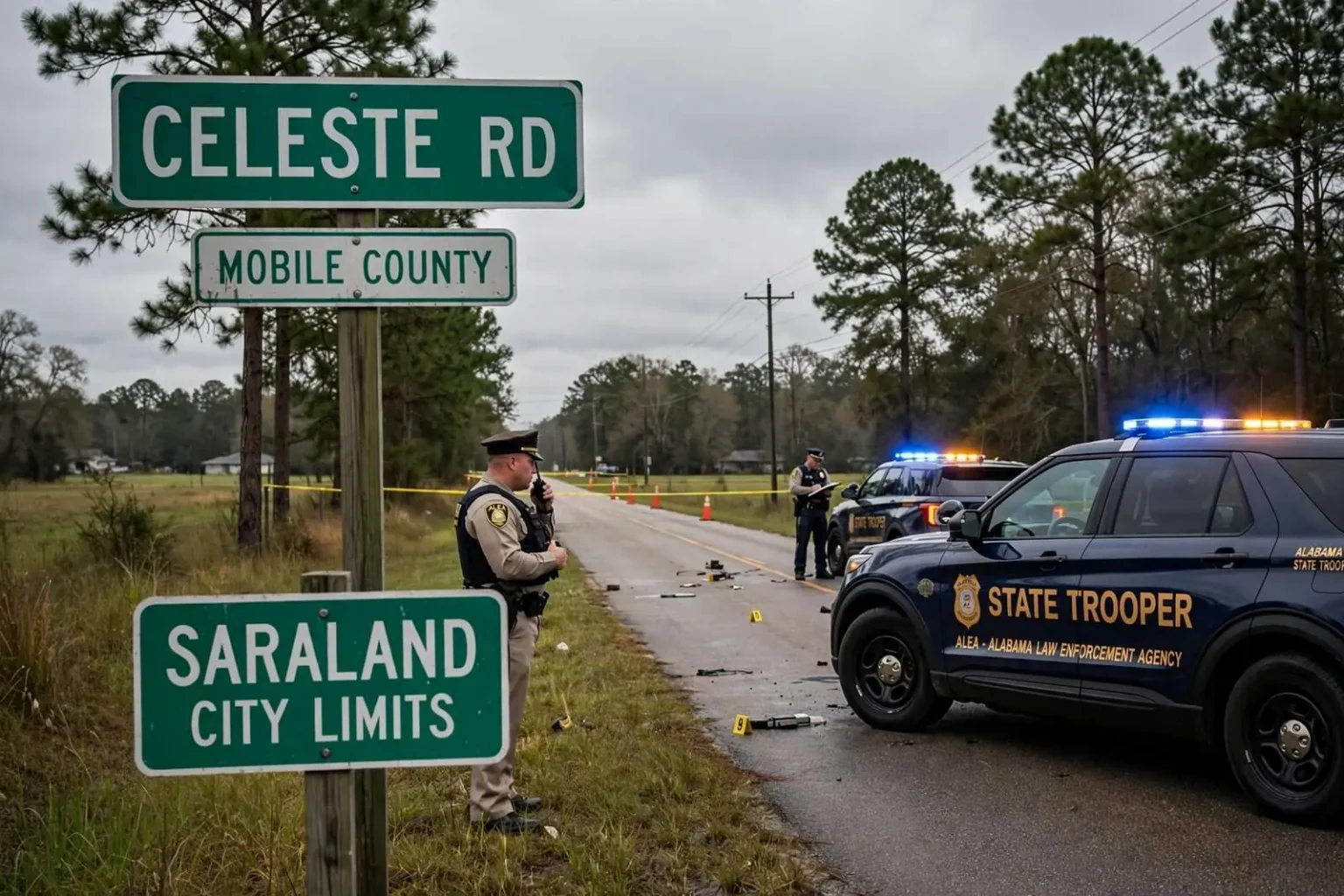
Alabama State Troopers say a 63-year-old Chunchula man was killed and a young passenger was hurt in a two-vehicle crash on Celeste Road near the Saraland city limits over the weekend. Troopers identified the driver killed in the crash as Alton George Miller, 63, of Chunchula, a small unincorporated community in northern Mobile County. Investigators said Miller was behind the wheel of one of the vehicles involved when the crash occurred.
The passenger riding with him, an 18-year-old Mobile man, was transported to the University of South Alabama Medical Center for treatment following the wreck. USA Medical Center, located in midtown Mobile, serves as one of the region’s primary trauma facilities and routinely receives patients injured in serious crashes from across Mobile County and the surrounding Gulf Coast. No details on the extent of the passenger’s injuries were included in the initial report.
Investigators initially described the passenger’s role in the crash differently before clarifying in an updated report that he had been riding in the same vehicle as Miller, rather than in the second vehicle involved in the two-car collision. Such revisions are not unusual in the hours after a fatal wreck, when the chaos of the scene and the statements of those involved can make seating arrangements difficult to sort out until investigators have time to interview witnesses and examine both vehicles.
The Investigation Remains Active
The Alabama Law Enforcement Agency, which oversees State Troopers, said the investigation into the exact cause of the crash remained active in the days following the wreck. Troopers have not yet released findings on whether speed, road conditions or driver error contributed to the wreck, and no charges had been announced as of the most recent report from investigators.
Fatal crash investigations conducted by Alabama State Troopers typically involve a detailed reconstruction of the scene, including skid mark analysis, vehicle damage assessment and, when available, data pulled from onboard vehicle systems. Modern vehicles increasingly store pre-crash information — braking, throttle position and speed in the seconds before impact — that investigators can download to reconstruct events with a precision that was impossible a generation ago. The resulting findings can determine whether a case is closed as a tragic accident or referred for prosecution.
Troopers have asked anyone who may have witnessed the crash or has additional information to come forward as the investigation continues. Witness accounts often play a decisive role in rural-road crashes, where there may be no traffic cameras or businesses with surveillance footage covering the roadway. No further updates on the surviving passenger’s condition were available as of the most recent report from investigators.
Celeste Road and the Roads Around It
Celeste Road is a rural connector route in northern Mobile County that links several communities near the Saraland city limits, an area that has seen a mix of residential growth and continued agricultural land use in recent years. Roads of this type carry commuters between growing subdivisions and the commercial corridors along U.S. 43 and Interstate 65, while still serving farm traffic and local residents who have used them for decades.
Two-vehicle crashes on rural roads like Celeste Road are frequently complicated by higher speed limits, fewer traffic signals and limited lighting compared to crashes that occur on more heavily trafficked corridors closer to the city center. When a collision does occur far from intersections, the absence of lighting can leave drivers with little warning of stopped or turning vehicles, and emergency response times can stretch longer than in denser areas simply because of the distances involved.
Growth in Northern Mobile County
The Saraland area has continued to grow in population over the past decade, drawing new residents to what was historically a more rural stretch of northern Mobile County. Saraland itself has expanded steadily northward along the U.S. 43 corridor, and neighboring communities in the area have absorbed much of the spillover growth from Mobile’s expanding suburbs. New subdivisions, schools and retail development have followed, changing the character of roads that were once lined mostly with fields and timberland.
That growth has, at times, put additional pressure on rural roads not originally designed for higher traffic volumes, a concern local officials have periodically raised as the area continues to develop. Narrow lanes, limited shoulders and drainage ditches close to the travel surface leave little margin for error, and daily traffic counts have climbed well beyond what the roads carried when they were first laid out. County and municipal engineers typically respond with incremental improvements — clearing, striping and signage — while more extensive widening projects compete for limited road funds across the county.
How Fatal Crashes Are Handled in Alabama
Crashes involving a death fall under the jurisdiction of Alabama State Troopers’ Highway Patrol Division rather than local police in most rural and unincorporated areas, which is why ALEA investigators took charge of the Celeste Road scene. Trooper investigators work from a fixed post covering Mobile County and coordinate with the Mobile County District Attorney’s Office if the evidence supports criminal charges. The identity of a deceased driver is generally released once next of kin have been notified, which is why details such as Miller’s name and hometown appeared in the public report.
For families in Chunchula and the surrounding communities, the crash is a stark reminder of the risks that persist on the connector roads that carry daily life across northern Mobile County. Local law enforcement agencies periodically conduct saturation patrols and sobriety checkpoints on rural routes in the area, and traffic-safety campaigns in south Alabama consistently emphasize seat belt use and speed management as the two factors most within a driver’s control. As the investigation into the Celeste Road crash continues, troopers’ findings will determine what, if anything, can be attributed to the road itself — and what the surviving passenger’s family and Miller’s loved ones will ultimately learn about how the wreck happened.
Rural Road Safety Across South Alabama
The circumstances of the Celeste Road crash mirror patterns that traffic-safety researchers have documented across south Alabama for years. Rural roads account for a disproportionate share of the state’s traffic deaths even though they carry far less traffic than urban interstates, a disparity driven by higher closing speeds, delayed discovery of wrecks, and longer intervals between a crash and the arrival of emergency medical care. In a collision on a city street, an injured occupant is often at a hospital within minutes; on a rural connector road, the clock starts with a 911 call and includes travel time to a trauma center that may be 20 miles or more away.
That arithmetic is why the proximity of the University of South Alabama Medical Center matters for crashes in northern Mobile County. As the region’s primary Level I trauma facility, USA Medical Center maintains the surgical teams and blood supply needed for the most severe injuries, and helicopter and ground ambulance services across the county are oriented toward moving critical patients there quickly. For an 18-year-old surviving a high-energy two-vehicle impact, access to that level of care can be the difference between recovery and a second fatality.
Alcohol, speed and restraint use remain the three factors that appear most often in Alabama’s fatal crash data, and all three are staples of the state’s “Drive Sober or Get Pulled Over” and “Click It or Ticket” enforcement waves. Rural two-lane roads are also where fatigue-related crashes cluster, since many connector routes carry early-morning and late-night commuters traveling between home and jobs in Mobile’s industrial corridors. Investigators have not indicated which of these factors, if any, played a role in the Celeste Road wreck. What is clear from the pattern of similar cases across the region is that the answers, once they come, tend to be found in the combination of vehicle data, roadway evidence and witness recollection that troopers are still assembling.
What Comes Next in the Case
In the weeks ahead, troopers’ findings will move through a fairly predictable sequence. The reconstruction report will establish the vehicles’ speeds and points of impact, the medical examiner’s office in Mobile County will document the cause of death for the district attorney’s file, and any toxicology results will be matched against witness statements and physical evidence. If the investigation closes without evidence of a violation, the file simply documents a fatal accident; if it shows impairment, recklessness or a mechanical violation, the case can be referred for charges ranging from negligent homicide to DUI-related counts.
For now, the crash stands as the latest entry in a long-running safety challenge for northern Mobile County: a growing population using a road network that grew up around farms, not subdivisions. Residents who travel Celeste Road daily will notice only a faded mark on the asphalt; for two families — one in Chunchula and another in Mobile — the details of the investigation will matter for much longer than the news cycle.