Four Family Members Killed in Sunday Afternoon Crash on Georgetown-Chunchula Road
State troopers identified four people killed when a van left Georgetown-Chunchula Road, overturned and struck a tree north of Prichard on Sunday.
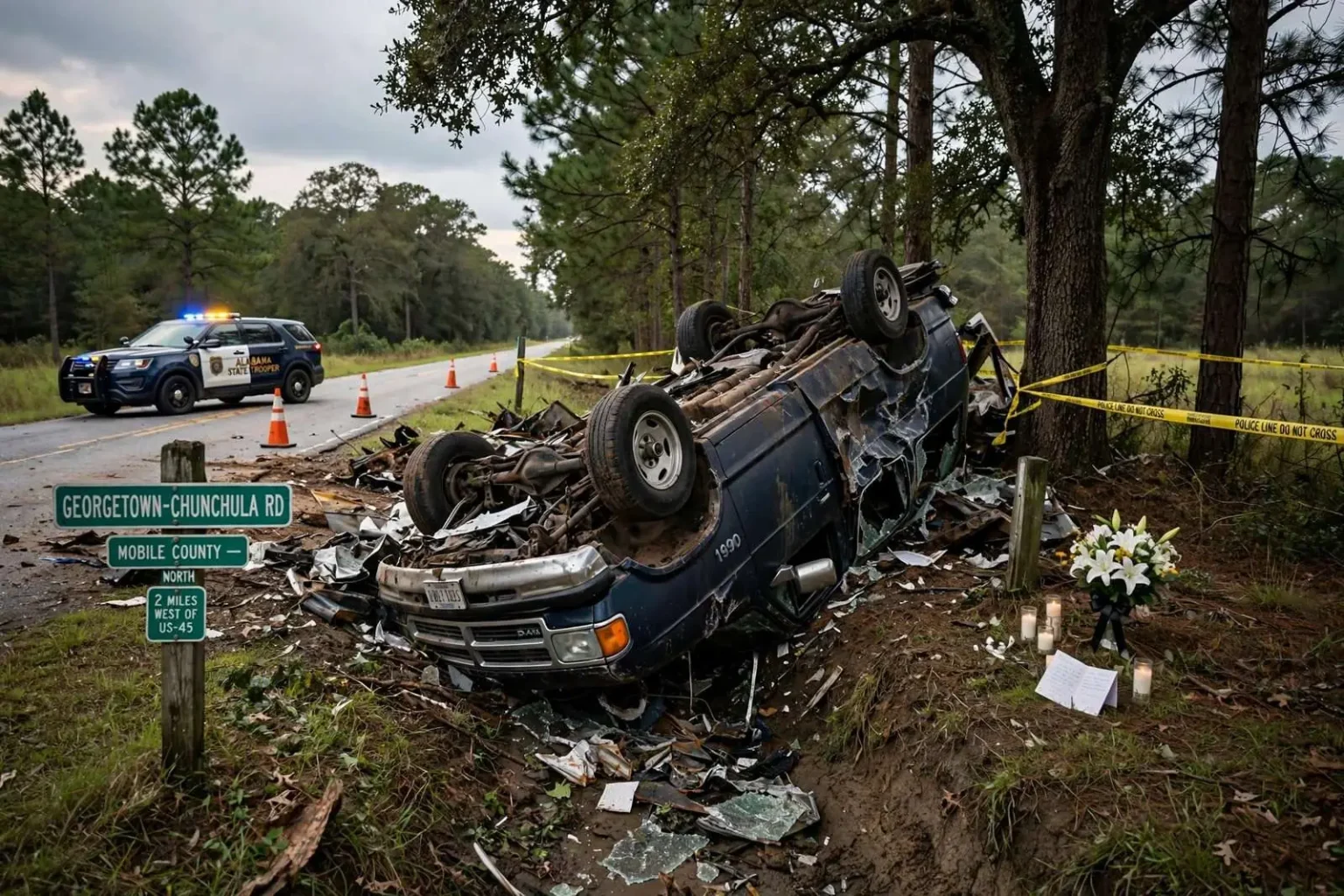
Alabama State Troopers have identified four people who died in a single-vehicle crash Sunday afternoon on Georgetown-Chunchula Road in Mobile County, an accident that claimed the lives of three adults and a teenager. The victims were all related, members of a single family whose Sunday ended in tragedy on a quiet rural stretch of road in the northern part of the county. The crash stands among the deadliest single-vehicle accidents in the Mobile County area in recent memory and has left the small communities along the route grieving.
According to Trooper Jamie Maloy, the crash happened around 3:10 p.m. roughly two miles west of U.S. 45 and about 10 miles north of Prichard. Troopers say a 1990 Dodge Ram van left the roadway, overturned, and struck a tree along the rural stretch of road. The driver, 50-year-old Michael W. Weatherspoon of Chunchula, was pronounced dead at the scene. Three passengers also died: 38-year-old Crystal Dawn Cassity of Chunchula, 41-year-old Melvin Louis Sowell of Chunchula, and 14-year-old Teresa Sowell of Mobile.
Troopers noted that Cassity and the teenager were not wearing seat belts at the time of the crash. Investigators regularly point to restraint use as one of the starkest dividing lines between survivable and fatal rollover crashes, because an unbelted occupant can be thrown from the vehicle or struck by the interior structure as it overturns. The 1990 van involved in the crash predates many of the modern safety features that have become standard on newer vehicles and are credited with reducing rollover deaths nationwide.
A Rural Corridor with a History of Danger
Georgetown-Chunchula Road is a two-lane rural route that winds through the northern reaches of Mobile County, connecting small unincorporated communities to U.S. 45 and other major roadways. The stretch where the crash occurred is bordered by wooded areas and has seen periodic serious accidents over the years, prompting some residents to call for improved signage and shoulder maintenance along the corridor. Like many county roads in the area, it carries a mix of local traffic, commuters heading toward U.S. 45, and drivers cutting between the small communities north of Mobile, all at speeds that leave little margin for error when a vehicle drifts off a narrow pavement edge.
Roadways of this kind present hazards that urban streets do not. Soft shoulders, mature trees close to the pavement, and limited lighting can turn a momentary lapse in attention into a catastrophic departure from the road. Safety engineers have long noted that rural two-lane roads account for a disproportionate share of the nation’s traffic deaths, and wooded shoulders mean that a vehicle that leaves the roadway is far more likely to strike a fixed object such as a tree rather than slide safely to a stop.
The van’s departure from the roadway, followed by an overturn and impact with a tree, is the sequence that crash reconstruction experts describe as among the most lethal. When a vehicle begins to roll, unrestrained occupants are subjected to violent interior motion, and ejection becomes a real possibility. Restraint use is the single most effective countermeasure available to occupants in that scenario, which is why troopers consistently document belt status in their reports on fatal crashes.
An Ongoing Investigation
Alabama State Troopers said the investigation into the exact cause of the crash was ongoing, with no additional details released beyond the preliminary account of the van leaving the roadway. Investigators typically examine factors such as vehicle condition, roadway design, weather, and driver behavior when reconstructing a fatal crash of this nature. That process can take weeks, as specialists review skid evidence, vehicle damage patterns, mechanical condition, and any relevant medical findings before reaching conclusions about why the van departed the road.
The Alabama Law Enforcement Agency, which oversees the state trooper division that responded to the crash, routinely reminds motorists in rural Mobile County of the importance of seat belt use, noting that unbelted occupants are significantly more likely to be killed or seriously injured when a vehicle leaves the roadway or rolls over. Under Alabama’s seat belt law, front-seat occupants are required to buckle up, and officers can stop a vehicle solely for that violation, a provision the state adopted to put teeth into its restraint campaign.
News of the crash rippled through the small Chunchula community as word spread Sunday evening, with neighbors and relatives learning that members of a family many in the area knew personally had been killed within sight of their own rural crossroads. Unincorporated communities in northern Mobile County are close-knit by necessity, bound together by volunteer fire departments, community churches, and the two-lane roads that connect them, and a loss of this magnitude touches classrooms, workplaces, and congregations across the area at once.
For the survivors in the family and the community around them, the days after a multi-fatality crash bring a familiar procession of practical burdens, from funeral arrangements to the logistical aftermath that follows any fatal wreck on a public road. Troopers close and investigate the scene, utilities and county crews address any damage along the roadway, and the coroner’s office handles the official identification and notification process that formalizes what neighbors already know by word of mouth.
What Investigators Will Examine
In crashes where a vehicle simply leaves the roadway with no other car involved, investigators look closely at several questions. The first is why the van departed the pavement: whether speed, a mechanical problem, a medical event, driver distraction, or a roadway factor such as edge drop-off played a role. The second is the vehicle itself; a van of 1990 vintage would be more than two decades old, and older vehicles can carry worn tires, aging suspension components, or structural rust that influences how a vehicle behaves once it leaves the pavement. Weather and visibility at 3:10 p.m. on a summer or Sunday afternoon would also be part of the standard review, as would any evidence of restraint use among all four occupants.
Reconstruction specialists with the state troopers’ highway patrol division handle these cases with a methodical checklist, photographing and measuring the scene, documenting the vehicle’s final resting position and the path it traveled, and interviewing anyone who may have witnessed the van in the minutes before the crash. Their findings eventually inform the official report, and in some cases lead to recommendations for roadway improvements along corridors where fatal crashes cluster.
Residents along Georgetown-Chunchula Road have previously raised concerns about the corridor with county officials, part of a broader conversation that plays out on rural roads across Mobile County about signage, shoulder conditions, and speed. Local government responsibility for county roads falls to the Mobile County Commission and its public works department, which weighs requests for improvements against funding and engineering priorities. Whether Sunday’s crash adds urgency to those requests remains to be seen, but fatal crashes on a rural route historically renew attention to the factors that made it dangerous.
A Community Left to Grieve
The loss of four members of one family, including a 14-year-old girl, leaves a mark that extends well beyond the immediate relatives. School officials in the area typically mobilize counseling resources when a student dies, and churches and community organizations in Chunchula and the surrounding communities often coordinate support for families dealing with sudden loss. In communities of this size, the crash scene itself becomes a place of remembrance in the days that follow, with mourners leaving flowers and mementos near the spot where the van came to rest against the trees.
Troopers closed their public statement by emphasizing the same message they deliver after nearly every rural fatality in the region: that restraint use, attention to speed, and caution on two-lane county roads remain the most effective protections available to families traveling them. The investigation into the crash remains open, and any additional details will come from the Alabama Law Enforcement Agency as the reconstruction work concludes.
The crash also underscores the particular vulnerability of the aging vehicles still common across rural Alabama. Pickup trucks and full-size vans from the late 1980s and early 1990s remain in daily use across the region, valued for their durability and low cost, but they lack the crash engineering that has reshaped occupant protection in the decades since. For families weighing vehicle choices on tight budgets, safety advocates note that restraint use becomes even more critical in older vehicles precisely because the vehicle itself offers fewer layers of protection.
As the community mourns, the case stands as one of the deadliest roadway events in northern Mobile County in recent years, a reminder of how quickly an ordinary Sunday drive on a familiar road can end in irreversible loss. The Alabama Law Enforcement Agency’s final report will document the technical findings, but for the communities along Georgetown-Chunchula Road, the reckoning will be simpler and heavier: four neighbors, one family, gone from a small corner of the county that knew them well.