

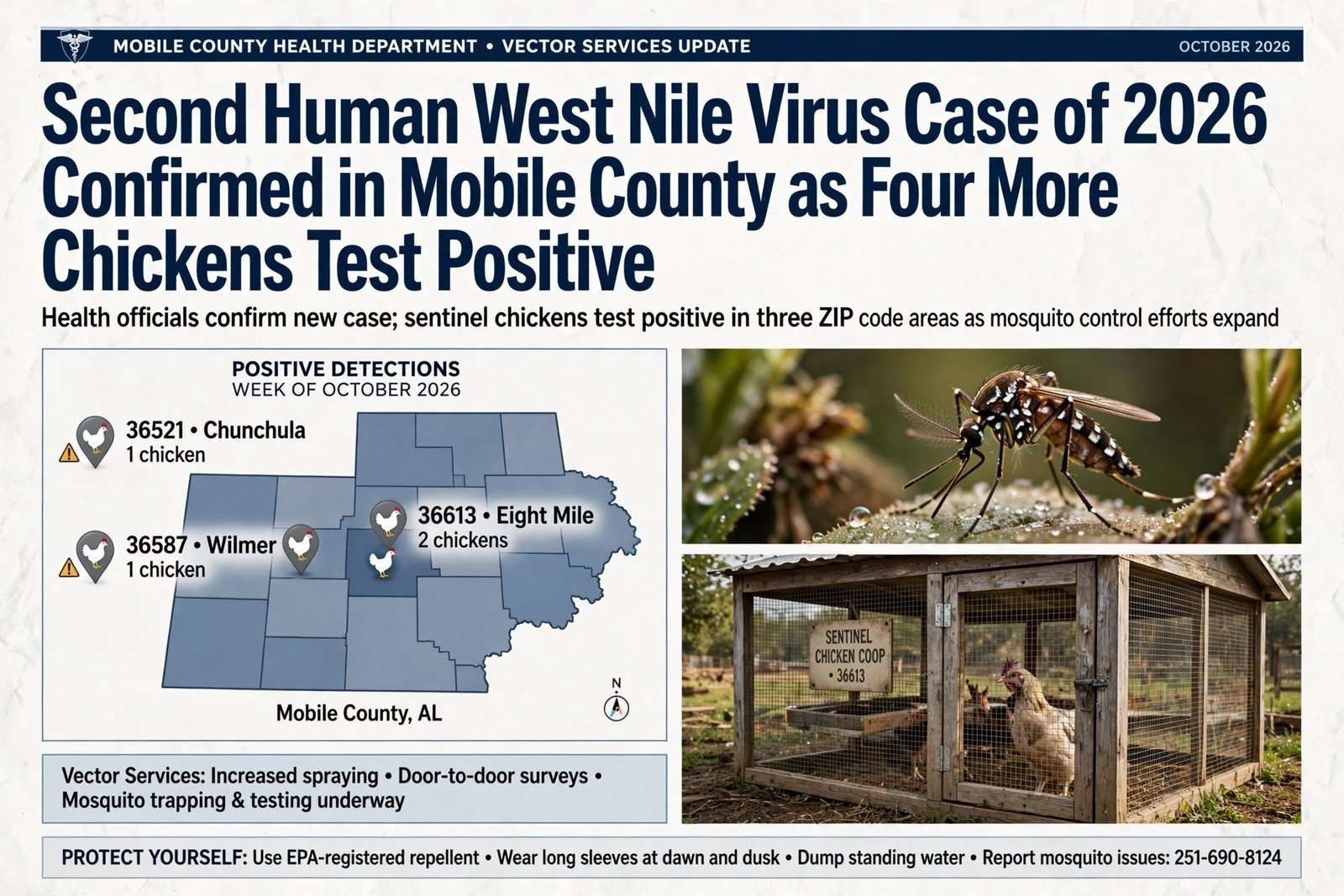
A second person in Mobile County has been infected with West Nile virus this year, health officials confirmed this week. At the same time, four more sentinel chickens have tested positive for the mosquito-borne virus in three areas of the county.
Dr. Kevin Michaels, Mobile County’s health officer, announced the human case. Federal patient privacy rules under the Health Insurance Portability and Accountability Act, known as HIPAA, bar the health department from sharing anything that could identify the patient, so no details about the person’s age, neighborhood or condition will be made public.
The new sentinel results come from chicken coops in three ZIP code areas:
- 36521, which covers the Chunchula area in north Mobile County — one chicken
- 36587, the Wilmer area in west Mobile County — one chicken
- 36613, the Eight Mile area — two chickens
Both the 36587 and 36613 areas recorded positive chickens earlier this season, so the newest results show the virus is still active in those areas as fall begins.
What the Health Department Is Doing
“West Nile virus is present in our county, and this detection is an important reminder for residents to protect themselves from mosquito bites,” Michaels said. “Vector Services will increase mosquito-control activity in and around these ZIP code areas, continue monitoring our sentinel chicken flocks, and work to identify mosquito populations that may be carrying the virus.”
The Mobile County Health Department’s Vector Services program outlined three steps for the affected areas:
- Extra spraying to cut down adult mosquito populations
- Door-to-door surveys in nearby neighborhoods to find breeding sites and talk with residents
- Trapping adult mosquitoes and testing them for West Nile virus
Spraying goes after mosquitoes that are already flying and able to spread the virus. The neighborhood surveys aim at the next generation by finding the buckets, tires, clogged gutters and other spots where larvae grow. Trap results tell crews whether infected mosquitoes are present and in what numbers, which helps them decide where to work next.
A Season of Detections
The human case comes after weeks of positive results from the county’s surveillance program. In mid-September, the health department reported six positive sentinel chickens in the 36509, 36582 and 36605 ZIP code areas. Before that, positives had turned up in the 36605, 36613, 36575 and 36587 areas. Together, the results show the virus has been circulating in several parts of the county, not confined to a single neighborhood.
Because most infected people never feel sick, confirmed human cases represent only a small share of actual infections. That is why public health agencies rely on bird and mosquito surveillance as an early warning instead of waiting for people to get sick.
How to Protect Yourself
The health department is urging residents, especially those who spend time outdoors, to take these precautions:
- Use an insect repellent registered with the U.S. Environmental Protection Agency that contains DEET or another approved active ingredient.
- Wear long sleeves and long pants outdoors, particularly at dawn and dusk.
- Stay and sleep in places with air conditioning or with window and door screens that are in good repair.
- Empty, cover, scrub or treat anything that holds standing water around homes, yards, workplaces and outdoor event sites.
According to the Centers for Disease Control and Prevention, EPA-registered active ingredients include DEET, picaridin, IR3535, oil of lemon eucalyptus, para-menthane-diol and 2-undecanone. When used as directed, these products have been reviewed for both safety and effectiveness. Follow the label, including reapplication times and age guidance for children. If you also use sunscreen, put it on first and repellent second.
Standing water is often the most overlooked part of the problem. Mosquitoes can breed in very small amounts of water, including water in buckets, flowerpots and saucers, old tires, birdbaths, pet bowls, gutters, tarps and other outdoor containers. Many of the mosquitoes that bite people in a yard were hatched nearby, so a weekly walk around the property to dump and scrub containers can make a real difference. Turn over wheelbarrows and children’s toys, change birdbath water at least once a week, keep gutters clear and store tires under cover.
About West Nile Virus
West Nile virus spreads in a cycle between birds and mosquitoes. Mosquitoes pick up the virus when they feed on infected birds and can then pass it to people, horses and other animals when they bite. In the United States, Culex mosquitoes are the main species that spread the virus, according to the CDC.
The virus was first found in the United States in 1999 in New York City. It has since spread across the continental United States, and the CDC now identifies it as the leading cause of mosquito-borne disease in the continental U.S.
Symptoms
Most people infected with West Nile virus never develop symptoms. The CDC estimates that about 8 in 10 infected people feel no illness at all. About 1 in 5 develop a fever along with symptoms such as headache, body aches, joint pain, vomiting, diarrhea or rash. Most of these people recover fully, although fatigue and weakness can linger for weeks or months.
About 1 in 150 infected people develop a serious illness that affects the central nervous system, such as encephalitis, which is inflammation of the brain, or meningitis, which is inflammation of the membranes around the brain and spinal cord. The Mobile County Health Department lists warning signs of severe illness as:
- High fever
- Severe headache
- Stiff neck
- Confusion or disorientation
- Muscle weakness
- Tremors
- Paralysis
- Seizures
Anyone with severe symptoms should get medical care right away. The CDC says severe illness can strike people of any age, but people over 60 face a higher risk. So do people with certain medical conditions, such as cancer, diabetes, high blood pressure or kidney disease, and people who have received organ transplants.
There is no vaccine to prevent West Nile virus in people and no medicine to treat the infection itself. Doctors can treat symptoms and provide supportive care, and people with severe illness may need to be hospitalized. That is why preventing mosquito bites remains the main defense.
How it does and does not spread
West Nile virus does not spread from person to person through casual contact, and people cannot catch it from horses. People and horses are considered “dead-end” hosts, meaning they do not carry enough virus in their blood to infect mosquitoes that bite them. Horses can be vaccinated against the virus, and horse owners in areas where it has been detected should talk with their veterinarians about keeping vaccinations current.
Why Fall Still Matters
Health officials say the risk of mosquito-borne encephalitis viruses is generally highest from August until the first fall freeze. On the Gulf Coast, that freeze often comes late, so the risk can stretch well into autumn. Cooler mornings in early October do not mean mosquito season is over.
That matters as the fall calendar fills up with high school football, festivals, tailgates and evening yard work, all of which put people outdoors around dusk, when many mosquitoes are biting.
Four Decades of Sentinel Surveillance
MCHD Vector Services has used sentinel poultry flocks placed around Mobile County to detect mosquito-borne viruses since 1985. Crews draw blood from the chickens every Monday and send the samples to a lab. Results usually come back later that week, which is why detections are often announced near the end of the week.
The approach works because the mosquitoes that carry West Nile virus feed heavily on birds. When an infected mosquito bites a sentinel chicken, the bird produces antibodies that show up on the blood test. The chickens generally do not get seriously ill, and they show health workers where infected mosquitoes have been active.
Besides monitoring 13 sentinel chicken coops, Vector Services traps mosquitoes and tests them for West Nile virus, Eastern equine encephalitis and St. Louis encephalitis. All three circulate between birds and mosquitoes along the Gulf Coast.
Results are reported by ZIP code rather than exact location, which protects the people who host coops. It also reflects how mosquitoes move. A positive chicken means infected mosquitoes were active somewhere in that area during the testing period. It does not mean the risk stops at a ZIP code line.
Reporting Mosquito Problems
Residents can report mosquito problems to MCHD Vector Services at 251-690-8124. The health department’s website also has an online service request form for mosquito and rodent concerns, along with more information about mosquito control.
Weekly sentinel testing will continue, and more detections are possible until colder weather arrives. Health officials’ advice stays the same each time: wear repellent, cover up at dawn and dusk, keep screens in good repair and dump standing water. Anyone who develops a high fever, severe headache, stiff neck, confusion or unexplained muscle weakness should seek medical care promptly.